The Cinema of Sorrows (Redux)

You Came Late And Your Beloved Is Lost
I began work on this essay with the impulse to downplay things like acting, character, story, theme - usually assumed as the privileged vessels of emotion - and to look elsewhere, at purely formal, non-representational elements of film style and language. Like most categorical, schematic distinctions, this one turned out to be false and misleading. Ultimately, it is a waste of time to set abstract against concrete, form against content, signifier against signified. In the films that move us, that take us somewhere in the truest sense, there is no distinction between these levels, only the deepest, inseparable fusion. This is an economy of form and content, as equal partners, that we are not yet used to: every so-called 'device' can absorb and express feeling; can move and transform the impulses and concerns of the film; can carry us, frame by frame, through thick and thin, to some place we haven't quite been or seen or heard before.
The film is just about to end. It is a sad film where things turn out badly. A voluptuously melancholic film, a hushed, pained, romantic melodrama full of mutual misunderstandings, missed connections and masochistic stupidities. The world ends, drains away, in the concluding four-minute scene of Martin Scorsese's The Age of Innocence. Poor Newland Archer (Daniel Day Lewis): he came late, and his beloved is lost. Newland is the sad anti-hero, so moving, but also so difficult and troubling, because he doesn't move much at all, in any sense: as the film draws to its magisterial ending, Newland takes refuge in cryptic statements of denial, lines like "she never asked me" and "just say I'm old fashioned, that should be enough".
So much flows in and out of this final scene, so much gathered and dispersed - even the birds who, in the final shot, circle up high and then gather in a spot on the ground which Newland, obliviously, walks through and disturbs. Most spectacularly, the centrepiece of the four minutes is a theatre of memory: Newland gets to replay, in his mind, and at last put right, the moment that once upon a time stymied him for the rest of his long and uneventful life. He wished for the Countess Olenska (Michelle Pfeiffer) to turn around before that Murnau-like boat passed and, if so, all would be well with the world, and between them as lovers. It didn't happen then, and now it happens with tremendous yearning but with no joy: Newland looks assaulted, wounded by that harsh, reflected light that causes him to blink, and sends him into fantasy-land with his eyes wide shut.
But these shots, while encapsulating a character and his destiny, also soar high and far from him; they constitute, like Almodóvar's apparition of a title, a gesture. Light, flicker, rapid montage, superimposition, a spectator and a vision: this is one of those privileged passages, also gone in less than sixty seconds, when the cinema all of a sudden bears witness to itself, reflecting on its powers of creation and destruction, as if to declare its hand at the dark or light heart of all our fantasy projections.
That constitutes the obvious fireworks in the scene. But its force is channelled and amplified by the more seemingly ordinary material on either side. Newland's son, Ted (Robert Sean Leonard), for instance, is the reality-principle in the scene. All he talks about and embodies are facts of place (on the third floor) and time (almost six o'clock), etiquettes of social reasonableness (she won't understand). Ted is a comfortably dressed, chipper guy; his jaunty walk and his movements briskly set-up a shot-reverse shot, low-high angle volley. That's his function and his form: to secure an orderly progression of elements. Newland on the other hand, walks slowly, in fact he's a log. For most of the scene, he barely moves more than a couple of feet's distance - and that's essentially in order to sit down.
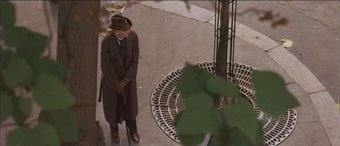
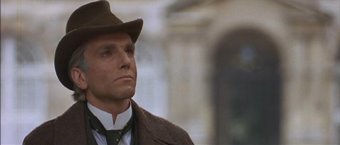
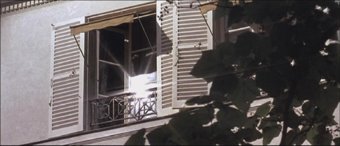
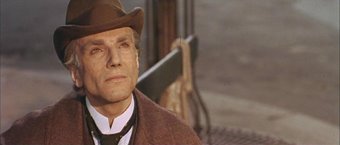
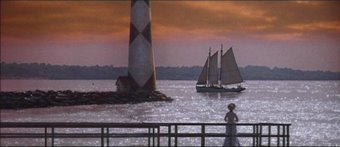

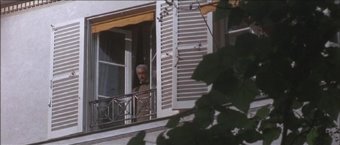

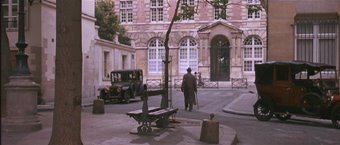
Scorsese has a found a street setting here that can centre Newland perfectly in the frame, wrap around him, like he's one of those trees rooted to the spot; or maybe some insect, since we almost always view him here from above. In this setting, once again bodies become ritually like objects, and the non-human is invested with presence. All the sadness of the entire movie flows around Newland in this strangely truncated street space, of which we deliberately see very little. Again, this space has a static, solemn, church-like air. All it offers, finally, is a back exit: the exit into off-screen oblivion and anonymity that Newland will duly, gratefully take, as extras walk on by, as Elmer Bernstein's music finishes, and the film takes us to the sharply wrenching but also deeply satisfying void of a black and soundless screen for some long seconds - the only place we can bear to be right now, right here.
The voice-over narration (spoken by Joanne Woodward) is sparse, located only in the first moments of the scene. Appropriately, this narration speaks, in its few words, about the mystery, grace and pathos of being moved inexpressibly. At the very end, for Scorsese, there are only images and sounds, a gesture and a place, and then nothingness: things, feelings, that words (even the best chosen words) can no longer express. The duration of the final, long-held, static shot, the closing cadences of the music, the black screen - are these signs of an excess, a melodramatic overflowing? I don't figure so. They are the signs of an artistry and a richness, a hyper-saturation of mood, feeling and meaning taken to the point of ecstasy. A delirious enchantment.
From Delirious Enchantment by Adrian Martin
Indeed, one might conclude that the melancholic identification permits the loss of the object in the external world precisely because it provides a way to preserve the object as part of the ego and, hence, to avert the loss as a complete loss. Here we see that letting the object go means, paradoxically, not full abandonment of the object but transferring the status of the object from external to internal. Giving up the object becomes possible only on the condition of a melancholic internalisation or, what might for our purposes turn out to be even more important, a melancholic incorporation.
If in melancholia loss is refused, it is not for that reason abolished. Internalisation preserves loss in the psyche; more precisely, the internalisation of loss is part of the mechanism of its refusal. If the object can no longer exist in the external world, it will then exist internally, and that internalisation will be a way to disavow the loss, to keep it at bay, to stay or postpone the recognition and suffering of loss.
From Melancholy Gender/Refused Identification by Judith Butler
All changes, even the most longed for, have their melancholy; for what we leave behind us is part of ourselves; we must die to one life before we can enter another.
The voice-over narration (spoken by Joanne Woodward) is sparse, located only in the first moments of the scene. Appropriately, this narration speaks, in its few words, about the mystery, grace and pathos of being moved inexpressibly. At the very end, for Scorsese, there are only images and sounds, a gesture and a place, and then nothingness: things, feelings, that words (even the best chosen words) can no longer express. The duration of the final, long-held, static shot, the closing cadences of the music, the black screen - are these signs of an excess, a melodramatic overflowing? I don't figure so. They are the signs of an artistry and a richness, a hyper-saturation of mood, feeling and meaning taken to the point of ecstasy. A delirious enchantment.
From Delirious Enchantment by Adrian Martin
Indeed, one might conclude that the melancholic identification permits the loss of the object in the external world precisely because it provides a way to preserve the object as part of the ego and, hence, to avert the loss as a complete loss. Here we see that letting the object go means, paradoxically, not full abandonment of the object but transferring the status of the object from external to internal. Giving up the object becomes possible only on the condition of a melancholic internalisation or, what might for our purposes turn out to be even more important, a melancholic incorporation.
If in melancholia loss is refused, it is not for that reason abolished. Internalisation preserves loss in the psyche; more precisely, the internalisation of loss is part of the mechanism of its refusal. If the object can no longer exist in the external world, it will then exist internally, and that internalisation will be a way to disavow the loss, to keep it at bay, to stay or postpone the recognition and suffering of loss.
From Melancholy Gender/Refused Identification by Judith Butler
All changes, even the most longed for, have their melancholy; for what we leave behind us is part of ourselves; we must die to one life before we can enter another.
Anatole France
Musique Du Jour: Prelude (Op. 28), Frederic Chopin


.jpg)
.jpg)
.jpg)
.jpg)
.jpg)
.jpg)
.jpg)
.jpg)
.jpg)
.jpg)


.jpg)
.jpg)


