Showing posts with label Blake. Show all posts

Friday, April 25, 2008

Somewhere, Under A Rainbow


Jean-François Millet (1814-1875) - Printemps, 1869


'The tree which moves some to tears of joy is in the Eyes of others only a Green thing that stands in the way. Some see Nature all ridicule and deformity, and by these I shall not regulate my proportions; and some scarce see Nature at all. But to the Eyes of the Man of Imagination, Nature is Imagination itself.'

William Blake

Tuesday, April 08, 2008

TIme Is Never Lost, Only Forgotten


William Blake (1757-1827) - Oberon, Titania and Puck with Fairies Dancing, c. 1786


'Those who have created for themselves an enveloping inner life, pay little heed to the importance of current events. What alters profoundly the course of their thinking is much more something which seems to be of no importance in itself and yet which reverses the order of time for them, making them live over again an earlier period of their life. The song of a bird in the park of Montboissier, a breeze laden with the scent of mignonette, are obviously incidents of less importance than the outstanding dates of the Revolution and the Empire. Yet they inspired Chateaubriand in his Mémoires d'Outre-tombe to write pages of an infinitely greater value.'

Marcel Proust

Monday, December 17, 2007

DIY Salvation


William Blake - Satan, Sin and Death, 1808


'If you meditate on your past sins long enough, you can get lost in your sins and not know what your virtues are. Why not meditate on the virtues? Foster the virtues and let the sins fall off.'

Joseph Campbell

Sunday, September 09, 2007

The Man Who Measured The World


William Blake - Isaac Newton, 1795


'Tact is the knack of making a point without making an enemy.'

Isaac Newton

Tuesday, March 13, 2007

Hell Is My Beloved


William Blake (1757-1827) - The Circle of the Lustful: Paolo and Francesca, c. 1824-27


'[Suffering] alone reveals the total significance of the beloved object. Possession of the beloved object does not imply death, but the idea of death is linked with the urge to possess. If the lover cannot possess the beloved he will sometimes think of killing her; often he would rather kill her than lose her. Or else he may wish to die himself. Behind these frenzied notions is the glimpse of a continuity possible through the beloved. Only the beloved, so it seems to the lover - because of affinities evading definition which match the union of bodies with that of souls - only the beloved can in this world bring about what our human limitations deny, a total blending of two beings, a continuity between two discontinuous creatures. Hence love spells suffering for us in so far as it is a quest for the impossible, and at a lower level, a quest for union at the mercy of circumstance. Yet it promises a way out of suffering. We suffer from our isolation in our individual separateness. Love reiterates: "If only you possessed the beloved one, your soul sick with loneliness would be one with the soul of the beloved." Partially at least this promise is a fraud. But in love the idea of such a union takes shape with frantic intensity, though differently perhaps for each of the lovers. And in any case, beyond the image it projects, that precarious fusion, allowing as it does for the survival of the individual, may in fact come to pass. That is beside the point; this fusion, precarious yet profound, is kept in the forefront of consciousness by suffering as often as not, by the threat of separation.'

From Erotism: Death and Sensuality by Georges Bataille

Sunday, January 14, 2007

Blake's Bedfellows


Tracey Emin (b. 1963) - My Bed, 1998


The Garden of Love

I went to the Garden of Love,
And saw what I never had seen;
A Chapel was built in the midst,
Where I used to play on the green.

And the gates of this Chapel were shut,
And 'Thou shalt not' writ over the door;
So I turned to the Garden of Love
That so many sweet flowers bore.

And I saw it was filled with graves,
And tombstones where flowers should be;
And priests in black gown were walking their rounds,
Binding with briars my joys and desires.

William Blake (1757-1827)


Links:

Tracey Emin.co.uk
Jeanette Winterson on Tracey Emin
Stuckism - Tracey Emin
On The Couch With Tracey Emin (Guardian Unlimited)
Tracey Emin (Guardian Unlimited)
Burned Into The Memory (Guardian Unlimited)
Two Go Mad In Margate (Guardian Unlimited)
Tate Online - Tracey Emin
Tracey Emin - Professor of Confessional Arts (EGS)
Tracey Emin - h2g2 (BBC)
Tracey Emin with Barry Barker (University of Brighton)
Tracey Emin at White Cube
Tracey Emin at Lehmann Maupin
Tracey Emin - The Saatchi Gallery


The Week in Review


Film:

The Blood of a Poet - d. Jean Cocteau (1930)
Jean Cocteau: Autobiography of an Unknown - d. Edgardo Cozarinsky (1984)
Orpheus - d. Jean Cocteau (1949)
Testament of Orpheus - d. Jean Cocteau (1959)
Villa Santo Sospir - d. Jean Cocteau (1952)

Television:

Smallville: Series Two

Books:

Beyond Good and Evil - Friedrich Nietzsche
The Will to Power - Friedrich Nietzsche
Human, All Too Human - Friedrich Nietzsche

Art:

Screenings: International and International New Media Works - NGV

Music:

Kindertotenlieder (Songs on the Death of Children) - Gustav Mahler
Pierrot Lunaire - Arnold Schoenberg
The Rite of Spring - Igor Stravinsky
Turangalila Symphonie - Olivier Messiaen
The Unanswered Question - Charles Ives

Saturday, December 16, 2006

Take Me To My Reader


Jenny Holzer (b. 1950) - Protect Me From What I Want, 2002


"We always long for the forbidden things, and desire what is denied us."

François Rabelais (1483-1553)


"The desire to write grows with writing."

Desiderius Erasmus (1469-1536)


"Those who restrain desire, do so because theirs is weak enough to be restrained."

William Blake (1757-1827)


"Love is the irresistible desire to be irresistibly desired."

Robert Frost (1874-1963)


"If you desire many things, many things will seem but few."

Benjamin Franklin (1706-1790)

Thursday, September 28, 2006

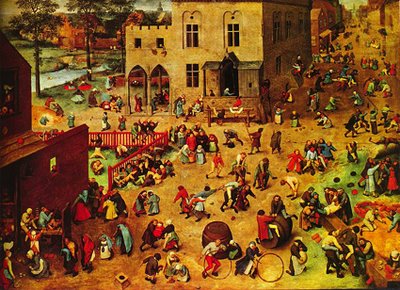
Where Have All The Children Gone?


Pieter Brueghel - Children's Games (1559-60)

This image can be accessed at: http://www.wga.hu/index1.html


The Echoing Green

The sun does arise
And make happy the skies;
The merry bells ring
And welcome the spring;
The skylark and thrush
The birds of the bush,
Sing louder around
To the bell's cheerful sound,
While our sports shall be seen
On the Echoing Green.

Old John with white hair,
Does laugh away care,
Sitting under the oak,
Among the old folk.
And soon they all say:
"Such, such were the joys
When we all, girls and boys,
In our youth time were seen
On the Echoing Green."

Till the little ones, weary,
No more can be merry;
The sun does descend,
And our sports have an end.
Round the laps of their mothers,
Many sisters and brother,
Like birds in their nest,
Are ready for rest,
And sport no more seen,
On the darkening green.

William Blake (1757-1827)