Showing posts with label Campbell. Show all posts

Wednesday, December 19, 2007

Hotel Cornucopia


Joseph Cornell - Untitled (Hotel Eden), 1945


'Life is not a problem to be solved but a mystery to be lived.'

Joseph Campbell

Monday, December 17, 2007

DIY Salvation


William Blake - Satan, Sin and Death, 1808


'If you meditate on your past sins long enough, you can get lost in your sins and not know what your virtues are. Why not meditate on the virtues? Foster the virtues and let the sins fall off.'

Joseph Campbell

Sunday, December 16, 2007

Dragons Without Dungeons


Raphael - Saint George Fighting the Dragon, c. 1504


'The demon that you can swallow gives you it’s power, and the greater life’s pain, the greater life’s reply.'

Joseph Campbell

Saturday, February 10, 2007

Dreams Of The Marionettes


Michelangelo Merisi da Caravaggio
(1571-1610) - Medusa, c. 1597


"Mythology is an expression of the collective unconscious."

"The human psyche is essentially the same all over the world. The psyche is the inward experience of the human body, which is essentially the same in all human beings, with the same organs, the same instincts, the same impulses, the same conflicts, the same fears. Out of this common ground have come what Jung has called the archetypes, which are the common ideas of myths."

"The elementary ideas: what could be called the ground ideas. These ideas Jung spoke of as archetypes of the unconscious. "Archetype" is a better term because "elementary idea" suggests head work. Archetypes of the unconscious means it comes from below. The archetypes of the unconscious are manifestations of the organs of the body and their powers. Archetypes are biologically grounded: the biographical is secondary to that. All over the world and at different times in human history, these archetypes have appeared in different costumes. The differences in costume are the result of environment and historical conditions."

"It's surprising how much memory there is down in the unconscious. There's a whole system . . . which, when we see it in animals, we call instinct. That is the biological ground. But then certain things happen that make it repulsive or difficult or frightening or sinful to do some of the things one is impelled to do, and that is when we begin to have our most troublesome psychological problems. Myths are primarily for fundamental instruction in these matters."

"A metaphor points to two ends: one is psychological, the other metaphysical. The dream is metaphoric of the structures of the psyche, and your dreams will correspond to the level of psychological realisation you are operating on. The metaphysical, on the other hand, points past all conceptualisations, all things, to the ultimate depth. And when the two come together, when the psyche and metaphysics meet, then you have a real myth."

"Myths are the world's dreams. They are archetypal dreams and deal with the great human problems."

"Myths and dreams come from the same place. They come from realisations of some kind that have then to find expression in symbolic form."

"Heaven and hell are within us, and all the gods. All the worlds are within us. They are magnified dreams, and dreams are manifestations in image form of the energies of the body on conflict with each other."

"Dreamtime is the time you get into when you do to sleep and have a dream that talks about the permanent conditions within your own psyche as they relate to the temporal conditions of your life right now."

"Everyone has to pass a threshold of some kind. This is an archetypal thing. So there is a basic mythological theme there even though it is a personal dream. These two levels . . . are found in all cultures. For example, everyone has the problem of facing death. This is a standard mystery."

"A dream is a personal experience of that deep, dark ground that is the support of our conscious lives, and a myth is the society's dream. The myth is the public dream and the dream is the private myth. If your private myth, your dream, happens to coincide with that of society, you are in accord with your group. If it isn't, you've got an adventure in the dark forest ahead of you."

"Dreams come up from the imagination which is grounded in the energy of the organs of the body, and these are all the same in human beings. Since imagination comes out of one biological ground, it is bound to produce certain themes . . . There are certain characteristics of dreams that can be enumerated, no matter who is dreaming."

"On some levels a private dream runs into runs into truly mythic themes that can't be interpreted except by an analogy with myth. Jung speaks of two orders of dream, the personal dream and the archetypal dream, or the dream of the mythic dimension. You can interpret a personal dream by association, figuring out what it is talking about in your own life, or in relation to your personal problem. But every now and then a dream comes up that is pure myth, and carries a mythic theme, or that is said to come from the archetypal person within us. "

"I think the psychology of Freud tends more to relate to what Jung calls the personal unconscious. When you break past that into the realms that cannot be interpreted in terms of personal experience, you're in the field of mythic forms. And if you're acquainted with the mythic forms, you understand where you are in a way that's impossible if you have no previous acquaintanceship."

Joseph Campbell

Saturday, February 03, 2007

Power Without Story


Ed Ruscha (b. 1937) - The End, c. 1990s


'I don't believe people are looking for the meaning of life as much as they are looking for the experience of being alive.'

Joseph Campbell

Saturday, November 25, 2006

Intimate Immensity: Part Three


René Magritte - The Listening Room (1958)


"Only thought can resemble. It resembles by being what it sees, hears, or knows; it becomes what the world offers it."

René Magritte

"The inner world is the world of your requirements and your energies and your structure and your possibilities that meets the outer world. And the outer world is the field of your incarnation. That's where you are. You've got to keep both going. As Novalis said, 'The seat of the soul is where the inner and outer worlds meet.' "

Joseph Campbell


"Immensity is within ourselves. It is attached to a sort of expansion of being that life curbs and caution arrests, but which starts again when we are alone. As soon as we becomes motionless, we are elsewhere; we are dreaming in a world that is immense. Indeed, immensity is the movement of the motionless man. It is one of the dynamic characteristics of quiet daydreaming.

And since we are learning philosophy from poets, here is a lesson in three lines, by Pierre Albert-Bireau:

And with a stroke of the pen I name myself
Master of the World
Unlimited man."
From The Poetics of Space by Gaston Bachelard

Friday, November 24, 2006

Intimate Immensity: Part Two


René Magritte - Personal Values (1952)


"If the dream is a translation of waking life, waking life is also a translation of the dream."

René Magritte


"The myth is the public dream and the dream is the private myth."

Joseph Campbell


"When this elsewhere is in natural surroundings, that is, when it is not lodged in the houses of the past, it is immense. And one might say that daydream is original contemplation.

If we could analyse impressions and images of immensity, or what immensity contributes to an image, we should soon enter into a region of the purest sort of phenomenology - a phenomenology without phenomena; or, stated less paradoxically, one that, in order to know the productive flow of images, need not wait for the phenomena of the imagination to take form and become stablised and completed images. In other words, since immense is not an object, a phenomonology of immense would refer us directly to our imagining consciousness. In analysing images of immensity, we should realise within ourselves the pure being of pure imagination. It then becomes clear that works of art are the by-products of this existentialism of the imagining being. In this direction of daydreams of immensity, the real product is consciousness of enlargement. We feel that we have been promoted to the dignity of the admiring being.

This being the case, in this meditation, we are not "cast into the world", since we open the world, as it were, by transcending the world seen as it is, or as it was, before we started dreaming. And even if we are aware of our own paltry selves - through the effects of harsh dialectics - we become aware of grandeur. We then return to the natural activity of our magnifying being."

From The Poetics of Space by Gaston Bachelard

Thursday, November 23, 2006

Intimate Immensity: Part One


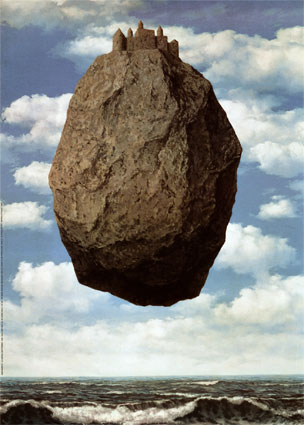
René Magritte - La Chateau des Pyrenees (1959)


"My painting is visible images which conceal nothing; they evoke mystery and, indeed, when one sees one of my pictures, one asks oneself this simple question: "What does it mean?" It does not mean anything, because mystery means nothing either. It is unknowable."

René Magritte

"Our thinking is largely discursive, verbal, linear. There is more reality in an image than a word."
Joseph Campbell


"One might say that immensity is a philosophical category of daydream. Daydream undoubtedly feeds on all kinds of sights, but through a sort of natural inclination, it contemplates grandeur. And this contemplation produces an attitude that is so special, an inner state that is so unlike any other, that the daydream transports the dreamer outside the immediate world to a world that bears the mark of infinity.

Far from the immensities of sea and land, merely through memory, we can recapture, by means of meditation, the resonances of this completion of grandeur. But is this really memory? Isn't imagination alone able to enlarge indefinitely the images of immensity? In point of fact, daydreaming, from the very first second, is an entirely constituted state. We do not see it start, and yet it always starts the same way, that is, it flees the object nearby and right away it is far off, elsewhere, in the space of elsewhere."

From The Poetics of Space by Gaston Bachelard