Showing posts with label Guattari. Show all posts

Sunday, June 29, 2008

Nine Gates


Dale Frank - a selection from the Transient Ischaemic Attack Painting series, 2005


Musique Du Jour: Spontaneous Sound, Christopher Tree

Thursday, January 11, 2007

Rhizome


Simon Patterson (b. 1967) - The Great Bear (detail), 1992


''Rhizome' describes the connections that occur between the most disparate and the most similar of objects, places and people; the strange chains of events that link people: the feeling of 'six degrees of separation', the sense of 'having been here before' and assemblages of bodies. Deleuze and Guattari's concept of the 'rhizome' draws from its etymological meaning, where 'rhizo' means combining form and the biological term 'rhizome' describes a form of a plant that can extend itself through its underground horizontal tuber-like root system and develop new plants. In Deleuze and Guattari's use of the term, the rhizome is a concept that 'maps' a process of networked, relational and transversal thought, and a way of being without 'tracing' the construction of that map as a fixed entity. Ordered lineages of bodies and ideas that trace their originary and individual bases are considered as forms of 'arborescent thought', and this metaphor of a tree-like structure that orders epistemologies and forms historical frames and homogeneous schemata, is invoked by Deleuze and Guattari to describe everything that rhizomatic thought is not.

In addition, Deleuze and Guattari describe the rhizome as an action of many abstract entities in the world, including music, mathematics, economics, politics, science, art, the ecology and the cosmos. The rhizome conceives how every thing and every body - all aspects of concrete, abstract and virtual entities and activities - can be seen as multiple in their inter-relational movements with other things and bodies. the nature of the rhizome is that of a moving matrix, composed of organic and non-organic parts forming symbiotic and aparallel connections, according to transitory and as yet undetermined routes. Such a reconceptualisation constitutes a revolutionary philosophy for the reassessment of any form of hierarchical thought, history or activity.

In a world that builds structures from economic circuits of difference and desire, Deleuze responds by reconsidering how bodies are constructed. He and Guattari argue that such structures constrain creativity and position things and people into regulatory orders. In A Thousand Plateaus, Deleuze and Guattari staged the entire book as a series of networked rhizomatic 'plateaus' that operate to counter historical and philosophical positions pitched toward the system of representation that fixes the flow of thought. Instead, through a virtuoso demonstration of the relational energies able to be configured through often disparate forms and systems of knowledge, they offer the reader an open system of thought. Rhizomatic formations can serve to overcome, overturn and transform structures of rigid, fixed or binary thought and judgement - the rhizome is 'anti-genealogy'. A rhizome contributes to the formation of a plateau through its lines of becoming, which form aggregate connections. There are no singular positions on the networked lines of a rhizome, only connected points which form connections between things. A rhizomatic plateau of thought, Deleuze and Guattari suggest, may be reached through the consideration of the potential of multiple and relational bodies and ideas. The rhizome is any network of things brought into contact with one another, functioning as an assemblage machine for new affects, new concepts, new bodies, new thoughts; the rhizomatic network is a mapping of the forces that move and/or immobilise bodies.

Deleuze and Guattari insist bodies and things ceaselessly take on new dimensions through their contact with different and divergent entities over time; in this way the concept of the 'rhizome' marks a divergent way of conceptualising the world that is indicative of Deleuzian philosophy as a whole. Rather than reality being thought of and written as an ordered series of structural wholes, where semiotic connections or taxonomies can be compiled from complete root to tree-like structure, the story of the world and its components, Deleuze and Guattari propose, can be communicated through the rhizomatic operations of things - movements, intensities and polymorphous formations. In opposition to descendent evolutionary models of classification, rhizomes have no hierarchical order to their compounding networks. Instead, Deleuzian rhizomatic thinking functions as an open-ended productive configuration, where random associations and connections propel, sidetrack and abstract relations between components. Any part within a rhizome may be connected to another part, forming a milieu that is decentred, with no distinctive end or entry point.

Deleuze apparatus for describing affective change is the 'rhizome'. Deleuze viewed every operation in the world as the affective exchange of rhizomatically-produced intensities that create bodies: systems, economies, machines and thoughts. Each and every body is propelled and perpetuated by innumerable levels of the affective forces of desire and its resonating materialisations. Variations to any given system can occur because of interventions within cyclical, systematic repetition. As the rhizome may be constituted within an existing body - including existing thoughts one might bring to bear upon another body - the rhizome is necessarily subject to the principles of diversity and difference through repetition, which Deleuze discussed in his books Nietzsche and Philosophy and Difference and Repetition.

Deleuze acknowledges Friedrich Nietzsche's concept of the eternal return as the constitution of things through repeated elements (existing bodies, modes of thought) that form a 'synthesis' of difference through the repetition of elements. 'Synthesis' is also described by Deleuze and Guattari as an assemblage of variable relations produced by the movement, surfaces, elusions and relations of rhizomes that form the bodies (desiring machines) through composite chains of previously unattached links. As a non-homogeneous sequence, then, the rhizome describes a series that may be composed of causal, chance, and/or random links. Rhizomatic connections between bodies and forces produce an affective energy or entropy. As Deleuze describes in his work on David Hume, the interaction of a socially, politically, or culturally determined force and any given body both produces and uses associations of ideas. The discontinuous chain is he medium for the rhizome's expanding network, just as it is also the contextual circumstance for the chain's production.

Rhizomatic writing, being, and/or becoming is not simply a process that assimilates things, rather it is a milieu of perpetual transformation. the relational milieu that the rhizome creates gives form to evolutionary environments where relations alter the course of how flows and collective desire develop. There is no stabilising function produced by the rhizomatic medium; there is no creation of a whole out of virtual and dispersed parts. Rather, through the rhizome, points form assemblages, multiple journey systems associate into possibly connected or broken topologies; in turn, such assemblages and typologies change, divide, and multiply through disparate and complex encounters and gestures. The rhizome is a powerful way of thinking without recourse to analogy or binary constructions. To think in terms of the rhizome is to reveal the multiple ways that you might approach any thought, activity, or concept - what you always bring with you are the many and various ways of entering into any body, of assembling thought and action through the world.'

Felicity F. Colman

Friday, December 01, 2006

The Marriage Of Order And Chaos


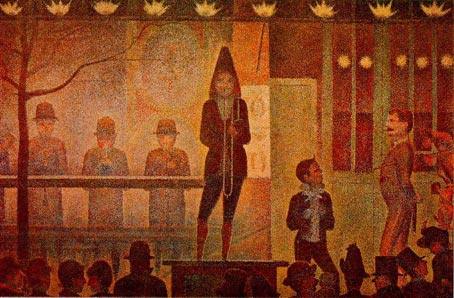
Georges-Pierre Seurat - Circus Sideshow (1887-88)


"Some say they see poetry in my paintings; I see only science."

Georges-Pierre Seurat


"We require just a little order to protect us from chaos. Nothing is more distressing than a thought that escapes itself, than ideas that fly off, that disappear hardly formed, already eroded by forgetfulness or precipitated into others that we no longer master. These are infinite variabilities, the appearing and disappearing of which coincide. They are infinite speeds that blend into the immobility of the colourless and silent nothingness they traverse, without nature or thought. This is the instant of which we do not know whether it is too long or too short for time. We receive sudden jolts that beat like arteries. We constantly lose our ideas. This is why we want to hang on to fixed opinions so much. We ask only that our ideas are linked together according to a minimum of constant rules. All that the association of ideas has ever meant is providing us with these protective rules - resemblance, continuity, causality - which enable us to put some order into ideas, preventing our "fantasy" (delirium, madness) from crossing the universe in an instant, producing winged horses and dragons breathing fire. But there would not be a little order in ideas if there was not also a little order in things or states of affairs, like an objective antichaos: "If cinnabar were sometimes red, sometimes black, sometimes light, sometimes heavy. . . my empirical imagination would never find opportunity when representing red colour to bring to mind heavy cinnabar." [Immanuel Kant, Critique of Pure Reason] And finally, at the meeting point of things and thought, the sensation must recur - that of heaviness whenever we hold cinnabar in our hands, that of red whenever we look at it - as proof or evidence of their agreement with our bodily organs that do not perceive the present without imposing on it a conformity with the past. This is all that we ask for in order to make an opinion for ourselves, like a sort of "umbrella", which protects us from chaos.

Our opinions are made up from all this. But art, science, and philosophy require more: they cast planes over the chaos. . . . Philosophy, science, and art want us to tear open the firmament and plunge into the chaos. We defeat it only at this price. . . . The philosopher, the scientist, and the artist seem to return from the land of the dead. . . . The artist brings back from the chaos varieties that no longer constitute a reproduction of the sensory in the organ but set up a being of the sensory, a being of sensation, on an anorganic plane of composition that is able to restore the infinite. . . . Painters go through a catastrophe, or through a conflagration, and leave the trace of this passage on the canvas, as of the leap leads them from chaos to composition. . . . It is as if the struggle against chaos does not take place without an affinity with the enemy, because another struggle develops and takes on more importance - the struggle against opinion, which claims to protect us from chaos itself."

From What is Philosophy? by Gilles Deleuze and Félix Guatarri


"A parade, the free entertainment offered at the entrance of a travelling theatre, is intended to attract a crowd and encourage the sale of tickets. Seurat painted this extraordinary work during six months in 1887–88 and showed it at the fourth exhibition of the Society of Independent Artists, in 1888. It was his first attempt to render the effects of artificial light at night using the Pointillist technique and seems to have been inspired by a lecture on artificial light by James McNeill Whistler that was translated into French and published by the poet Stephen Mallarmé. Seurat achieved an unprecedented effect in the rendering of the illumination from the row of gas jets. Circus Sideshow is also Seurat's first systematic application of the scientific theories of Charles Henry (1859–1926) regarding the relationship between aesthetics and the physiology and psychology of the senses. By 1890 Seurat had formulated an aesthetic based on these theories that explains his intentions in Circus Sideshow: 'Art is Harmony. Harmony is the analogy of contrary and similar elements of tone, of colour, and of line, considered according to their dominants and under the influence of light, in gay, calm, or sad combinations . . . . Gaiety of tone is given by the luminous dominant; of colour, by the warm dominant; of line, by lines above the horizontal.'"

From the Metropolitan Museum of Art website.

Monday, November 27, 2006

The Fragile Afterlife Of Images


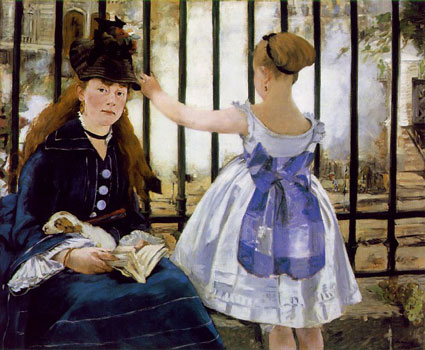
Edouard Manet - Gare Saint-Lazare (1873)


"It is not enough to know your craft - you have to have feeling."

Edouard Manet


"The young man will smile on the canvas for as long as the canvas lasts. Blood throbs under the skin of the woman's face, the wind shakes a branch, a group of men prepare to leave. In a novel or film, the young man will stop smiling, but he will start to smile again when we turn this page or that moment. Art preserves, and it is the only thing in the world that is preserved. It preserves and is preserved itself (quid juris?) , although it actually lasts no longer than its support and materials - stone, canvas, chemical colour, and so on (quid facti?) The young girl maintains the pose that she has had for five thousand years, a gesture that no longer depends on whoever made it. The air still has the turbulence, the gust of wind, and the light that it had that day last year, and it no longer depends on whoever was breathing it that morning. If art preserves it does not do so like industry, by adding a substance to make the thing last. The thing became independent of its "model" from the start, but it is also independent of other possible personae who are themselves artists-things, personae of painting breathing the air of this painting. And it is no less independent of the viewer or hearer, who only experience it after, if they have the strength for it. What about the creator? It is independent of the creator through the self-positing of the created, which is preserved in itself. What is preserved - the thing or the work of art - is a bloc of sensations, that is to say, a compound of percepts and affects.

Percepts are no longer perceptions; they are independent of a state of those who experience them. Affects are no longer feelings or affections; they go beyond the strength of those who undergo them. Sensations, percepts, and affects are beings whose validity lies in themselves and exceeds any lived. They could be said to exits in the absence of man because man, as he is caught in stone, on the canvas, or by words, is himself a compound of percepts and affects. The work of art is a being of sensation and nothing else: it exists in itself."

From What is Philosophy? by Gilles Deleuze and Félix Guatarri


". . . the differences which exist between every one of our real impressions - the differences which explain why a uniform depiction of life cannot bear much resemblance to reality - derive probably from the following cause: the slightest word that we have said, the most insignificant action that we have performed at any one epoch of our life was surrounded by, and coloured by the reflection of, things which logically had no connection with it and which later have been separated from it by our intellect which could make nothing of it for its own rational purposes, things, however, in the midst of which - here the pink reflection of the evening upon the flower-covered wall of a country restaurant, a feeling of hunger, a desire for women, the pleasure of luxury; there the blue volutes of the morning sea and, enveloped in them, phrases of music half emerging like the shoulders of water-nymphs - the simplest act or gesture remains immured as within a thousand vessels, each of them filled with things of a colour, a scent, a temperature that are absolutely different one from another, vessels, moreover, which being disposed over the whole range of our years, during which we have never ceased to change if only in our dreams and thoughts, are situated at the most various moral altitudes and give us sensation of extraordinarily diverse atmospheres."

From Remembrance of Things Past by Marcel Proust