Showing posts with label Philosophy. Show all posts

Friday, July 04, 2008

The Ripples Of Reflection


Doug Aitken - don't think twice II, 2006


Reflection is the courage to make the truth of our own presuppositions and the realm of our goals into the things that most deserve to be called into question.


Monday, June 16, 2008

A Fistful Of Levinas


Oscar Muñoz (b. 1951) - Line of Destiny, 2006 (single screen projection)


1. The object which presents itself to the thinker determines the thinker. But it determines the thinker without touching the thinker, without weighing down on him; in such a manner that the thinker submits to the imposed content of thought ‘in good grace’, as if he had anticipated the object right down to the surprises it holds in store for knowledge.

2. [Every] loss of time, every lapse, holds on to itself, or is recuperated in the memory, finds itself again, or is reconstructed; it adheres to an ensemble through the agency of memory or historiography. Consciousness in reminiscence glorifies the ultimate resilience of presence. The time of consciousness lends itself to [self-] representation – this is more strongly synchrony that diachrony.

3. To represent is not simply to render present ‘again’, it is to fetch back to the present itself an actual perception which is flowing away . . . to fetch back to the instantaneity of thought everything which seems independent of it.

4. The Same, in its relation to Alterity, refuses what is exterior to its own instant, to its identity in order to rediscover in that free-floating instant . . . as conferred sense, as a noema, everything which had been rejected.

5. Admittedly, the self which conducts its thoughts becomes (or, more exactly, ages) in the time in which are spread out its [the self’s] successive thoughts throughout which the self thinks in the present. But this becoming does not appear on the level of representation.

Emmanuel Levinas


Musique Du Jour: Pendulum Music, Steve Reich


Thursday, May 22, 2008

Seven Kinds Of Sadness: Part Three

Death by Philosophy (Redux)


Exhibit A: A Deadly Thirst


Jacques-Louis David (1748-1825) - The Death of Socrates (1787)


There is but one truly serious philosophical problem, and that is suicide. Judging whether life is or is not worth living amounts to answering the fundamental question of philosophy. All the rest - whether or not the world has three dimensions, whether the mind has nine or twelve categories - comes afterwards. These are games; one must first answer. And if it is true, as Nietzsche claims, that a philosopher, to deserve our respect, must preach by example, you can appreciate the importance of that reply, for it will precede the definitive act. These are facts the heart can feel; yet they call for careful study before they become clear to the intellect.

If I ask myself how to judge that this question is more urgent than that, I reply that one judges by the actions it entails. I have never seen anyone die for the ontological argument. Galileo, who held a scientific truth of great importance, abjured it with the greatest of ease as soon as it endangered his life. In a certain sense, he did right. That truth was not worth the stake. Whether the earth or the sun revolves around the other is a matter of profound indifference. To tell the truth, it is a futile question. On the other hand, I see many people die because the judge that life is not worth living. I see others paradoxically getting killed for the ideas or illusions that give them a reason for living (what is called a reason for living is also an excellent reason for dying). I therefore conclude that the meaning of life is the most urgent of questions. How to answer it? On all essential problems (I mean thereby those that run the risk of leading to death or those that intensify the passion of living) there are probably but two methods of thought: the method of La Palisse and the method of Don Quixote. Solely the balance between evidence and lyricism can allow us to achieve simultaneously emotion and lucidity. In a subject at once so humble and so heavy with emotion, the learned and classical dialectic must yield, one can see, to a more modest attitude of mind deriving at one and the same time from common sense and understanding.

Albert Camus


Exhibit B: The Fatal Game


Edouard Manet (1832-1883) - Suicide, 1877


Suicide has never been dealt with except as a social phenomenon. On the contrary, we are concerned here . . . with the relationship between individual thought and suicide. An act like this is prepared within the silence of the heart, as is a great work of art. The man himself is ignorant of it. One evening he pulls the trigger or jumps. Of an apartment building manager who had killed himself I was told that he had lost his daughter five years before, that he had changed greatly since, and that the experience had "undermined" him. A more exact word cannot be imagined. Beginning to think is beginning to be undermined. Society has but little connection with such beginnings. The worm is in man's heart. That is where it must be sought. One must follow and understand this fatal game that leads from lucidity in the face of existence to flight from the light . . .

But if it is hard to fix the precise instant, the subtle step when the mind opted for death, it is easier to deduce from the act itself the consequences it implies. In a sense, and as in a melodrama, killing yourself amounts to confessing. It is confessing that life is too much for you or that you do not understand it. Let's not go too far in such analogies, however, but rather return to everyday words. It is merely confessing that that "is not worth the trouble". Living, naturally, is never easy. You continue making the gestures commanded by existence for many reasons, the first of which is habit. Dying voluntarily implies that you have recognised, even instinctively, the ridiculous character of that habit. Dying voluntarily implies that you have recognised, even instinctively, the ridiculous character of that habit, the absence of any profound reason for living, the insane character of that daily agitation, and the uselessness of suffering.

Albert Camus


Exhibit C: The Burning Question


Thich Quang Duc (June 11th, 1963)


What, then, is that incalculable feeling that deprives the mind of the sleep necessary to life? A world that can be explained even with bad reasons is a familiar world. But, on the other hand, in a universe suddenly divested of illusions and lights, man feels an alien, a stranger. His exile is without remedy since he is deprived of the memory of a lost home or the promised land. This divorce between man and his life, the actor and his setting, is properly the feeling of absurdity. All healthy men having thought of his own suicide, it can be seen, without further explanation, that there is a direct connection between this feeling and the longing for death.

The subject of this essay is precisely this relationship between the absurd and suicide, the exact degree to which suicide is a solution to the absurd. The principle can be established that for a man who does not cheat, what he believes to be true must determine his action. Belief in the absurdity of existence must then dictate his conduct. It is legitimate to wonder, clearly and without false pathos, whether a conclusion of this importance requires forsaking as rapidly as possible an incomprehensible condition. I am speaking, of course, of men inclined to be in harmony with themselves.

Stated clearly, this problem may seem both simple and insoluble. But it is wrongly assumed that simple questions involve answers that are no less simple and that the evidence implies evidence. A priori and and reversing the terms of the problem, just as one does or does not kill oneself, it seems that there are but two philosophical solutions, either yes or no. This would be too easy. But allowance must be made for those who, without concluding, continue questioning. Here I am only slightly indulging in irony: this is the majority. I notice also that those who answer "no" act as if they thought "yes". As a matter of fact, if I accept the Nietzschean criterion, they think "yes" in one way or another. On the other hand, it often happens that those who commit suicide were assured of the meaning of life. These contradictions are constant. It may even be said that they have never been as on this point where, on the contrary, logic seems so desirable. It is a commonplace to compare philosophical theories and the behaviour of those who profess them . . . Schopenhauer is often cited, as a fit subject for laughter, because he praised suicide while seated at a well-set table. This is no subject for joking. That way of not taking the tragic seriously is not grievous, but it helps to judge a man.

In the face of such contradictions and obscurities must we conclude that there is no relationship between the opinion one has about life and the act one commits to leave it? Let us not exaggerate in this direction. In a man's attachment to life there is something stronger than all the ills in the world the body's judgement is as good as the mind's, and the body shrinks from annihilation. We get into the habit of living before acquiring the habit of thinking. In that race which daily hastens us towards death, the body retains its irreparable lead. In short, the essence of that contradiction lies in what I shall call the act of eluding because it is both less and more than diversion in the Pascalian sense. Eluding is the invariable game. The typical act of eluding, the fatal evasion that constitutes the third theme of this essay, is hope. Hope for another life one must "deserve" or trickery of those who live not for life itself but for some great idea that will transcend it, refine it, give it a meaning, and betray it . . .

Albert Camus


Musique Du Jour: See That My Grave Is Kept Clean, Diamanda Galas


Monday, May 19, 2008

Replay V

The Grammar of Becoming


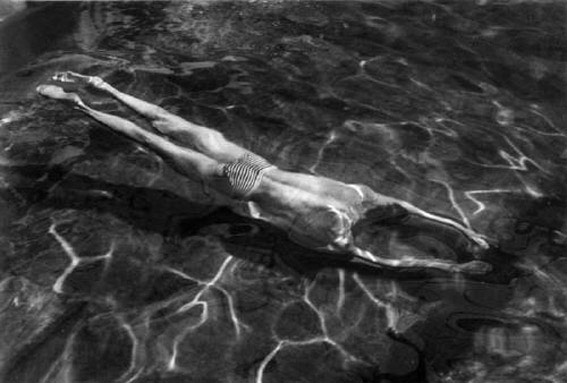
André Kertész - Underwater Swimmer (1917)


To learn is to enter into the universal of the relations which constitute the Idea, and into their corresponding singularities. The idea of the sea, for example, as Leibniz showed, is a system of liaisons or differential relations between particulars and singularities corresponding to the degree of variation among these relations - the totality of the system being incarnated in the real movement of the waves. To learn to swim is to conjugate the distinctive points of our bodies with the singular points of the objective Idea in order to form a problematic field.

From Difference and Repetition by Gilles Deleuze


What does learning consist in? Here is a traditional view: learning is a matter of memorising something that somebody else knows. It sounds simplistic, if we put it that way. But who among us has not attended high school and college and has not been subjected to this view of learning? A teacher, a professor, stands before the class, chalk or transparencies in hand. There are things you need to learn, items you need to know. Before the class period is over, these things will be transferred from the teacher's lecture notes, the professor's transparencies, to your notebook. From there, these things will be transferred to your brain. When those transfers are successful, you will be said to have learned what the teacher, the professor, has taught you.

It is a meager model of learning. It is also the most common one. It is a model that operates on some surface assumptions and a slightly deeper one. Its surface assumptions are, first, that the teacher knows what there is to know about a subject and you do not. Second, there is the assumption that the way that you learn what the teacher knows is to listen to the teacher and commit to memory what he or she has to say. Last, on the teacher's side, there is the assumption that by talking or using other media to substitute for talking, the teacher can impart to the student what needs to be known.

The slightly deeper assumption has to do with the dogmatic image of thought. It is the assumption that what is to be learned comes in discrete packets of identities. There are particular somethings that need to be known. These somethings may be related to one another or they may not. In either case, they are independent enough from one another to be isolated each to a sentence, a paragraph, or a chapter. These somethings are then represented by the sentences spoken by the teacher or professor, and then arrive at your ear or on your paper. If the learning us successful, there will have been no alteration, no damage, of any of these somethings along the way. Their identities will retain their integrity. And if you do your job you will be able to repeat or manipulate these identities when test time comes around.

There is another view of learning that does not start with the assumption that what is to be learned has the character of an identity or group of identities. It starts instead from the assumption that what there is to be learned has the character of difference rather than identity. If what is to be learned does not have the character of identity, then the learning itself is not a project of transferring identities from the knower to the one who seeks to know. It is instead a project of experimentation.

Swimmers do not learn facts about the water and about their bodies and then apply them to the case in hand. The water and their bodies are swarms of differences. In order to navigate their bodies through the water they will need to acquire a skill: to "conjugate" their bodies with the water in such a way as to stay on its surface. This skill involves no memorisation. It involves an immersion, a finding one's way through things, coming through one's body to understand what one is capable of in the water. There is no one way to do this, and different ways may lead to different kinds of success. There are also failures; water may be composed of differences, but not every path through those differences will keep one afloat.

Swimmers apprentice themselves to the water. They get a feel for the water, for how it moves and what possibilities it offers them. They get a feel for their bodies in the water. And they conjugate one against the other. The couplet body/water is a problematic field...Particular ways of swimming are solutions within that problematic field. They do not solve the problem of swimming. For there is no single problem of swimming. There is instead a problematic field of body/water, of which particular ways of swimming are solutions. They are experiments in conjugation of this problematic field, much of which takes place below the level of conscious thought, beneath the identities representation offers us: "'learning' always takes place in and through the unconscious, thereby establishing a profound complicity between nature and mind." [Deleuze, Difference and Repetition]

What does learning how to think consist in? Unlike learning how to swim, it first requires the abandonment of bad habits. These habits are the ones instilled in all of us by the dogmatic image of thought and its representational view of language and the world. We must discover this image and this view; we must see what roles they play in preventing us from really thinking.

But that is not all. That is only the negative task, the clearing of the ground. Alongside this abandonment we must also experiment in ways of thinking. We must conjugate our thought and our world, our thought and our language.

There are those who have gone before us, who have swum in this water before: Spinoza, Bergson, Nietzsche among them. They may help ease us into the water, teach us some of the strokes, so we don't drown before we get started. We can apprentice ourselves to them. Sooner or later, however, we must push off from the shore and conjugate things for ourselves...[We] must do it for ourselves, each of us...

There are two mistakes we might make in considering the prospect of learning to think. The first mistake would be to assume that thinking, unlike swimming, is a purely conscious activity, that thinking is a manipulation of thought. That mistake is our inheritance from the dogmatic image of thought. We feel our way into thinking in much the same way as we feel our way into swimming. Thinking is at least as unconscious as it is conscious, and it is no less an experiment...The second mistake would be to assume that each of us must face this task alone. In fact, we can face it in groups, conjugating ourselves with one another as well as with the world. Thinking does not need to be a solitary activity, and it surely does not take place in a world which we do not share with others...[We might] consider our place among others in the world, to think about it, or with it, or in it.

From Gilles Deleuze: An Introduction by Todd May


Philosophy is a battle against the bewitchment of our intelligence by means of language.

Ludwig Wittgenstein

Replay VI

This Is Not A Paint(h)ing: Part One


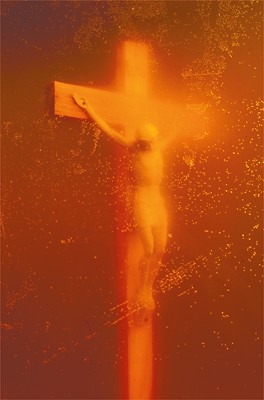
Andres Serrano - Piss Christ (1987)


A philosopher of the imagination, therefore, should follow the poet to the ultimate extremity of his images, without ever reducing this extremism, which is the specific phenomenon of the poetic impulse. In a letter to Clara Rilke, Rilke wrote: 'Works of art always spring from those who have faced the danger, gone to the very end of an experience, to the point beyond which no human being can go. The further one dares to go, the more decent, the more personal, the more unique a life becomes.' But is it necessary to go and look for "danger" other than the danger of writing, of expressing oneself? Doesn't the poet put language in danger? Hasn't the fact that, for so long, poetry has been the echo of heartache, given it a pure dramatic tonality? When we really live a poetic image, we learn to know, in one of its tiny fibres, a becoming of being that is an awareness of the being's inner disturbance. Here being is so sensitive that it is upset by a word. In the same manner, Rilke adds: 'This sort of derangement, which is peculiar to us, must go into our work.'

. . .

If, through poetry, we restore to the activity of language its free field of expression, we are obliged to supervise the use of fossilized metaphors.

From The Poetics of Space by Gaston Bachelard


Two of the many articles spawned by the above photograph:

Sacrifice, Piss Christ and Liberal Excess: Part 1 - Damien Casey (Arts and Opinion, 2004)

Sacrifice, Piss Christ and Liberal Excess: Part 2 (The Rebuttal) - Michael Casey, Anthony Fisher and Haydan Ramsey (Arts and Opinion, 2004)


Reading:

Visions of Excess: Selected Writings, 1927-1939 (ed. Allan Stoekl) - Georges Bataille

The Three Ecologies - Felix Guatarri

Chaosmosis: An Ethico-Aesthetic Paradigm - Felix Guatarri

The Deleuze Reader (ed. Constantin V. Boundas) - Gilles Deleuze

Monday, May 14, 2007

Nightfall In The Forest Of Philosophy


Caspar David Friedrich (1774-1840) - Evening, 1820-1


'An intellectual is someone whose mind watches itself.'

Albert Camus

Wednesday, May 02, 2007

Icarus On A Leash


Louis Michel Eilshemius (1864-1941) - Afternoon Wind, 1899


'Happiness is not an ideal of reason, but of imagination.'

Immanuel Kant

Saturday, April 14, 2007

At The Crossroads Of Art And Philosophy


Caspar David Friedrich (1774-1840) - A Walk at Dusk, c. 1830-35


'We have art in order not to die of truth.'

Friedrich Nietzsche

'The philosopher creates, he doesn't reflect.'

Gilles Deleuze

'Happiness belongs to those who are sufficient unto themselves. For all external sources of happiness and pleasure are, by their very nature, highly uncertain, precarious, ephemeral and subject to chance. '

Arthur Schopenhauer

Friday, April 06, 2007

The Icy Maze


Piet Mondrian (1872-1944) - Composition with Red, Yellow and Blue, 1921


'Once the last trace of emotion has been eradicated, nothing remains of thought but absolute tautology.'

Theodor Adorno

Thursday, April 05, 2007

The Enigma Of Everyday Objects


Jean Baptiste Simeon Chardin (1699-1779) - Pipes and Drinking Pitcher, 1737


'The aspects of things that are most important for us are hidden because of their simplicity and familiarity.'

Ludwig Wittgenstein

Thursday, February 15, 2007

The Virtues of Vicissitude


Peter Paul Rubens (1577-1640) - Prometheus Bound, 1611-12


'Whether it be hedonism, pessimism, utilitarianism, eudemonism - all of these ideas that measure the value of things according to pleasure or suffering, that is to say, according to secondary states and side-effects, are foreground ideas, and naive. Anyone conscious of having creative energies and an artist's conscience will look down on them not without mockery, but also not without pity. Pity for all of you! Although it is not pity in your sense, to be sure. It is not pity for social 'misery', for 'society' and its sick and injured, for the perennially depraved and downtrodden who lie around us everywhere; even less is it pity for the grumbling, oppressed, rebellious ranks of slaves who are looking to be masters (which they call 'being free'). Our pity is a more elevated, more far-sighted pity - we see how human beings are being reduced, how all of you are reducing them! And there are moments when we look at your pity especially with an indescribable anxiety, when we defend ourselves against this pity - when we find your seriousness more dangerous than any frivolity. If possible (and no 'if possible' can be more crazy) you want to abolish suffering! And we? - it seems that we want it to be, if anything, worse and greater than before! Well-being in your sense of the word - that certainly is no goal, it seems to us to be an end! A condition that would immediately make people ludicrous and contemptible - make us wish their downfall! The discipline of suffering, great suffering - don't you know that this discipline alone has created all human greatness to date? The tension of the soul in unhappiness, which cultivates its strength; its horror at the sight of great destruction; its inventiveness and bravery in bearing, enduring, interpreting, exploiting unhappiness, and whatever in the way of depth, mystery, mask, spirit, cleverness, greatness the heart has been granted - has it not been granted them through suffering, through the discipline of great suffering? In the human being, creature and creator are united: the human being is matter, fragment, excess, clay, filth, nonsense, chaos; but the human being is also creator, sculptor, hammer-hardness, observer-divinity, and the Seventh Day - do you not understand this opposition? Do you understand that you pity is for the 'creature in the human being', that which must be formed, broken, forged, torn, burned, annealed, purified - that which necessarily has to suffer and should suffer? And our pity - do you not understand whom our reversed pity is intended for, when it resists your pity as the worst of all possible self-indulgences and weaknesses?

Pity versus pity, then!'

From Beyond Good and Evil by Friedrich Nietzsche

Tuesday, February 13, 2007

The Possible And The Real


Yves Tanguy (1900-1955) - Old Horizon, 1928


'I believe in the end we shall consider it evident that the artist in executing his work is creating the possible as well as the real. Whence comes it then that one might hesitate to say the same thing for nature? Is not the world a work of art incomparably richer than that of the greatest artist? And is there not as much absurdity, if not more, in supposing, in the work of nature, that the future is outlined in advance, that possibility existed before reality? Once more let me say I am perfectly willing to admit that the future states of a closed system of material points are calculable and hence visible in its present state. But, I repeat, this system is extracted, or abstracted, from a whole which, in addition to inert and unorganised matter, comprises organisation. Take the concrete and complete world, with the life and consciousness it encloses; consider nature in its entirety, nature the generator of new species as novel and original in form as the design of any artist; in these species concentrate upon individuals, plants or animals, each of which has its own character - I was going to say its personality (for one blade of grass does not resemble another any more that a Raphael resembles a Rembrandt); lift your attention above and beyond individual man to societies which disclose actions and situations comparable to those of any drama: how can one still speak of possibles which would precede their own realisation? How can we fail to see that the event can always be explained afterwards by an arbitrary choice of antecedent events, a completely different event could have been equally well explained in the same circumstances by another choice of antecedents - nay, by the same antecedents otherwise cut out, otherwise distributed, otherwise perceived - in short, by our retrospective attention? Backwards over the course of time a constant remodelling of the past by the present, of the cause by the effect, is being carried out.

We do not see it, always for the same reason, always a prey to the same illusion, always because we treat as more what is the less, as the less what is the more. If we put the possible back in its proper place, evolution becomes something quite different from the realisation of a program: the gates of the future open wide; freedom is offered an unlimited field. The fault of those doctrines - rare indeed in the history of philosophy - which have succeeded in leaving room for indetermination and freedom in the world, is to have failed to see what their affirmation implied. When they spoke of indetermination, of freedom, they meant by indetermination a competition between possibles, by freedom a choice between possibles - as if possibility was not created by freedom itself! As if any other hypothesis, by affirming an ideal pre-existence of the possible to the real, did not reduce the new to a mere arrangement of former elements! As if it were not thus to be led sooner or later to regard that arrangement as calculable and foreseeable! By accepting the premise of the contrary theory one was letting the enemy in. We must resign ourselves to the inevitable: it is the real which makes itself possible, not the possible which becomes real.'

From The Creative Mind by Henri Bergson

Wednesday, February 07, 2007

Death By Philosophy: Part Three


The Burning Question


Thich Quang Duc (June 11th, 1963)


'What, then, is that incalculable feeling that deprives the mind of the sleep necessary to life? A world that can be explained even with bad reasons is a familiar world. But, on the other hand, in a universe suddenly divested of illusions and lights, man feels an alien, a stranger. His exile is without remedy since he is deprived of the memory of a lost home or the promised land. This divorce between man and his life, the actor and his setting, is properly the feeling of absurdity. All healthy men having thought of his own suicide, it can be seen, without further explanation, that there is a direct connection between this feeling and the longing for death.

The subject of this essay is precisely this relationship between the absurd and suicide, the exact degree to which suicide is a solution to the absurd. The principle can be established that for a man who does not cheat, what he believes to be true must determine his action. Belief in the absurdity of existence must then dictate his conduct. It is legitimate to wonder, clearly and without false pathos, whether a conclusion of this importance requires forsaking as rapidly as possible an incomprehensible condition. I am speaking, of course, of men inclined to be in harmony with themselves.

Stated clearly, this problem may seem both simple and insoluble. But it is wrongly assumed that simple questions involve answers that are no less simple and that the evidence implies evidence. A priori and and reversing the terms of the problem, just as one does or does not kill oneself, it seems that there are but two philosophical solutions, either yes or no. This would be too easy. But allowance must be made for those who, without concluding, continue questioning. Here I am only slightly indulging in irony: this is the majority. I notice also that those who answer "no" act as if they thought "yes". As a matter of fact, if I accept the Nietzschean criterion, they think "yes" in one way or another. On the other hand, it often happens that those who commit suicide were assured of the meaning of life. These contradictions are constant. It may even be said that they have never been as on this point where, on the contrary, logic seems so desirable. It is a commonplace to compare philosophical theories and the behaviour of those who profess them . . . Schopenhauer is often cited, as a fit subject for laughter, because he praised suicide while seated at a well-set table. This is no subject for joking. That way of not taking the tragic seriously is not grievous, but it helps to judge a man.

In the face of such contradictions and obscurities must we conclude that there is no relationship between the opinion one has about life and the act one commits to leave it? Let us not exaggerate in this direction. In a man's attachment to life there is something stronger than all the ills in the world the body's judgement is as good as the mind's, and the body shrinks from annihilation. We get into the habit of living before acquiring the habit of thinking. In that race which daily hastens us towards death, the body retains its irreparable lead. In short, the essence of that contradiction lies in what I shall call the act of eluding because it is both less and more than diversion in the Pascalian sense. Eluding is the invariable game. The typical act of eluding, the fatal evasion that constitutes the third theme of this essay, is hope. Hope for another life one must "deserve" or trickery of those who live not for life itself but for some great idea that will transcend it, refine it, give it a meaning, and betray it . . . '

From Absurdity and Suicide by Albert Camus

Tuesday, February 06, 2007

Death By Philosophy: Part Two


The Fatal Game


Édouard Manet (1832-1883) - Suicide, 1877


'Suicide has never been dealt with except as a social phenomenon. On the contrary, we are concerned here . . . with the relationship between individual thought and suicide. An act like this is prepared within the silence of the heart, as is a great work of art. The man himself is ignorant of it. One evening he pulls the trigger or jumps. Of an apartment building manager who had killed himself I was told that he had lost his daughter five years before, that he had changed greatly since, and that the experience had "undermined" him. A more exact word cannot be imagined. Beginning to think is beginning to be undermined. Society has but little connection with such beginnings. The worm is in man's heart. That is where it must be sought. One must follow and understand this fatal game that leads from lucidity in the face of existence to flight from the light . . .

But if it is hard to fix the precise instant, the subtle step when the mind opted for death, it is easier to deduce from the act itself the consequences it implies. In a sense, and as in a melodrama, killing yourself amounts to confessing. It is confessing that life is too much for you or that you do not understand it. Let's not go too far in such analogies, however, but rather return to everyday words. It is merely confessing that that "is not worth the trouble". Living, naturally, is never easy. You continue making the gestures commanded by existence for many reasons, the first of which is habit. Dying voluntarily implies that you have recognised, even instinctively, the ridiculous character of that habit. Dying voluntarily implies that you have recognised, even instinctively, the ridiculous character of that habit, the absence of any profound reason for living, the insane character of that daily agitation, and the uselessness of suffering.'

From Absurdity and Suicide by Albert Camus

Monday, February 05, 2007

Death By Philosophy: Part One


A Deadly Thirst


Jacques-Louis David (1748-1825) - The Death of Socrates (1787)


'There is but one truly serious philosophical problem, and that is suicide. Judging whether life is or is not worth living amounts to answering the fundamental question of philosophy. All the rest - whether or not the world has three dimensions, whether the mind has nine or twelve categories - comes afterwards. These are games; one must first answer. And if it is true, as Nietzsche claims, that a philosopher, to deserve our respect, must preach by example, you can appreciate the importance of that reply, for it will precede the definitive act. These are facts the heart can feel; yet they call for careful study before they become clear to the intellect.

If I ask myself how to judge that this question is more urgent than that, I reply that one judges by the actions it entails. I have never seen anyone die for the ontological argument. Galileo, who held a scientific truth of great importance, abjured it with the greatest of ease as soon as it endangered his life. In a certain sense, he did right. That truth was not worth the stake. Whether the earth or the sun revolves around the other is a matter of profound indifference. To tell the truth, it is a futile question. On the other hand, I see many people die because the judge that life is not worth living. I see others paradoxically getting killed for the ideas or illusions that give them a reason for living (what is called a reason for living is also an excellent reason for dying). I therefore conclude that the meaning of life is the most urgent of questions. How to answer it? On all essential problems (I mean thereby those that run the risk of leading to death or those that intensify the passion of living) there are probably but two methods of thought: the method of La Palisse and the method of Don Quixote. Solely the balance between evidence and lyricism can allow us to achieve simultaneously emotion and lucidity. In a subject at once so humble and so heavy with emotion, the learned and classical dialectic must yield, one can see, to a more modest attitude of mind deriving at one and the same time from common sense and understanding.'

From Absurdity and Suicide by Albert Camus

Tuesday, January 16, 2007

American Prometheus


Alexander ('Lex') Joseph Luthor (Michael Rosenbaum) - Ep. 15, 'Nicodmeus', Smallville: Season One


'It is my good fortune that after the whole millennia of error and confusion I have rediscovered the way that leads to a Yes and a No.

I teach the No to all that makes weak - that exhausts.

I teach the Yes to all that strengthens, that stores up strength, that justifies the feeling of strength.

So far one has taught neither the one nor the other: virtue has been taught, mortification of the self, pity, even the negation of life. All these are the values of the exhausted.

Prolonged reflection on the physiology of exhaustion forced me to ask to what extent the judgements of the exhausted had penetrated the world of values.

My result was as surprising as possible, even for me who was at home in many a strange world: I found that all of the supreme value judgements - all that have come to dominate mankind, at least that part that has become tame - can be derived from the judgements of the exhausted.

Under the holiest names I pulled up destructive tendencies; one has called God what weakens, teaches weakness, infects with weakness. I found that the "good man" is one of the forms in which decadence affirms itself.

That virtue of which Schopenhauer still taught that it is the supreme, the only virtue, and the basis of all virtues - precisely pity I recognised as more dangerous that any vice. To cross as a matter of principle selection in the species and its purification of refuse - that has so far been called the virtue par excellence.

One should respect fatality - that fatality that says to the weak: perish!

One has called it God - that one resisted fatality, that one corrupted mankind and made it rot. One should not use the name of God in vain.

The race is corrupted - not by its vices but by its ignorance; it is corrupted because it did not recognise exhaustion as exhaustion: mistakes about physiological states are the sources of all ills.

Virtue is our greatest misunderstanding.

Problem: How did the exhausted come to make the laws about values? Put differently: How did those come to power who are the last? How did the instinct of the human animal come to stand on its head?'

From 'European Nihilism' (The Will to Power) by Friedrich Nietzsche

Monday, January 15, 2007

Smarter Than Jesus


'Genius and ideal state in contradiction. Socialists desire to produce a good life for the greatest number. If the enduring homeland of this good life, the perfect state, were really achieved, it would destroy the earth from which a man of great intellect, or any powerful individual grows: I mean great energy. When this state is achieved, mankind would have become too feeble to produce genius any longer. Should we not therefore wish that life retain its violent character, and that wild strengths and energies be called forth over and over again? Now, a warm, sympathetic heart desires precisely the elimination of that wild and violent character, and the warmest heart one can imagine would yearn for it most passionately; though this same passion would have its fire, its warmth, even its existence from that wild and violent character of life. The warmest heart, then, desires the elimination of its rationale and its own destruction; that is, it wants something illogical; it is not intelligent. The highest intelligence and the warmest heart cannot coexist in one person, and a wise man who passes judgement on life also places himself above kindness, considering it only as something to be evaluated along with everything else in the sum of life. The wise man must oppose the extravagant wishes of unintelligible kindness, because he cares about the survival of his type, and the eventual genesis of the highest intellect. At least he will not further the establishment of the "perfect state", if there is room there only for feeble individuals. Christ, on the other hand, whom we like to imagine as having the warmest of hearts, furthered men's stupidity, took the side of the intellectually weak, and kept the greatest intellect from being produced: and this was consistent. We can predict that his opposite, the absolute wise man, will just as necessarily prevent the production of a Christ.'

From 'Signs of Higher and Lower Culture' (Human, All Too Human) by Friedrich Nietzsche

Thursday, January 11, 2007

Rhizome


Simon Patterson (b. 1967) - The Great Bear (detail), 1992


''Rhizome' describes the connections that occur between the most disparate and the most similar of objects, places and people; the strange chains of events that link people: the feeling of 'six degrees of separation', the sense of 'having been here before' and assemblages of bodies. Deleuze and Guattari's concept of the 'rhizome' draws from its etymological meaning, where 'rhizo' means combining form and the biological term 'rhizome' describes a form of a plant that can extend itself through its underground horizontal tuber-like root system and develop new plants. In Deleuze and Guattari's use of the term, the rhizome is a concept that 'maps' a process of networked, relational and transversal thought, and a way of being without 'tracing' the construction of that map as a fixed entity. Ordered lineages of bodies and ideas that trace their originary and individual bases are considered as forms of 'arborescent thought', and this metaphor of a tree-like structure that orders epistemologies and forms historical frames and homogeneous schemata, is invoked by Deleuze and Guattari to describe everything that rhizomatic thought is not.

In addition, Deleuze and Guattari describe the rhizome as an action of many abstract entities in the world, including music, mathematics, economics, politics, science, art, the ecology and the cosmos. The rhizome conceives how every thing and every body - all aspects of concrete, abstract and virtual entities and activities - can be seen as multiple in their inter-relational movements with other things and bodies. the nature of the rhizome is that of a moving matrix, composed of organic and non-organic parts forming symbiotic and aparallel connections, according to transitory and as yet undetermined routes. Such a reconceptualisation constitutes a revolutionary philosophy for the reassessment of any form of hierarchical thought, history or activity.

In a world that builds structures from economic circuits of difference and desire, Deleuze responds by reconsidering how bodies are constructed. He and Guattari argue that such structures constrain creativity and position things and people into regulatory orders. In A Thousand Plateaus, Deleuze and Guattari staged the entire book as a series of networked rhizomatic 'plateaus' that operate to counter historical and philosophical positions pitched toward the system of representation that fixes the flow of thought. Instead, through a virtuoso demonstration of the relational energies able to be configured through often disparate forms and systems of knowledge, they offer the reader an open system of thought. Rhizomatic formations can serve to overcome, overturn and transform structures of rigid, fixed or binary thought and judgement - the rhizome is 'anti-genealogy'. A rhizome contributes to the formation of a plateau through its lines of becoming, which form aggregate connections. There are no singular positions on the networked lines of a rhizome, only connected points which form connections between things. A rhizomatic plateau of thought, Deleuze and Guattari suggest, may be reached through the consideration of the potential of multiple and relational bodies and ideas. The rhizome is any network of things brought into contact with one another, functioning as an assemblage machine for new affects, new concepts, new bodies, new thoughts; the rhizomatic network is a mapping of the forces that move and/or immobilise bodies.

Deleuze and Guattari insist bodies and things ceaselessly take on new dimensions through their contact with different and divergent entities over time; in this way the concept of the 'rhizome' marks a divergent way of conceptualising the world that is indicative of Deleuzian philosophy as a whole. Rather than reality being thought of and written as an ordered series of structural wholes, where semiotic connections or taxonomies can be compiled from complete root to tree-like structure, the story of the world and its components, Deleuze and Guattari propose, can be communicated through the rhizomatic operations of things - movements, intensities and polymorphous formations. In opposition to descendent evolutionary models of classification, rhizomes have no hierarchical order to their compounding networks. Instead, Deleuzian rhizomatic thinking functions as an open-ended productive configuration, where random associations and connections propel, sidetrack and abstract relations between components. Any part within a rhizome may be connected to another part, forming a milieu that is decentred, with no distinctive end or entry point.

Deleuze apparatus for describing affective change is the 'rhizome'. Deleuze viewed every operation in the world as the affective exchange of rhizomatically-produced intensities that create bodies: systems, economies, machines and thoughts. Each and every body is propelled and perpetuated by innumerable levels of the affective forces of desire and its resonating materialisations. Variations to any given system can occur because of interventions within cyclical, systematic repetition. As the rhizome may be constituted within an existing body - including existing thoughts one might bring to bear upon another body - the rhizome is necessarily subject to the principles of diversity and difference through repetition, which Deleuze discussed in his books Nietzsche and Philosophy and Difference and Repetition.

Deleuze acknowledges Friedrich Nietzsche's concept of the eternal return as the constitution of things through repeated elements (existing bodies, modes of thought) that form a 'synthesis' of difference through the repetition of elements. 'Synthesis' is also described by Deleuze and Guattari as an assemblage of variable relations produced by the movement, surfaces, elusions and relations of rhizomes that form the bodies (desiring machines) through composite chains of previously unattached links. As a non-homogeneous sequence, then, the rhizome describes a series that may be composed of causal, chance, and/or random links. Rhizomatic connections between bodies and forces produce an affective energy or entropy. As Deleuze describes in his work on David Hume, the interaction of a socially, politically, or culturally determined force and any given body both produces and uses associations of ideas. The discontinuous chain is he medium for the rhizome's expanding network, just as it is also the contextual circumstance for the chain's production.

Rhizomatic writing, being, and/or becoming is not simply a process that assimilates things, rather it is a milieu of perpetual transformation. the relational milieu that the rhizome creates gives form to evolutionary environments where relations alter the course of how flows and collective desire develop. There is no stabilising function produced by the rhizomatic medium; there is no creation of a whole out of virtual and dispersed parts. Rather, through the rhizome, points form assemblages, multiple journey systems associate into possibly connected or broken topologies; in turn, such assemblages and typologies change, divide, and multiply through disparate and complex encounters and gestures. The rhizome is a powerful way of thinking without recourse to analogy or binary constructions. To think in terms of the rhizome is to reveal the multiple ways that you might approach any thought, activity, or concept - what you always bring with you are the many and various ways of entering into any body, of assembling thought and action through the world.'

Felicity F. Colman

Wednesday, January 10, 2007

Arborescent Schema


Mike + Doug Starn (b. 1961) - Structure of Thought 15 (from Absorption + Transmission), 2005-7


'The arboreal schema is one of Deleuze's many potent and prominent biological and organic images. His criticism, and his use of the schema, is scattered across his corpus, at various times targeting approaches to philosophy, psychiatry, literature, science, theoretical criticism and even everyday living. The notion of an arborescent or tree-like schema is Deleuze's counterpoint to his model of the rhizome, which he uses to challenge tendencies in thinking and to suggest ways of rehabilitating 'thought' as a creative and dynamic enterprise.

Deleuze's model of the tree-like structure appears to be quite simple. Typically, at its top, is some immutable concept given prominence either by transcendental theorising or unthinking presumption. In Deleuze's work on epistemology and ontology, he identifies Plato's Forms, the models of the subject espoused by René Descartes and Immanuel Kant, as well as the 'Absolute Spirit' of Georg Wilhelm Friedrich Hegel as examples. All other concepts or particulars are organised vertically under this concept in a tree/trunk/root arrangement. The ordering is strictly hierarchical, from superior to subordinate, or transcendent to particular, such that the individual or particular element is conceived as less important, powerful, productive, creative or interesting than the transcendent.

The subordinate elements, once so arranged, are unable to 'move' horizontally in such a way as to establish creative and productive interrelationships with other concepts, particulars or models. Rather, their position is final, according to an organising principle implied or determined by a superior concept.

Furthermore, the tree is a self-contained totality or closed system that is equal just to the sum of its parts. Relations between elements of the system are interior to and inherent within the model. They are stable or even essential in so far as, first, the superior concept is the all-powerful defining force that dictates the position or meaning of all else in the system and, second, the tendency is to think of the system either as complete in itself or else unconnected to other systems in any meaningful way. The tree is 'fixed to the spot' and static. Any remaining movement is minimal and internal to the system rather than exploratory or connective. Because the creative potential of disorder and inter-connectivity is precluded, the potential inherent in conceptualising and thinking in this manner is very limited.

Deleuze's model calls to mind the porphyrian tree, a device used by the philosopher Porphyry to show how reality and our concepts are ordered and how logical categorisation proceeds. The concept of 'Substance' can be placed at the top of the tree, and dichotomous branching at each level obtained by adding a specific difference such that, at the lowest level, some individual can be identified as a sub-set of 'Substance'.

This version of the arboreal model also highlights something of its complexity and ontological importance for Deleuze. The difference evident between particulars is subsumed by the similarity that defines them in terms of superior concepts in general and the transcendent concept (Substance) in particular. Rather than deriving concepts from individual particulars (or interactions between them), an abstract concept is used to organise individuals and determine their meaning relative just to the organisational hierarchy. Difference has to be added back to each element in order to define it as a particular, rather than having individual elements serve as the starting point for conceptualisation. In contrast, Deleuze holds that lived experience comprises particularity and uniqueness in each moment, experience and individual, the inherent differences of which ought always to be acknowledged. By positing the concept over the particular, thinking of the arboreal kind abstracts from lived experience in its very structure.

For Deleuze, thinking in such a way stifles creativity, leaves superior concepts relatively immune to criticism and tends to close one's mind to the dynamism, particularity and change that is evident in lived experience. Not only is such thinking necessarily abstract, it also serves to protect the status quo and relieve dominant concepts and positions from productive critique.'

Cliff Stagoll

Friday, January 05, 2007

A Certain Nothingness


René Magritte (1898-1967) - The Treason of Images, 1928-9


'In order to understand Sartre's thought regarding the imagination, it is necessary to examine first an aspect of Husserl's phenomenology, the noetic/noematic structure of awareness. According to Husserl, it is a fact that we can be aware of the same object in different ways, of different objects in the same way, and also of different objects in different ways. For example, with respect to the object, I can perceive a table, a pen, and a framed picture; with respect to the mode of awareness, I can perceive a table, I can imagine a table, and I can remember a table - in each case, the same table. Husserl termed the object of awareness the noema and the mode of awareness of the object, the noesis. To understand Husserl's phenomenology on the problem of the imagination it is important to keep in mind that when I perceive this table or when I imagine this same table, I am aware of the same noema in two different modes. Of course, the image of he table is not the table, but by means of my apprehending the image of the table I have a secondary apprehension of the table itself. Sartre concerns himself with studying the essential difference between perception and imagination with respect to the modes in which each of these presents its object, rather than distinguishing as Husserl does between a primary and secondary apprehension. The object of perception is posited as real; that is, the object perceived is, in virtue of its being perceived, taken to be a real object. But in the case of the imagination either the object is posited as non-existent, as absent, as exiting elsewhere, or, in the neutral case, the object simply may not be posited as existing at all. Thus the characteristic possessed by an image that distinguishes the image from the object of perception is that, according to Sartre, the image ". . . involves a certain nothingness":
Alive, appealing and strong as an image is, it presents its object as not being. This does not prevent us from reacting to the image as if it were before us . . .
Regarding this distinction between perception and imagination, Sartre makes two observations. The first is that, in the case of perception, the object perceived is given against a background of total reality; the object is, as it were, the figure, and reality is the ground. The top of the desk now visible is part of the desk, itself part of what is in the room, and so on. In contrast to this mode of givenness of the perceived object is that of the imagined object. Instead of being given against the ground of the totality of the real, the imagined object is given (to take only one of the four possible modes listed above) precisely as absent, which is to say, the imagined object is given as something which is nothing in relation to the background of real things.

In virtue of this nothingness of the imagined object, it is necessary to take up the question: How is the nature of consciousness to be construed so that it will be possible to understand how consciousness can posit an image; that is, how consciousness can bring before itself an object that is nothing in relation to the contents of reality? It is Sartre's contention that, if consciousness were but one event among others in the world, and if it were also in thoroughgoing casual interaction with these other events, that there could be no awareness of images as images, as representations:
If we assume a consciousness placed at the very bosom of the world as one existence among others, we must conceive it hypothetically as completely subjected to the action of a variety of realities - without its being able to avoid the detail of these realities by an intuition which would embrace their totality. This consciousness could therefore contain only real modifications aroused by real actions and all imagination would be prohibited to it, exactly in the degree to which it would be engulfed by the real.
Sartre's thesis is that, in order for an image to be entertained as an image, consciousness must set the image over against the totality of the real, since the image is not one real item among others but merely a representation. But, in order for the imagination to posit the image as over against reality, it is necessary that consciousness not be "engulfed in the real" and determined in all its aspects by the causal efficacy of reality upon it. Consciousness has to disentangle itself from reality in order to posit the image as nothing in relation to the real, since, if such a disentanglement were not effected, the image could only be one other real item among others. As such, it would not be an image, but merely another item presented to consciousness because of the activity on consciousness of the other events that constitute reality. And it is just this ability to set itself over against the totality of the real that constitutes the freedom of consciousness:
For a consciousness to be able to imagine it must be able to escape from the world by its very nature, it must be able to by its own efforts to withdraw from the world. In a word it must be free.
This freedom from reality, this escaping from the world, is conceived by Sartre as definable correlatively to a (Heideggerian) being-in-the-world. In other words, consciousness can withdraw from the world on the ground of a logically prior being in the world. Consciousness, which has now been shown to be in essence imaginative, posits the image as a nothing in relation to the real in which consciousness is basically engaged but which, in virtue of its imaginativeness, it can transcend. . .

[The] concept of meaning for Sartre rests on his theory of imagination and therefore on the nature of freedom. Although consciousness is a being-in-the-world, there is yet a sense in which the concept of the world is not fundamental but rather derivative from the fact of the imaginativeness of consciousness. Simply stated, Sartre's point is that
The imaginary thus represents at each moment the implicit meaning of the real.
The real is what is simply there for awareness. Therefore, to apprehend the real as world, as a meaningful articulation of data, it is necessary that the real, the simply there, be surpassed toward the imaginary. The sense of this notion of surpassing toward the imaginary is that the situation directly confronted perceptually receives definition by having placed (metaphorically) alongside it an imaginative consciousness which is in an essential respect a reverse of the perceived situation. For example, I note the absence of my dictionary not simply because the dictionary is not perceptually encountered in the bookcase, but also because the imaginativeness of my consciousness places beside what I do perceive in the bookcase the image of the dictionary, an image which presents the dictionary as being absent. The real is what I immediately confront; the world is that same situation, meaningfully articulated by the imagination and set over against the consciousness that is there engaged:
. . . imagination, far from appearing as an actual characteristic of consciousness turns out to be an essential and transcendental condition of consciousness.
As well as of freedom in the world . . . '

From Existentialism as Philosophy by F. Molina