Showing posts with label Ingres. Show all posts

Sunday, April 27, 2008

La Grand-mère D'Olympia


Jean-Auguste-Dominique Ingres (1780-1867) - The Grand Odalisque, 1814


The faculty of the imagination is both the rudder and the bridle of the senses.

Simone de Beauvior


It is not sufficient that what one paints should be made visible. It must be made tangible.

Georges Braque


Painting from nature is not copying the object; it is realizing one's sensations.

Paul Cezanne


The aura given out by a person or object is as much a part of them as their flesh. The effect that they make in space is as bound up with them as might be their colour or smell . . . Therefore the painter must be as concerned with the air surrounding his subject as with the subject itself.

Lucian Freud


Born of the sensibility, art sows and creates life in its turn.

Remy de Goncourt


Body experience . . . is the centre of creation. I rarely draw what I see. I draw what I feel in my body.

Barbara Hepworth


The senses are our bridge between the incomprehensible and the comprehensible.

August Macke


I want to reach that state of condensation of sensations which constitutes a picture.

Henri Matisse


All the arts are based on the senses. What they do for the person who practices them, and also the persons interested in them, is make that particular sense more active and more acute.

Henry Moore


Nothing exists in the intellect that has not first gone through the senses.

Plutarch


The Week In Review

Films:

Roma, città aperta (Rome, Open City), 1945 - d. Roberto Rosselini
Paisà (Paisan), 1946 - d. Roberto Rosselini
Germania, anno zero (Germany Year Zero), 1947 - d. Roberto Rosselini
Crumb, 1994 - d. Terry Zwigoff
Sick: The Life & Death of Bob Flanagan, Supermasochist, 1997 - d. Kirby Dick
In the Realms of the Unreal, 2004 - d. Jessica Yu
The Edge of Heaven (Auf der anderen Seite), 2007 - d. Fatih Akin

Television:

Entourage: Series 1-3

Books:

Baudelaire by Claude Pichois

Articles & Chapters:

Salon Rhetoric by P. ten-Doesschate Chu
City vs. Country: The Rural Image in French Painting from Millet to Gauguin by R. Herbert
To Create a Living Art: Rethinking Courbet's Landscape Painting by Mary Morton
Pre-Raphaelite Realism: Landscape and the Human Model by Elisabeth Prettejohn
Courbet and Popular Imagery: An Essay on Realism and Naivete by M. Shapiro
Rejecting Nothing, Selecting Nothing by A. Staley
The Topographical Aesthetic in French Tourism and Landscape by Greg M. Thomas

Exhibitions:

Fiona Hall: Force Field - Museum of Contemporary Art (Sydney)

Music:

String Quartets - Benjamin Britten
String Quartets - Michael Nyman
Third (2008) - Portishead
String Quartets - Michael Tippett

Tuesday, March 25, 2008

A Fistful Of Icons


Jean Auguste Dominique Ingres (1780-1867) - The Apotheosis of Homer, 1827


Allegories are, in the realm of thoughts, what ruins are in the realm of things.

Walter Benjamin

Tuesday, August 21, 2007

The Emperor's Old Clothes


Jean-Auguste-Dominique Ingres - Napoleon on his Imperial throne, 1806


Napoleon was passionately attached to the theatre and (to a lesser extent) the opera, but there was scarcely any other aspect of Parisian life in which he interfered more. From Milan in 1805, Napoleon told Fouché that he thought a new play about Henri IV was 'too close to the present day' even at two centuries' distance (clearly he viewed the assassination of Henri somewhat subjectively, in the light of various recent plots against himself). He added, 'I think that you should prevent it, without showing your intervention.' In particular he objected to the words, in the heroic King's mouth, 'je tremble' on the ground that 'a sovereign may be afraid, but he must never say so.

From Seven Ages of Paris by Alistair Horne.

Friday, February 02, 2007

Two Backs (February Special)


Jean-Auguste-Dominique Ingres (1780-1867) - The Bather of Valpiçon, 1808 (left) and Lucian Freud (b. 1922) - Naked Man, Back View, 1991-92 (right)


With talent, you do what you like. With genius, you do what you can.

Jean-Auguste-Dominique Ingres


With me it's what Yeats called the fascination with what's difficult. I'm only trying to do what I can't do.

Lucian Freud

Monday, October 16, 2006

Flesh And Fantasy: Part One


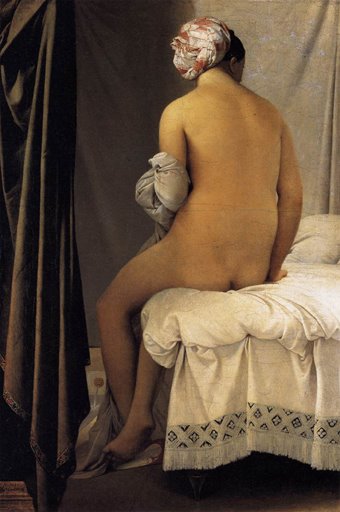
Jean-Auguste-Dominique Ingres (1780-1867) - The Bather, 1808


Language is a skin: I rub my language against the other. It is as if I had words instead of fingers, or fingers at the tip of my words. My language trembles with desire.

Roland Barthes

Nakedness reveals itself. Nudity is placed on display. The nude is condemned to never being naked. Nudity is a form of dress.

John Berger

Just because we're sisters under the skin doesn't mean we've got much in common.

Angela Carter


Resources

Ingres' Character and Personality (Grove Art Online):

Ingres was the staunchest, most conservative defender of the classical tradition, preaching an inflexible, if sometimes contradictory, doctrine of ideal beauty and the absolute supremacy of line and pure form over colour and emotion. He described himself as generally affable but with a ‘white hot’ temper if he felt himself wronged. His personality, like his art, was marked by a preference for the order of a familiar universe. He adjusted slowly to changes in daily habits and remained the worst sort of provincial traveller, comparing everything that was new to him unfavourably with the home equivalent.

According to Charles Blanc, Ingres’s friend and biographer, ‘Here was a man for whom invention was painful, but who bent his faults by a prodigious love of the beautiful’. In times of stress, Ingres was likely to react with a whole variety of physical symptoms, for example boils and atrocious headaches during the last few months of 1833, while he was working on the Apotheosis of Homer. There were times, however, when the pleasures of work were sweeter than ever before: ‘Every day I am shut away in my studio from morning to night. I am love struck by painting, I don’t possess it, it possesses me’. He was not at all the 19th-century bohemian artist; he loved every bourgeois comfort and expected his wife to look after his domestic needs.

In a letter of 7 July 1862 to Hippolyte Fockedey Victor Mettez described ‘le Père Ingres’ as ‘choleric, impatient, obstinate, good, naive, righteous, lazy . . . by moments eloquent and sublime...an incredible mélange’. This ‘mélange’ was echoed in an intimate sketch of Ingres by the composer Charles Gounod: ‘He had an enthusiasm which sometimes approached eloquence. He had the tenderness of a child and the indignations of an apostle. He was naive and sensitive. He was sincerely humble before the great masters, but fiercely proud of his own accomplishments’ (Mémoires d’un artiste, Paris, 1896).

Ingres’s passions for music (Gluck, Haydn, Mozart and Beethoven), for literature (Plutarch, Virgil, Homer, Shakespeare, Dante and Vasari) and the visual arts (Raphael and Michelangelo) were deep and lifelong. His friends were friends for life, unless they crossed him, and nothing pleased him more than his favourite music in the company of a select circle of friends. As a student, he was seen as too serious, intolerant of the usual studio antics; as a teacher, although he often acted as a father figure to his favourite students, he brooked no opposition: ‘Discussion was, unfortunately, not possible with M. Ingres’. And M. Ingres he remained, even to his family and closest friends.


More images by this artist can be accessed at:

http://www.wga.hu/index1.html


Reading:

Ways of Seeing - John Berger

The Female Nude - Linda Nead

Visual and Other Pleasures - Laura Mulvey