Showing posts with label Barthes. Show all posts

Saturday, May 31, 2008

The (Dis)enchantments Of Love


Barbara Kruger (b. 1945) - Untitled (under the skin, thin skin, skin deep, thick skin, skin tight, skinned alive), 2003


1. Language is a skin: I rub my language against the other. It is as if I had words instead of fingers, or fingers at the tip of my words. My language trembles with desire.

2. Discredited by modern opinion, love's sentimentality must be assumed by the amorous subject as a powerful transgression which leaves him alone and exposed; by a reversal of values, then, it is this sentimentality which today constitutes love's obscenity.

Roland Barthes


Musique Du Jour: I've Got You Under My Skin, The Sun Spots and This Is Not A Love Song, Nouvelle Vague


Tuesday, April 24, 2007

Déjà Lu


Gregory Crewdson (b. 1962) - Untitled (from the series 'Twilight'), 2001


'Literature is the question minus the answer.'

Roland Barthes

Saturday, March 31, 2007

The Brotherhood Of Men And Cabbages


Giuseppe Arcimboldo (1527-93) - Vertumnus, c. 1590-1


'[Arcimboldo] imposes a system of substitution (an apple comes to stand for a cheek, as in a coded message...), and, in the same way, a system of transposition (the whole figure is somehow drawn back toward the detail). However, and this is Arcimboldo's peculiarity, what is remarkable about the composite heads is that the picture hesitates between coding and decoding: even when we have displaced the screen of substitution and of transposition in order to perceive the head composed as an effect, our eyes retain the tracery of the first meanings which have served to produce this effect.'

From 'Arcimboldo or Magician and Rhétoriqueur' (in The Responsibility of Forms) by Roland Barthes

Tuesday, February 27, 2007

Somewhere Between Certainty And Oblivion


Roland Barthes (1915-1980)


'The Photograph does not necessarily say what is no longer, but only and for certain what has been. This distinction is decisive. In front of a photograph, our consciousness does not necessarily take the nostalgic path of memory (how many photographs are outside of individual time), but for every photograph existing in the world, the path of certainty: the Photograph's essence is to ratify what it presents. One day I received from a photographer a picture of myself [not the one shown above, by the way] which I could not remember being taken, for all my efforts; I inspected the tie, the sweater, to discover in what circumstances I had worn them; to no avail. And yet, because it was a photograph I could not deny that I had been there (even if I did not know where). This distinction between certainty and oblivion gave me a kind of vertigo, something of a detective "anguish" (the theme of Blow-Up was not far off); I went on to the photographer's show as to a police investigation, to learn at last what I no longer knew about myself.'

From Camera Lucida by Roland Barthes

Saturday, January 13, 2007

You Still Lookin' At Me?


Vincent van Gogh
(1853-1890). The most recently discovered portrait photograph of Vincent van Gogh, found in the collection of his cousin, Anton Mauve. Research suggests that it was taken when Vincent was working in Goupil's in The Hague, so he would have been between sixteen and twenty years of age.


"The noeme of Photography is simple, banal; no depth: "that has been". I know our critics: What! a whole book (even a short one) to discover something I know at first glance? Yes, but such evidence can be a sibling of madness. The Photograph is an extended, loaded evidence - as if it caricatured not the figure of what it represents (quite the converse) but its very existence, The image, says phenomenology, is an object-as-nothing. Now, in the Photograph, what I posit is not only the absence of the object; it is also, by one and the same movement, on equal terms, the fact that this object has indeed existed and that it has been there where I see it. Here is where the madness is, for until this day no representation could assure me of the past of a thing except my intermediaries; but with the Photograph, my certainty is immediate: no one in the world can undeceive me. The Photograph then becomes a bizarre medium, a new form of hallucination: false on the level of perception, true on the level of time: a temporal hallucination, so to speak, a modest, shared hallucination (on the one hand "it is not there", on the other "but it has indeed been"): a mad image chafed by reality."

Roland Barthes

"'But I don't want to go among mad people, ' Alice remarked.
'Oh, you can't help that,' said the Cat. 'We're all mad here. I'm mad. You're mad.'
'How do you know I'm mad?' said Alice.
'You must be,' said the Cat, 'or you wouldn't have come here.'"

Lewis Carroll

"In a completely sane world, madness is the only freedom!"

J. G. Ballard

"The extreme limit of wisdom, that's what the public calls madness."

Jean Cocteau

"Psychoanalysis can unravel some of the forms of madness; it remains a stranger to the sovereign enterprise of unreason. It can neither limit nor transcribe, nor most certainly explain, what is essential in this enterprise."

Michel Foucault

Monday, October 16, 2006

Flesh And Fantasy: Part One


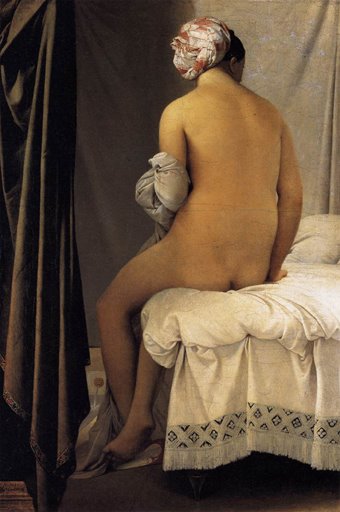
Jean-Auguste-Dominique Ingres (1780-1867) - The Bather, 1808


Language is a skin: I rub my language against the other. It is as if I had words instead of fingers, or fingers at the tip of my words. My language trembles with desire.

Roland Barthes

Nakedness reveals itself. Nudity is placed on display. The nude is condemned to never being naked. Nudity is a form of dress.

John Berger

Just because we're sisters under the skin doesn't mean we've got much in common.

Angela Carter


Resources

Ingres' Character and Personality (Grove Art Online):

Ingres was the staunchest, most conservative defender of the classical tradition, preaching an inflexible, if sometimes contradictory, doctrine of ideal beauty and the absolute supremacy of line and pure form over colour and emotion. He described himself as generally affable but with a ‘white hot’ temper if he felt himself wronged. His personality, like his art, was marked by a preference for the order of a familiar universe. He adjusted slowly to changes in daily habits and remained the worst sort of provincial traveller, comparing everything that was new to him unfavourably with the home equivalent.

According to Charles Blanc, Ingres’s friend and biographer, ‘Here was a man for whom invention was painful, but who bent his faults by a prodigious love of the beautiful’. In times of stress, Ingres was likely to react with a whole variety of physical symptoms, for example boils and atrocious headaches during the last few months of 1833, while he was working on the Apotheosis of Homer. There were times, however, when the pleasures of work were sweeter than ever before: ‘Every day I am shut away in my studio from morning to night. I am love struck by painting, I don’t possess it, it possesses me’. He was not at all the 19th-century bohemian artist; he loved every bourgeois comfort and expected his wife to look after his domestic needs.

In a letter of 7 July 1862 to Hippolyte Fockedey Victor Mettez described ‘le Père Ingres’ as ‘choleric, impatient, obstinate, good, naive, righteous, lazy . . . by moments eloquent and sublime...an incredible mélange’. This ‘mélange’ was echoed in an intimate sketch of Ingres by the composer Charles Gounod: ‘He had an enthusiasm which sometimes approached eloquence. He had the tenderness of a child and the indignations of an apostle. He was naive and sensitive. He was sincerely humble before the great masters, but fiercely proud of his own accomplishments’ (Mémoires d’un artiste, Paris, 1896).

Ingres’s passions for music (Gluck, Haydn, Mozart and Beethoven), for literature (Plutarch, Virgil, Homer, Shakespeare, Dante and Vasari) and the visual arts (Raphael and Michelangelo) were deep and lifelong. His friends were friends for life, unless they crossed him, and nothing pleased him more than his favourite music in the company of a select circle of friends. As a student, he was seen as too serious, intolerant of the usual studio antics; as a teacher, although he often acted as a father figure to his favourite students, he brooked no opposition: ‘Discussion was, unfortunately, not possible with M. Ingres’. And M. Ingres he remained, even to his family and closest friends.


More images by this artist can be accessed at:

http://www.wga.hu/index1.html


Reading:

Ways of Seeing - John Berger

The Female Nude - Linda Nead

Visual and Other Pleasures - Laura Mulvey

Sunday, September 24, 2006

When The Void Becomes Eloquent


Roland Barthes
(1915-1980)


'We know now that a text is not a line of words releasing a single 'theological' meaning (the 'message' of the Author-God) but a multidimensional space in which a variety of writings, none of them original, blend and clash. The text is a tissue of quotations drawn from the innumerable centres of culture.'

Roland Barthes (1915-1980), The Death of the Author (1968) [published in Image-Music-Text, 1977]

Admirers of Barthes' essay should also read: What is an Author? - Michel Foucault (1969)


Reading:

The Phenomenology of Perception
- Maurice Merleau-Ponty

The World of Percpetion -
Maurice Merleau-Ponty

Viewing:

King Kong (1933) - d. Merian C. Cooper and Ernest B. Schoedsack