Showing posts with label Foucault. Show all posts

Saturday, June 28, 2008

The Fairest Corpses Of All


Vanessa Beecroft - VB 43.005.te., 200o


This place that Proust slowly, anxiously comes to occupy anew every time he awakens: from that place, as soon as my eyes are open, I can no longer escape. Not that I am nailed down by it, since after all I can not only move, shift, but I can also move it, shift it, change its place. The only thing is this: I cannot move without it. I cannot leave it here where it is, so that I, myself, may go elsewhere; I can hide in the morning under the covers, make myself as small as possible, I can even let myself melt under the sun at the beach - it will always be there. Where I am. It is here, irreparably: it is never elsewhere. My body, it's the opposite of a utopia: that which is never under different skies. It is the absolute place, the little fragment of space where I am, literally, embodied [faire corps].

And what if by chance I lived with it, in a kind of worn familiarity, as with a shadow, or as with those everyday things that ultimately I no longer see, that life had grayed out, like those chimneys, those roofs that line the sky every night in front of my window? Still, every morning: same presence, same wounds. In front of my eyes the same unavoidable images are drawn, imposed by the mirror: thin face, slouching shoulders, myopic gaze, no more hair - not handsome at all. And it is in this ugly shell of my head, in this cage I do not like, that I will have to reveal myself and walk around; through this grill I must speak, look and be looked at; under this skin I will have to rot.

My body: it is the place without recourse to which I am condemned. And actually I think it is against this body (as if to erase it) that all these utopias have come into being. The prestige of utopia - to what does utopia owe its beauty, its marvel? Utopia is a place outside of all places, but it is a place where I will have a body without body, a body that will be beautiful, limpid, transparent, luminous, speedy, colossal in its power, infinite in its duration. Untethered, invisible, protected - always transfigured. It may very well be that the first utopia, the one most deeply rooted in the hearts of men, is precisely the utopia of an incorporeal body.

Michel Foucault


Musique Du Jour: Model, Alexander Balanescu Quartet (Kraftwerk)

Wednesday, January 24, 2007

The Revolting Body


Egon Schiele (1890-1918) - Self-Portrait Masturbating, 1911


'The restrictions on masturbation hardly start in Europe until the eighteenth century. Suddenly, a panic-theme appears: an appalling sickness develops in the Western world. Children masturbate. Via the medium of families, though not at their initiative, a system of control of sexuality, an objectivisation of sexuality allied to corporal persecution, is established over the bodies of children. But sexuality, through thus becoming an object of analysis and concern, surveillance and control, engenders at the same time and intensification of each individual's desire, for, in and over his body.

The body thus became the issue of a conflict between parents and children, the child and the instances of control. The revolt of the sexual body is the reverse effect of this encroachment. What is the response on the side of power? An economic (and perhaps also ideological) exploitation of eroticisation, from sun-tan products to pornographic films. Responding precisely to the revolt of the body, we find a new mode of investment which presents itself no longer in the form of control by repression but that of control by stimulation. 'Get undressed - be slim, good-looking, tanned!' For each move by the adversary, there is an answering one by the other.'

From Body/Power, an interview with Michel Foucault.

'Have adults forgotten how they themselves were incited and aroused by sex impulses as children? Have they forgotten how the frightful passion burned and tortured them while they were still children? I have not forgotten, for I suffered excruciatingly from it.'

Egon Schiele

Saturday, January 13, 2007

You Still Lookin' At Me?


Vincent van Gogh
(1853-1890). The most recently discovered portrait photograph of Vincent van Gogh, found in the collection of his cousin, Anton Mauve. Research suggests that it was taken when Vincent was working in Goupil's in The Hague, so he would have been between sixteen and twenty years of age.


"The noeme of Photography is simple, banal; no depth: "that has been". I know our critics: What! a whole book (even a short one) to discover something I know at first glance? Yes, but such evidence can be a sibling of madness. The Photograph is an extended, loaded evidence - as if it caricatured not the figure of what it represents (quite the converse) but its very existence, The image, says phenomenology, is an object-as-nothing. Now, in the Photograph, what I posit is not only the absence of the object; it is also, by one and the same movement, on equal terms, the fact that this object has indeed existed and that it has been there where I see it. Here is where the madness is, for until this day no representation could assure me of the past of a thing except my intermediaries; but with the Photograph, my certainty is immediate: no one in the world can undeceive me. The Photograph then becomes a bizarre medium, a new form of hallucination: false on the level of perception, true on the level of time: a temporal hallucination, so to speak, a modest, shared hallucination (on the one hand "it is not there", on the other "but it has indeed been"): a mad image chafed by reality."

Roland Barthes

"'But I don't want to go among mad people, ' Alice remarked.
'Oh, you can't help that,' said the Cat. 'We're all mad here. I'm mad. You're mad.'
'How do you know I'm mad?' said Alice.
'You must be,' said the Cat, 'or you wouldn't have come here.'"

Lewis Carroll

"In a completely sane world, madness is the only freedom!"

J. G. Ballard

"The extreme limit of wisdom, that's what the public calls madness."

Jean Cocteau

"Psychoanalysis can unravel some of the forms of madness; it remains a stranger to the sovereign enterprise of unreason. It can neither limit nor transcribe, nor most certainly explain, what is essential in this enterprise."

Michel Foucault

Wednesday, November 22, 2006

The Author Has Left The Text


Erica Baum - Mr. 5 17 37 (2004)

1. “To this day, the “author” remains an open question…”

2. “Beckett supplies a direction: “What matter who’s speaking, someone said, what matter who’s speaking.” . . . [Writing] as an ongoing process [that] slights our customary attention to the finished product . . . [The] writing of our day has freed itself from the necessity of expression”; it only refers to itself, yet it is not restricted to the confines of interiority. On the contrary, we recognise it in its exterior deployment. This reversal transforms writing into an interplay of signs, regulated less by the content it signifies than by the very nature of the signifier. Moreover, it implies an action that is always testing the limits of its regularity, transgressing and reversing an order that it accepts and manipulates. Writing unfolds like a game that inevitably moves beyond its own rules and finally leaves them behind. Thus, the essential basis of this writing is not the exalted emotions related to the act of composition or the insertion of the subject into language. Rather, it is primarily concerned with creating an opening where the writing subject endlessly disappears.”

3. “Writing is now linked to sacrifice and to the sacrifice of life itself; it is a voluntary obliteration of the self that does not require representation in books because it takes place in the everyday existence of the writer. Where a work had the duty of creating immortality, it now attains the right to kill, to become the murderer of its author. . . If we wish to know the writer in our day, it will be through the singularity of his absence and in his links to death, which has transformed him into a victim of his own writing.”

4. “It is obviously insufficient to repeat empty slogans: the author has disappeared; God and man died a common death. Rather, we should re-examine the empty space left by the author’s disappearance; we should attentively observe, along its gaps and fault lines, its new demarcations, and the reapportionment of this void; we should await the fluid functions released by this disappearance.”

5. “Yet - and it is here that the specific difficulties attending the author’s name appear - the link between a proper name and the individual being named and the link between an author’s name and that which it names are not isomorphous and do not function in the same way; and these differences require clarification . . .

Its presence is functional in that it serves as a means of classification. A name can group together a number of texts and thus differentiate them from others. A name also establishes different forms of relationship among texts . . . Finally, the author’s name characterises a particular manner of existence of discourse. Discourse that possesses an author’s name is not to be immediately consumed and forgotten; neither is it accorded the momentary attention given to ordinary, fleeting words. Rather, this status and its manner of reception are regulated by the culture in which it circulates.

We can conclude that, unlike a proper name, which moves from the interior of a discourse to the real person outside who produced it, the name of the author, defining their form, and characterising their mode of existence. It points to the existence of certain groups of discourse and refers to the status of this discourse within a society and culture. The author’s name is not a function of a man’s civil status, nor is it fictional; it is situated in the breach, among the discontinuities, which give rise to new groups of discourse and their singular mode of existence. Consequently, we can say that in our culture, the name of the author is a variable that accompanies only certain texts to the exclusion of others . . . In this sense, the function of an author is to characterise the existence, circulation, and operation of certain discourses within society.”

6. “In dealing with the “author” as a function of discourse, we must consider the characteristics of a discourse that support this use and determine its difference from other discourses.

First, they are the objects of appropriation; the form of property they have become is of a particular type whose legal codification was accomplished some years ago.

Secondly, the “author-function” is not universal or constant in all discourse.

The third point concerning this “author-function” is that it is not formed spontaneously through the simple attribution of an individual. It results from a complex operation whose purpose is to construct the rational entity we can call an author. Undoubtedly, this construction is assigned a “realistic” dimension as we speak of an individual’s “profundity” or “creative” power, his intentions or the original inspiration manifested in the writing. Nevertheless, these aspects of an individual, which we designate as an author (or which comprise an individual as an author), are projections, in terms always more or less psychological, of our way of handling texts: in the comparisons we make, the traits we extract as pertinent, the continuities we assign, or the exclusions we practice. In addition, all these operations vary according to the period and the form of discourse concerned.”

7. “The author explains the presence of certain events within a text, as well as their transformations, distortions, and their various modifications (and this through an author’s biography or by reference to his particular point of view, in the analysis of his social preferences and his position within a class or by delineating his fundamental objectives). The author also constitutes a principle of unity in writing where any unevenness of production is ascribed to changes caused by evolution, maturation, or outside influence. In addition, the author serves to neutralise the contradictions that are found in a series of texts. Governing this function is the belief that there must be - at a particular level of an author’s thought, of his conscious or unconscious desire - a point where contradictions are resolved, where the incompatible elements can be shown to relate to one another or to cohere around a fundamental; and originating contradiction. Finally, the author is a particular sources of expression who, in more or less finished forms, is manifested equally well, and with similar validity, in a text, in letters, fragments, drafts, and so forth.”

8. “However, it would be false to consider the function of the author as a pure and simple reconstruction after the fact of a text given as passive material, since a text always bears a number of signs that refer to the author. . .

[All] discourse that supports this “author-function” is characterised by this plurality of egos.”

9. [The] “author-function” is tied to the legal and institutional systems that circumscribe, determine, and articulate the realm of discourses; it does not operate in a uniform manner in all discourses, at all times, and in any given culture; it is not defined by the spontaneous attribution of a text to its creator, but through a series of precise and complex procedures; it does not refer, purely and simply, to an actual individual insofar as it simultaneously gives rise to a variety of egos and to a series of subjective positions that individuals of any class may come to occupy.”

10. “[There] undoubtedly exist specific discursive properties or relationships that are irreducible to the rules of grammar and logic and to the laws that govern objects. These properties require investigation if we hope to distinguish the larger categories of discourse. The different forms of relationship (or nonrelationships) that an author can assume are evidently one of these discursive properties.

This form of investigation might also permit the introduction of an historical analysis of discourse. Perhaps the time has come to study not only the expressive value and formal transformations of discourse, but its mode of existence: the modifications and variations, within any culture, of modes of circulation, valorisation, attribution and appropriation. Partially at the expense of themes and concepts that an author places in his work, the “author-function” could also reveal the manner in which discourse is articulated on the basis of social relationships.

Is it not possible to re-examine, as a legitimate extension of this kind of analysis, the privileges of the subject? Clearly, in undertaking an internal and architectonic analysis of a work (whether it be a literary text, a philosophical system, or a scientific work) and in delimiting psychological and biographical references, suspicions arise concerning the absolute nature and creative role of the subject. But the subject should not be entirely abandoned. It should be reconsidered, not to restore the theme of an originating subject, but to seize its functions, its interventions in discourse, and its system of dependencies. We should suspend the typical questions: how does a free subject penetrate the density of things and endow them with meaning; how does it accomplish its design by animating the rules of discourse from within? Rather, we should ask: under what conditions and through what forms can an entity like the subject appear in the course of discourse; what position does it occupy; what functions does it exhibit; and what rules does it follow in each type of discourse? In short, the subject (and its substitutes) must be stripped of its creative role and analysed as a complex and variable function of discourse.

The author - or what I have called the “author-function” - is undoubtedly only one of the possible specifications of the subject and, considering past historical transformations, it appears that the form, complexity, and even the existence of this function are far from immutable. We can easily imagine a culture where discourse would circulate without any need for an author. Discourses, whatever their status, form, or value, and regardless of our manner of handling them, would unfold in a pervasive anonymity.”

From What is an Author? by Michel Foucault.

Tuesday, October 17, 2006

Flesh And Fantasy: Part Two


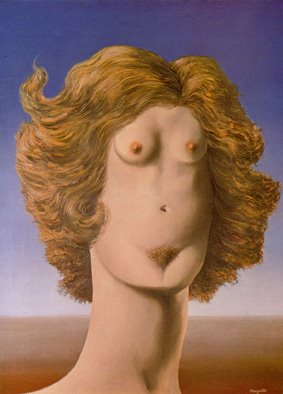
Rene Magritte - The Rape (1934)


"Everything we see hides another thing, we always want to see what is hidden by what we see."

Rene Magritte

"This book [The Order of Things] first arose out of a passage in Borges, out of the laughter that shattered, as I read the passage, all the familiar landmarks of my thought - our thought, the thought that bears the stamp of our age and our geography - breaking up all the ordered surfaces and all the planes with which we are accustomed to tame the wild profusion of existing things...This passage quotes 'a certain Chinese encyclopaedia' in which it is written that 'animals are divided into: (a) belonging to the emperor, (b) embalmed, (c) tame, (d) sucking pigs, (e) sirens, (f) fabulous, (g) stray dogs, (h) included in the present classification, (i) frenzied, (j) innumerable, (k) drawn with a very fine camelhair brush, (l) et cetera, (m) having just broken the water pitcher, (n) that from a long way off look like flies'. In the wonderment of this taxonomy, the thing that...is demonstrated as the exotic charm of another system of thought, is the limitation of our own, the stark impossibility of thinking that."

Michel Foucault

"Never lose sight of the fact that all human felicity lies in man's imagination, and that he cannot think to attain it unless he heeds all his caprices. The most fortunate of persons is he who has the most means to satisfy his vagaries."

Marquis de Sade

Monday, October 09, 2006

Portrait Of The Artist As An Ageing Imbecile


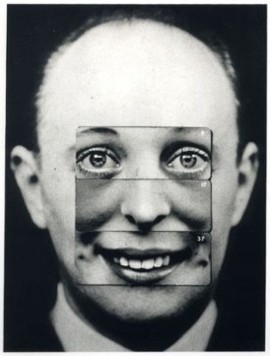
Andy Warhol - Self Portrait (1986)


"Stupidity is contemplated: sight penetrates its domain and becomes fascinated; it carries one gently along and its action is mimed in the abandonment of oneself; we support ourselves upon its amorphous fluidity; we await the first leap of an imperceptible difference, and blankly, without fever, we watch to see the glimmer of light return. Error demands rejection - we can erase it; we accept stupidity - we see it, we repeat it, and softly, we call for total immersion.

This is the greatness of Warhol with his canned foods, senseless accidents, and his series of advertising smiles."

From Language, Counter-Memory, Practice by Michel Foucault

Tuesday, October 03, 2006

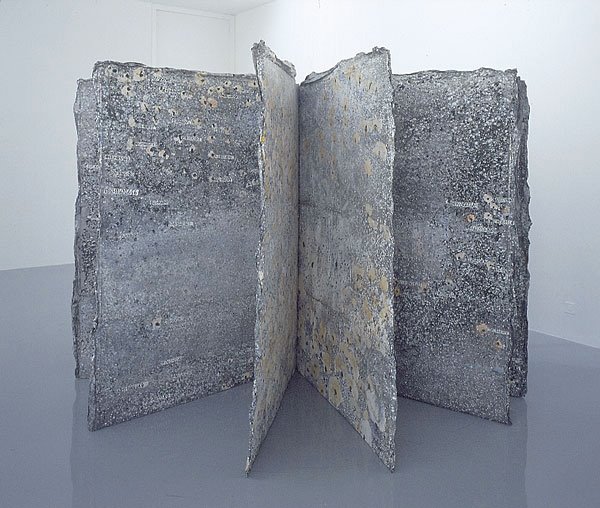
What Is A Book?


Anselm Kiefer - The Secret Life of Plants (2002)


"What, in short, is the strange unit designated by the term, work? What is necessary to its composition, if a work is not something written by a person called an "author"?...If an individual is not an author, what are we to make of those things he has written or said, left among his papers or communicated to others? Is this not properly a work? What, for instance, were Sade's papers before he was consecrated as an author? Little more, perhaps, than roles of paper on which he endlessly unravelled his fantasies while in prison.

Assuming we are dealing with an author, is everything he wrote and said, everything he left behind, to be included in his work?...If we wish to publish the complete works of Nietzsche, for example, where do we draw the line? Certainly everything must be published, but can we agree on what "everything" means? We will, of course, include everything that Nietzsche himself published, along with the drafts of his works, his plans for aphorisms, his marginal notations and corrections. But what if, in a notebook filled with aphorisms, we find a reference, a reminder of an appointment, an address, or a laundry bill, should this be included in his works? Why not?...Such questions only begin to suggest the range of our difficulties, and, if some have found it convenient to bypass the individuality of the writer or his status as an author to concentrate on a work, they have failed to appreciate the equally problematic nature of the word "work" and the unity it designates."

From What is an Author? by Michel Foucault