Showing posts with label Gott. Show all posts

Friday, November 17, 2006

The Monster's Bride: Part Three


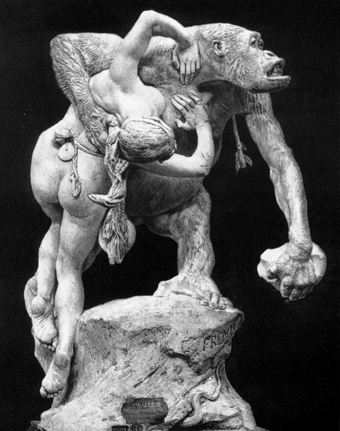
Emmanuel Frémiet - Gorille enlevant une negresse (1887)

"After his involvement with the Museum d'histoire naturelle, Frémiet was surely familiar with the research of Jacques Boucher de Perthes (1788-1868). In the successive volumes of his Antiquites Celtiques et Antediluviennes (1847, 1857 and 1863), Boucher de Perthes argued that the peculiarly shaped stones he had found among the bones of extinct mammals in the Abbeville region of France were actually primitive cutting and hunting implements fashioned by antediluvian peoples. At the time of their first publication, his theories were ridiculed by many, since they did not concur with the Christian Church's religious notions of the beginnings of mankind dating no earlier than 4000 BC. By 1887, however, Boucher de Perthes' discoveries were thoroughly vindicated. It is interesting to consider whether the ape's possession of a chiselled cutting tool in Frémiet’s Gorilla Carrying off a Woman depicts a pure gorilla or an ape that has evolved in intelligence one step towards the human condition. Certainly, the critics of the day were divided as to whether his new work promoted or argued against Darwinian theory.

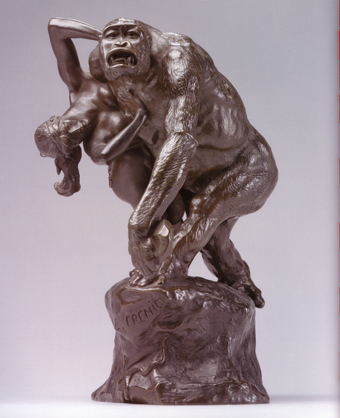
In 1887, the state authorities were faced with acknowledging the celebrity of Frémiet’s life-size plaster and immediately acquired it; yet they were also confronted by its highly controversial subject matter. Frémiet himself had written to the chief arts administrator of the day, pleading that 'with your dual interest in the fine arts and in science, it is to be hoped that you will decide to acquire my sculpture, which really belongs in the Museum d'histoire naturelle'. This was not to be and despite Frémiet’s many entreaties, the work was stowed away until 1895 when it was consigned to the Musee des Beaux-Arts de Nantes, where it remains today. The sculptor was able to bring the work back to Paris briefly some years later, when he received a commission from an American collector for a life-size bronze to be cast from it. This enabled the sculpture to be once again exhibited to a huge audience, at the Exposition Universelle of 1900.

Its exile in Nantes failed to make Frémiet’s composition disappear as he had permission from the French State to edition bronze versions of the work in a reduced size, and these proved to be highly popular collectables. The ambiguous but compelling Gorilla Carrying off a Woman was also reproduced widely, by both engraving and photography. By all these means, Frémiet’s sculpture entered the public consciousness as one of the defining images of the time."

From Clutch of the Beast by Ted Gott

Thursday, November 16, 2006

The Monster's Bride: Part Two


Emmanuel Frémiet - Gorille enlevant une negresse (1887)

"The 'Gorilla wars' of the 1860s and the entire weight of evolutionary debate attendant upon the theories of Darwin, Huxley and others lay behind Emmanuel Frémiet’s decision to revisit the gorilla in 1887. As Bartlett recounted in 1891:


Always seeing a plaster cast of a gorilla at the Garden [the Jardin des Plantes of the Museum] and regretting the destruction of the one he had made in 1859, decided Frémiet to make another group of the same subject, but differently and more compactly treated. Its appearance in the Salon of 1887 created an immense sensation and, as usual, a wide division of opinion. The few best artists and art lovers pronounced it, independent of subject, a great masterpiece, while many wholly condemned it, because of its subject.

Frémiet’s life and career had also changed significantly in the three decades that lay between his first and second versions of the Gorilla. From the 1860s Frémiet had become fascinated with creating meticulously accurate reconstructions of the appearance and armour of military figures from Roman times to the Middle Ages. His St George and the Dragon 1891, for example, casts the Christian saint in the guise of a medieval warrior, whose armour is based on actual examples of the period that the artist studied in France's Imperial Army Museum. A deep interest in the sciences of prehistoric archaeology and palaeontology also ran alongside Frémiet’s fascination for medieval reconstructions, leading him to create a number of sculptures depicting the struggles of Stone Age peoples. In July 1875, a month after the death of the esteemed animalier sculptor Antoine-Louis Barye, Frémiet was named as Barye's replacement to the post of Master of Zoological Drawing at the Museum d'histoire naturelle.

When Frémiet created the 1887 version of the life-size Gorille enlevant une femme (Gorilla carrying off a woman), it carried the same power to shock audiences as its predecessor of 1859. The immediacy and solidity of its depiction of a wounded primate locked in mortal combat with a living, struggling woman was far removed from the passivity of even the best taxidermists' efforts then on display in the world's museums. While gorillas had by now become familiarised within both scientific and public discourse, living specimens of the great ape were still highly prized and exotic items for those zoos lucky enough to possess one. The life-size Gorilla carrying off a woman was another controversial triumph for Frémiet, who had last received a medal at the Salon in 1851. He now carried off the Salon's coveted prize, the Medal of Honour.


Whereas the 1859 sculpture had depicted a female gorilla dragging away an arguably 'naturally selected' dead trophy, Frémiet upped the ante in 1887. The woman was now Caucasian and very much alive, even presaging an art nouveau nymph in her curvaceous struggle with a visibly male primate. Frémiet no longer made his viewers play mute witness to the triumphant swagger of a murderous beast, but took them right into the heart of a much more ambiguous battle, set in the Stone Age.

The 1887 sculpture further muddied the waters by alluding to controversial new archaeological discoveries. Rather than being an innocent victim, the woman wears part of a gorilla's jawbone as a hair adornment, indicating her status as a Stone Age predator. She is part of a prehistoric hunting party that has been attacking the gorilla as edible prey. Moreover, it is her companions at whom the beast grimaces and snarls - those who have hurled the lance that pierces the left shoulder of the gorilla. The chiselled rock which the ape grabs in self-defence might well have belonged to his attackers, for it resembles a cutting tool from the Palaeolithic era."

From Clutch of the Beast by Ted Gott

Wednesday, November 15, 2006

The Monster's Bride: Part One


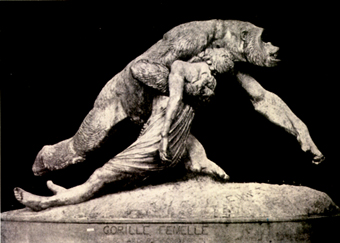
Emmanuel Frémiet - Gorille enlevant une negresse (1859)

"In 1859, the French sculptor Emmanuel Frémiet (1824-1910) alarmed the jury of the Paris Salon by submitting a greater than life-size plaster composition, Gorille enlevant une negresse (Gorilla Carrying off a Negress). The jury found it to be too confronting for both its graphic violence and for its proximity to current debates about evolution. In that same year, Charles Darwin had published On the Origin of Species by Means of Natural Selection, a work that acted as a flashpoint for evolutionary theory. For decades prior to the appearance of Darwin's landmark text, scientists and theologians struggled to reconcile a barrage of new discoveries in the fields of archaeology, geology and comparative anatomy with traditionally held beliefs concerning the world's and humanity's creation.

By 1859 Frémiet had already established a national and international reputation as a master sculptor. He had caught the imagination of visitors to the annual Paris Salon in 1843 with his life-size plaster sculptures of both wild and domestic animals that were astonishing for their faithfulness to nature and lifelike qualities. Frémiet’s three-dimensional evocations of domestic pets proved especially popular in his early career, bringing him increasing critical acclaim and the financial reward of official patronage. He seemed, however, to have seriously blotted his copybook with the Gorilla Carrying off a Negress, at least in the eyes of the more conservative controllers of the art world. Frémiet himself recalled:


At a time when a lot of noise was being made about mankind and apes being brothers, it was an audacious idea; and my work proved even more aggravating since, the gorilla being the ugliest of all the primates, the comparison was hardly flattering for humans ... The jury's condemnation was unanimous. My work was declared to be seriously offensive to public morality, and it was banished pitilessly from the Salon.

Alfred, Comte de Nieuwerkerke, the chief arts administrator, quickly intervened and a place was found for the artist's sculpture, despite its official rejection from the items accepted into the Salon proper. The Gorilla was installed towards the entrance of the Salon's sculpture section, set back in a niche behind heavy green velvet curtains. While the conservative jury surely hoped to marginalise the work, this special treatment - or maltreatment - served only to create a cause celebre around Frémiet's sculpture. Parting these curtains to obtain a glimpse of the censored work became de rigueur for adult visitors to that year's Salon. According to the artist, women were especially titillated by the piece, whose composition was certainly confronting. The sculpture not only depicted a murder, but also seemed to allude to ravishment, visualising the worst fears of many about the planet's largest and most human-seeming primate. Reading the sculpture in this way, the critic Charles Baudelaire took exception to its subject matter:


Why are we not given a crocodile, a tiger, or any other wild animal that might eat a woman? Because this is not about eating, but rape! It is the ape alone, this gigantic ape at once so much more and less than a man, which has at times shown a human appetite for women ... To be honest, such subjects are beneath the dignity of so talented an artist, and the jury has done well to reject this sordid topic.

It is perhaps not surprising that Gorilla Carrying off a Negress, which was destroyed in 1861 and is now known only from a handful of photographs, was disturbing to viewers in 1859. The gorilla itself was still a newly discovered and much misunderstood species, and this added scientific and speculative weight to the frisson produced by Frémiet's sculpture."

From Clutch of the Beast by Ted Gott