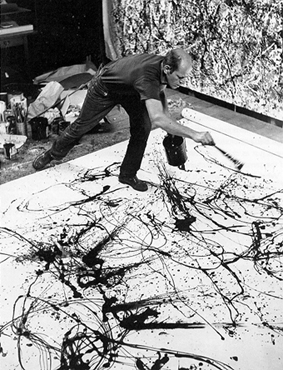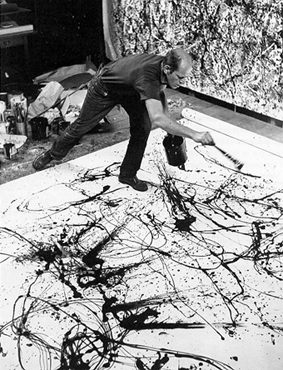
Jackson Pollock in his studio (1950) - p. Hans Namuth
"When I am in my painting, I'm not aware of what I'm doing. It's only after a sort of 'get acquainted' period that I see what I have been about...It is only when I lose contact with the painting that the result is a mess. Otherwise there is pure harmony, an easy give and take, and the painting comes out well."
Jackson Pollock
"Modern painting is the first complex style in history which proceeds from elements that are not pre-ordered as closed articulated shapes. The artist today creates an order out of unordered variable elements to a degree greater than the artist of the past.
In ancient art an image of two animals facing each other orders symmetrically bodies that in nature are already closed symmetrical forms. The modern artist, on the contrary, is attracted to those possibilities of form which include a considerable randomness, variability and disorder, whether he finds them in the world or while improvising with his brush, or in looking at spots and marks, or in playing freely with shapes - inverting, adjusting, cutting, varying, reshaping, regrouping, so as to maximise the appearance of randomness. His goal is often an order which retains a decided quality of randomness as far as this is compatible with an ultimate unity of the whole. That randomness corresponds in turn to a feeling of freedom, an unconstrained activity at every point.
Ignoring natural shapes, he is alert to qualities of movement, interplay, change and becoming in nature. And he provokes within himself, in his spontaneous motions and play, an automatic production of chance."
From Recent Abstract Painting (1957) by Meyer Schapiro
"[The] drip paintings are clearly implicated in a whole informing metaphoric of masculinity: the very concepts that seem immediately to apply to them - space, scale, action, trace, energy, 'organic intensity', 'being in the painting', being 'One' - are all, among other things, operators of sexual difference."
From Jackson Pollock's Abstraction by T. J. Clark
"The catalyst that brought to a head Pollock's self-consciousness of his masquerade was the film Hans Namuth made of the artist at work in the late summer and fall of 1950...After the completion of the painting-on-glass scene, Pollock, who had been sober for more than two years, walked into the house and poured himself a large drink. At the dinner that followed, a drunken Pollock repeatedly shouted at Namuth, "I'm not a phony, you're a phony," before overturning the dinner table. He never got back on the wagon; the drip paintings, and his career, were effectively over."
From
Pollock and Postwar Masculinity by
Andrew PerchukReading:This is My Body - Jan Avgikos
'Her Dress Hangs Here': De-frocking the Kahlo Cult - Oriana Badderley
Theory and Art Criticism - Terry Barrett
Of Sculpture and Painting - David Bachelor
Gauguin's Tahitian Body - Peter Brooks
New Encounters with Les Demoiselles d'Avignon: Gender, Race and the Origins of Cubism - Anna C. Chave
Gauguin: On Primitivism (in
Theories of Modern Art) - Herschel B. Chipp (ed.)
Going Native: Paul Gauguin and the Invention of Primitivist Modernism - Abigail Solomon-Godeau
Modernist Painting - Clement Greenberg
Culture, Politics and Identity in the Paintings of Frida Kahlo - Janice Helland
By Design: The Early Work of Hannah Hoch in Context - Maria Makela
Notes on Sculpture, Part 2 - Robert Morris
The Imaginary Orient - Linda Nochlin
Pollock and Postwar Masculinity - Andrew Perchuk
Picasso in the Light of a Marxist Sociology of Art - Max Raphael
Picasso and Braque: 1909-1911 - Robert Rosenblum
Orientalism - Edward Said
Recent Abstract Painting (1957) - Meyer Schapiro
Beautiful Beasts: The Call of the Wild (in
Managing Monsters: Six Myths of Our Time) - Marina Warner
Reluctant Brides: Beauty and the Beast I and
Go! Be a Beast: Beauty and the Beast II (in
From the Beast to the Blonde) - Marina Warner
In Purgatory: The Work of Felix Gonzales-Torres - Simon Watney