Showing posts with label Cultural Theory. Show all posts

Wednesday, March 14, 2007

Grim Reapings


Timothy H. O'Sullivan (c. 1840-1882) - The Harvest of Death, July 4th, 1863


'The view proposed in On Photography [Sontag, 1977] - that our capacity to respond to our experiences with emotional freshness and ethical pertinence is being sapped by the relentless diffusion of vulgar and appalling images - might be called the conservative critique of the diffusion of such images.

I call this argument conservative because it is the sense of reality that is eroded. There is still a reality that exists independent of the attempts to weaken its authority. The argument is in fact a defence of reality and the imperilled standards for responding more fully to it.

In the more radical - cynical - spin on this critique, there is nothing to defend: the vast maw of modernity has chewed up reality and spat the whole mess out as images. According to a highly influential analysis, we live in a "society of the spectacle". Each situation has to be turned into a spectacle to be real - that is, interesting - to us. People themselves aspire to becoming images: celebrities. Reality has abdicated. There are only representations: media.

Fancy rhetoric, this. And very persuasive to many, because one of the characteristics of modernity is that people feel they can anticipate their own experience. This view is associated in particular with the writings of the late Guy Debord, who thought he was describing an illusion, a hoax, and Jean Baudrillard, who claims to believe that images, simulated realities, are all that exist now; it seems to be something of a French speciality.) It is common to say that war, like everything else that appears to be real, is médiatique. . . Reports of the death of reality - like the death of reason, the death of the intellectual, the death of serious literature - seem to have been accepted without much reflection by many who are attempting to understand what feels wrong, or empty, or idiotically triumphant in contemporary politics and culture.

To speak of reality becoming a spectacle is a breathtaking provincialism. It universalises the viewing habits of a small, educated population living in the rich part of the world, where news has been converted into entertainment - that mature style of viewing which is a prime acquisition of "the modern", and a prerequisite for dismantling traditional forms of party-based politics that offer real disagreement and debate. It assumes everyone is a spectator. It suggests, perversely, unseriously, that there is no real suffering in the world. But is is absurd to identify the world with these zones in the well-off countries where people have the dubious privilege of being spectators, or of declining to be spectators, of other people's pain, just as it is absurd to generalise about the ability to respond to the suffering of others on the basis of the mind-set of those consumers of news who know nothing at first hand about war and massive injustice and terror. There are hundreds of millions of television viewers who are far from inured to what they see on television. They do not have the luxury of patronising reality.

It has become a cliché of the cosmopolitan discussion of images of atrocity to assume that they have little effect, and that there is something innately cynical about their diffusion. As important as people now believe images of war to be, this does not dispel the suspicion that lingers about the interest in these images, and the intentions of those who produce them. Such a reaction comes from two extremes of the spectrum: from cynics who have never been near a war, and from the war-weary who are enduring the miseries being photographed.

Citizens of modernity, consumers of violence as spectacle, adepts of proximity without risk, are schooled to be cynical about the possibility of sincerity. Some people will do anything to keep themselves from being moved. How much easier, from one's chair, far from danger, to claim the position of superiority.'

From Regarding the Pain of Others by Susan Sontag

Wednesday, January 31, 2007

The Bleeding


André Kertész (1894-1965) - Distortions, c. 1933


'Can it be that in the West, in our time, the female body has been constructed not only as a lack or absence but with more complexity, as a leaking, uncontrollable, seeping liquid; as formless flow; as viscosity, entrapping, secreting; as lacking not so much or simply the phallus but self-containment - not a cracked or porous vessel, like a leaking ship, but a formlessness that engulfs all form, a disorder that threatens all order? I am not suggesting that this is how women are, that this is their ontological status. Instead, my hypothesis is that women's corporeality is inscribed as a mode of seepage. My claim is not that women have been somehow desolidified but the more limited one which sees that women, insofar as they are human, have the same degree of solidity, occupy the same genus, as men, yet insofar as they are women, they are represented and live themselves as seepage, liquidity. The metaphorics of uncontrollability, the ambivalence between desperate, fatal attraction and strong revulsion, deep-seated fear of absorption, the association of femininity with contagion and disorder, and the undecidability of the limits of the female body (particularly, but not only, with the onset of puberty and in the case of pregnancy), its powers of cynical seduction and allure are all common themes in literary and cultural representations of women. But these may well be a function of the projection outward of their corporealities, the liquidities that men seem to want to cast out of their own representations.'

From Volatile Bodies: Toward a Corporeal Feminism by
Elizabeth Grosz.

Wednesday, November 22, 2006

The Author Has Left The Text


Erica Baum - Mr. 5 17 37 (2004)

1. “To this day, the “author” remains an open question…”

2. “Beckett supplies a direction: “What matter who’s speaking, someone said, what matter who’s speaking.” . . . [Writing] as an ongoing process [that] slights our customary attention to the finished product . . . [The] writing of our day has freed itself from the necessity of expression”; it only refers to itself, yet it is not restricted to the confines of interiority. On the contrary, we recognise it in its exterior deployment. This reversal transforms writing into an interplay of signs, regulated less by the content it signifies than by the very nature of the signifier. Moreover, it implies an action that is always testing the limits of its regularity, transgressing and reversing an order that it accepts and manipulates. Writing unfolds like a game that inevitably moves beyond its own rules and finally leaves them behind. Thus, the essential basis of this writing is not the exalted emotions related to the act of composition or the insertion of the subject into language. Rather, it is primarily concerned with creating an opening where the writing subject endlessly disappears.”

3. “Writing is now linked to sacrifice and to the sacrifice of life itself; it is a voluntary obliteration of the self that does not require representation in books because it takes place in the everyday existence of the writer. Where a work had the duty of creating immortality, it now attains the right to kill, to become the murderer of its author. . . If we wish to know the writer in our day, it will be through the singularity of his absence and in his links to death, which has transformed him into a victim of his own writing.”

4. “It is obviously insufficient to repeat empty slogans: the author has disappeared; God and man died a common death. Rather, we should re-examine the empty space left by the author’s disappearance; we should attentively observe, along its gaps and fault lines, its new demarcations, and the reapportionment of this void; we should await the fluid functions released by this disappearance.”

5. “Yet - and it is here that the specific difficulties attending the author’s name appear - the link between a proper name and the individual being named and the link between an author’s name and that which it names are not isomorphous and do not function in the same way; and these differences require clarification . . .

Its presence is functional in that it serves as a means of classification. A name can group together a number of texts and thus differentiate them from others. A name also establishes different forms of relationship among texts . . . Finally, the author’s name characterises a particular manner of existence of discourse. Discourse that possesses an author’s name is not to be immediately consumed and forgotten; neither is it accorded the momentary attention given to ordinary, fleeting words. Rather, this status and its manner of reception are regulated by the culture in which it circulates.

We can conclude that, unlike a proper name, which moves from the interior of a discourse to the real person outside who produced it, the name of the author, defining their form, and characterising their mode of existence. It points to the existence of certain groups of discourse and refers to the status of this discourse within a society and culture. The author’s name is not a function of a man’s civil status, nor is it fictional; it is situated in the breach, among the discontinuities, which give rise to new groups of discourse and their singular mode of existence. Consequently, we can say that in our culture, the name of the author is a variable that accompanies only certain texts to the exclusion of others . . . In this sense, the function of an author is to characterise the existence, circulation, and operation of certain discourses within society.”

6. “In dealing with the “author” as a function of discourse, we must consider the characteristics of a discourse that support this use and determine its difference from other discourses.

First, they are the objects of appropriation; the form of property they have become is of a particular type whose legal codification was accomplished some years ago.

Secondly, the “author-function” is not universal or constant in all discourse.

The third point concerning this “author-function” is that it is not formed spontaneously through the simple attribution of an individual. It results from a complex operation whose purpose is to construct the rational entity we can call an author. Undoubtedly, this construction is assigned a “realistic” dimension as we speak of an individual’s “profundity” or “creative” power, his intentions or the original inspiration manifested in the writing. Nevertheless, these aspects of an individual, which we designate as an author (or which comprise an individual as an author), are projections, in terms always more or less psychological, of our way of handling texts: in the comparisons we make, the traits we extract as pertinent, the continuities we assign, or the exclusions we practice. In addition, all these operations vary according to the period and the form of discourse concerned.”

7. “The author explains the presence of certain events within a text, as well as their transformations, distortions, and their various modifications (and this through an author’s biography or by reference to his particular point of view, in the analysis of his social preferences and his position within a class or by delineating his fundamental objectives). The author also constitutes a principle of unity in writing where any unevenness of production is ascribed to changes caused by evolution, maturation, or outside influence. In addition, the author serves to neutralise the contradictions that are found in a series of texts. Governing this function is the belief that there must be - at a particular level of an author’s thought, of his conscious or unconscious desire - a point where contradictions are resolved, where the incompatible elements can be shown to relate to one another or to cohere around a fundamental; and originating contradiction. Finally, the author is a particular sources of expression who, in more or less finished forms, is manifested equally well, and with similar validity, in a text, in letters, fragments, drafts, and so forth.”

8. “However, it would be false to consider the function of the author as a pure and simple reconstruction after the fact of a text given as passive material, since a text always bears a number of signs that refer to the author. . .

[All] discourse that supports this “author-function” is characterised by this plurality of egos.

9. [The] “author-function” is tied to the legal and institutional systems that circumscribe, determine, and articulate the realm of discourses; it does not operate in a uniform manner in all discourses, at all times, and in any given culture; it is not defined by the spontaneous attribution of a text to its creator, but through a series of precise and complex procedures; it does not refer, purely and simply, to an actual individual insofar as it simultaneously gives rise to a variety of egos and to a series of subjective positions that individuals of any class may come to occupy.”

10. “[There] undoubtedly exist specific discursive properties or relationships that are irreducible to the rules of grammar and logic and to the laws that govern objects. These properties require investigation if we hope to distinguish the larger categories of discourse. The different forms of relationship (or nonrelationships) that an author can assume are evidently one of these discursive properties.

This form of investigation might also permit the introduction of an historical analysis of discourse. Perhaps the time has come to study not only the expressive value and formal transformations of discourse, but its mode of existence: the modifications and variations, within any culture, of modes of circulation, valorisation, attribution and appropriation. Partially at the expense of themes and concepts that an author places in his work, the “author-function” could also reveal the manner in which discourse is articulated on the basis of social relationships.

Is it not possible to re-examine, as a legitimate extension of this kind of analysis, the privileges of the subject? Clearly, in undertaking an internal and architectonic analysis of a work (whether it be a literary text, a philosophical system, or a scientific work) and in delimiting psychological and biographical references, suspicions arise concerning the absolute nature and creative role of the subject. But the subject should not be entirely abandoned. It should be reconsidered, not to restore the theme of an originating subject, but to seize its functions, its interventions in discourse, and its system of dependencies. We should suspend the typical questions: how does a free subject penetrate the density of things and endow them with meaning; how does it accomplish its design by animating the rules of discourse from within? Rather, we should ask: under what conditions and through what forms can an entity like the subject appear in the course of discourse; what position does it occupy; what functions does it exhibit; and what rules does it follow in each type of discourse? In short, the subject (and its substitutes) must be stripped of its creative role and analysed as a complex and variable function of discourse.

The author - or what I have called the “author-function” - is undoubtedly only one of the possible specifications of the subject and, considering past historical transformations, it appears that the form, complexity, and even the existence of this function are far from immutable. We can easily imagine a culture where discourse would circulate without any need for an author. Discourses, whatever their status, form, or value, and regardless of our manner of handling them, would unfold in a pervasive anonymity.”

From What is an Author? by Michel Foucault.

Thursday, October 12, 2006

The Last Days Of The "Idiot Box"?


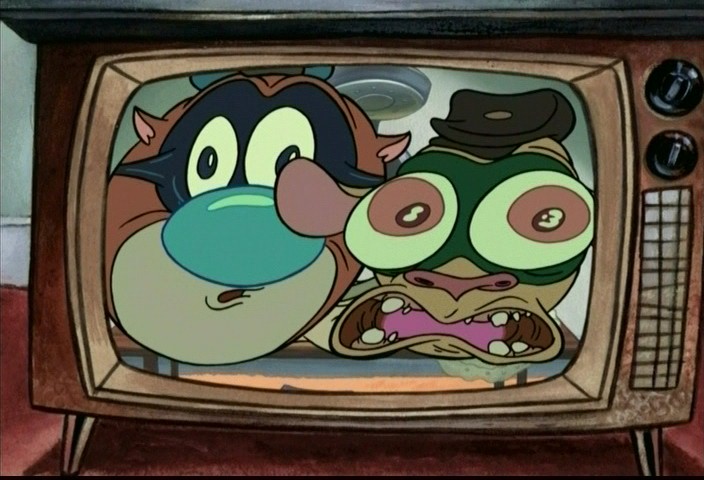
Ren and Stimpy - (from the episode) Altruists!


"The argument, then, is that television produces the conditions of an ironic knowingness, at least as a possibility...[which] may offer a way of thinking subjectivity free of subjection...Most of all, it opens identity to diversity, and escapes the notion of cultural identity as a fixed volume...But if it does all this, it does not do it in that utopia of guaranteed resistance which assumes the progressiveness of naturally oppositional readers who will get it right in the end. It does, rather, with terms hung in suspension. . .tactics of empowerment, games of subordination with neither term fixed in advance."

From Playing at Being American:Game and Tactics by John Caughie (1990)

Tuesday, October 03, 2006

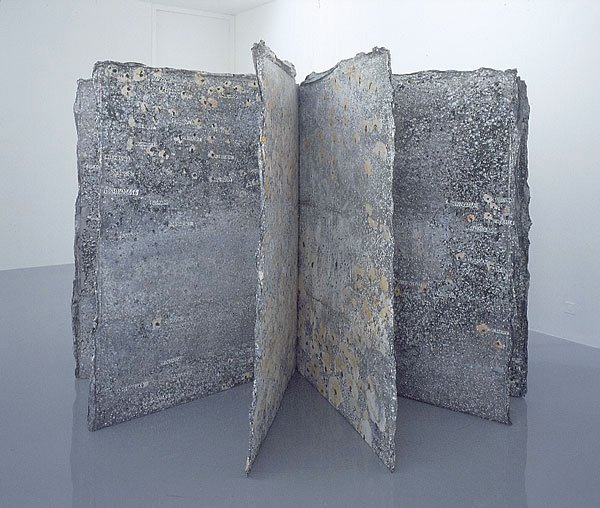
What Is A Book?


Anselm Kiefer - The Secret Life of Plants (2002)


"What, in short, is the strange unit designated by the term, work? What is necessary to its composition, if a work is not something written by a person called an "author"?...If an individual is not an author, what are we to make of those things he has written or said, left among his papers or communicated to others? Is this not properly a work? What, for instance, were Sade's papers before he was consecrated as an author? Little more, perhaps, than roles of paper on which he endlessly unravelled his fantasies while in prison.

Assuming we are dealing with an author, is everything he wrote and said, everything he left behind, to be included in his work?...If we wish to publish the complete works of Nietzsche, for example, where do we draw the line? Certainly everything must be published, but can we agree on what "everything" means? We will, of course, include everything that Nietzsche himself published, along with the drafts of his works, his plans for aphorisms, his marginal notations and corrections. But what if, in a notebook filled with aphorisms, we find a reference, a reminder of an appointment, an address, or a laundry bill, should this be included in his works? Why not?...Such questions only begin to suggest the range of our difficulties, and, if some have found it convenient to bypass the individuality of the writer or his status as an author to concentrate on a work, they have failed to appreciate the equally problematic nature of the word "work" and the unity it designates."

From What is an Author? by Michel Foucault

Sunday, September 24, 2006

When The Void Becomes Eloquent


Roland Barthes
(1915-1980)


'We know now that a text is not a line of words releasing a single 'theological' meaning (the 'message' of the Author-God) but a multidimensional space in which a variety of writings, none of them original, blend and clash. The text is a tissue of quotations drawn from the innumerable centres of culture.'

Roland Barthes (1915-1980), The Death of the Author (1968) [published in Image-Music-Text, 1977]

Admirers of Barthes' essay should also read: What is an Author? - Michel Foucault (1969)


Reading:

The Phenomenology of Perception
- Maurice Merleau-Ponty

The World of Percpetion -
Maurice Merleau-Ponty

Viewing:

King Kong (1933) - d. Merian C. Cooper and Ernest B. Schoedsack