Showing posts with label Ourlser. Show all posts

Wednesday, May 14, 2008

Mastering The Digital Uncanny


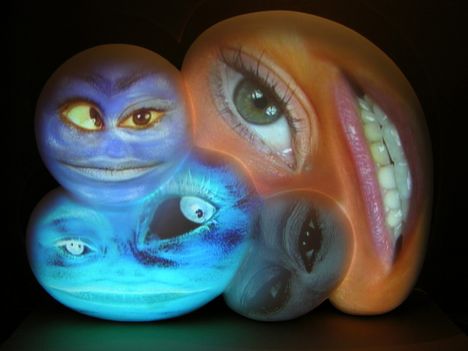
Tony Oursler (b. 1957) - Mansheshe, 1997


Since his exhibition of The Waiting in 1992, Tony Oursler’s work has focused on the video image’s operation in the space and time of performance and encounter, explored in relocations of projected or screened images onto three-dimensional objects, including dummies and mannequins, flowers, spheres and abstract sculptural forms. Overtly theatrical in their negotiation of place, presentation and “projection,” while referencing historical and contemporary spectacle, including phantasmagoria and spiritualist practices, as well as popular reactions to technology, Oursler’s staging of these uncanny presences engages with psychological and perceptual responses to mediatised forms and signs. In the course of this activity, Oursler’s work has come to emphasize the experience and performance of “presence” in ways that depart from the overt displacement of the “authority” of “classical presence” that Chantal Pontbraid influentially identified with “the expression of performance through technical means” in her essay “The Eye Finds No Fixed Point On Which To Rest,” published in Modern Drama in 1982. Indeed, in its engagement with the performance of presence through media, Oursler’s work can also be seen to defer in significant ways from the critique of presence that, in his book Presence and Resistance (1992), Phillip Auslander, after Pontbraid, identified with the cultural politics of contemporary, media-based performance practices. By contrast, Oursler’s hybrid objects are designed to prompt processes of empathy and catharsis, frequently taking their effect in the viewer’s recognition of and identification with a “media entity” whose perceived “presence” may challenge the integrity and stability of the onlooker’s position.

Nick Kaye

The space after the light leaves the monitor; where life begins and the machine ends - the living rooms and bedrooms where the bodies are - these are the interesting spaces.

Tony Oursler

With all this darkness round me I feel less alone.

Samuel Beckett


Musique Du Jour: Luciano Berio, Sinfonia III


Friday, April 20, 2007

Twinkle, Twinkle


Tony Oursler (b. 1957) - Star, 2005


'I wish that I was where I am.'

Gertrude Stein

Sunday, March 18, 2007

A Conference Of Organs


Tony Oursler (b. 1957) - Station, 2002


'We are all haunted houses.'

H.D. (Hilda Doolittle)


The Week in Review

Films:

Dirty Harry, 1971 - d. Don Siegel
Magnum Force, 1973 - d. Ted Post
The Enforcer, 1976 - d. James Fargo

Television:

The Mighty Boosh: Series 1 and 2

Books:

My Last Sigh - Luis Buñuel
Diary of a Genius - Salvador Dalí

Sunday, October 15, 2006

This Is Not A Paint(h)ing: Part Three


Tony Oursler - Clump (2006)


"Outside and inside form a dialectic of division, the obvious geometry of which blinds us as soon as we bring it into play in metaphorical domains. It has the sharpness of the dialectics of yes and no, which decides everything. Unless one is careful, it is made into a basis of images that govern all thoughts of positive and negative. Logicians draw circles that overlap or exclude each other, and all their rules become immediately clear. Philosophers, when confronted with outside and inside, think in terms of being and non-being. Thus profound metaphysics is rooted in an implicit geometry which - whether we will or no - confers spatiality upon thought; if a metaphysician could not draw, what would he think? Open and closed, for him, are thoughts. They are metaphors that he attaches to everything, even to his systems. In a lecture given by Jean Hyppolite on the subtle structure of denegation (which is quite different from the simple structure of negation) Hyppolite spoke of a "first myth of inside and outside". And he added: "you feel the full significance of this myth of outside and inside in alienation, which is founded on these two terms. Beyond what is expressed in their formal opposition becomes tinged with aggressivity. Formal opposition is incapable of remaining calm. It is obsessed by the myth. But this action of the myth throughout the immense domain of imagination and expression should not be studied by attributing it the false light of geometrical intuitions.

"This side" and "beyond" are faint repetitions of the dialectics of inside and outside: everything takes form, even infinity. We seek to determine being and, in so doing, transcend all situations, to give a situation of all situations. Man's being is confronted with the world's being, as though primitivity could be easily arrived at. The dialectics of here and there has been promoted to the rank of an absolutism according to which these unfortunate adverbs of place are endowed with unsupervised powers of ontological determination. Many metaphysical systems would need mapping. But in philosophy, all short-cuts are costly, and philosophical knowledge cannot advance from schematised experiments."

From The Poetics of Space by Gaston Bachelard


Further resources:

Tony Oursler Online

Tony Oursler on artnet

Tony Oursler: Projecting the Psyche - Pravin Sathe

Hallucinating with the Ears - Andrew Clifford

NGA (New Aquisitions) - Incubator (Tony Oursler, 2003)

Tony Oursler: The Presence Project - Gabriella Giannachi