Showing posts with label Bachelard. Show all posts

Friday, June 13, 2008

This Is Not A Paint(h)ing: Part Two (Redux)


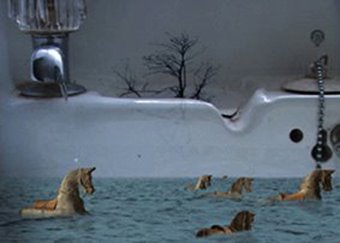
Hiraki Sawa (b. 1977) - Going Places Sitting Down (video still), 2004

I believe a leaf of grass is not less than the
journey-work of the stars,
And the pismire is equally perfect, and a grain of sand,
and the egg of the wren,
And the tree toad is a chef-d’œuvre for the highest,
And the running blackberry would adorn the parlours
0f heaven . . .

Walt Whitman, Song of Myself

Psychologists - and more especially philosophers - pay little attention to the play of miniature frequently introduced into fairytales. In the eyes of the psychologist, the writer is merely amusing himself when he creates houses that can be set on a pea. But this is a basic absurdity that places the tale on a level with the merest fantasy. And fantasy precludes the writer from entering, really, into the domain of the fantastic. Indeed he himself, when he develops his facile inventions, often quite ponderously, would appear not to believe in a psychological reality that corresponds to these miniature features. He lacks that little particle of dream which could be handed on from writer to reader. To make others believe, we must believe ourselves. Is it worthwhile, then, for a philosopher to raise a phenomenological problem with regard to these literary "miniatures", these objects that are so easily made smaller through literary means? Is it possible for the conscious - of both writer and reader - to play a sincere role in the very origin of images of this kind?

Yet we are obliged to grant these images a certain objectivity, from the mere fact that they both attract and interest many dreamers. One might say that these houses in miniature are false objects that possess a true psychological objectivity. Here the process of imagination is typical, and poses a problem that must be distinguished from the general problem of geometrical similarities. The geometrician sees exactly the same thing in two similar figures, drawn to different scales. The plan of a house drawn on a reduced scale implies none of the problems that are inherent to a philosophy of the imagination. There is even no need to consider it from the general standpoint of representation, although it would be important, from this standpoint, to study the phenomenology of similarity. Our study should be specified as belonging definitely under the imagination.

Everything will be clear, for instance, if, in order to enter into the domain where we imagine, we are forced to cross the threshold of absurdity, as in the case of [Bean Treasure] , Charles Nodier's hero, who gets into a fairy's coach the size of a bean. In fact, he gets into it with six "litrons" of beans on his shoulder. There is thus a contradiction in numbers as well as in the size of the space involved. Six thousand beans fit into one. And the same thing is true when Michael - who is oversize - finds himself, to his great surprise, in the house of the [Beggar Fairy], which is hidden under a tuft of grass. But he feels at home there, and settles down. Happy at being in a small place, he realises an experience of topohilia; that is, once inside the miniature house, he sees its vast number of rooms; from the interior he discovers interior beauty. Here we have an inversion of perspective, which is either fleeting or captivating, according to the talent of the narrator, or the reader's capacity for dream. Nodier, who was often too eager to be "agreeable", and too much amused to give full reign to his imagination, allows certain badly camouflaged rationalisations to subsist. In order to explain psychologically this entry into the tiny house, he recalls the little cardboard houses that children play with. In other words, the tiny things we imagine simply take us back to childhood, to familiarity with toys and the reality of toys.

But the imagination deserves better than that. In point of fact, imagination in miniature is natural imagination which appears at all ages in the daydreams of born dreamers. Indeed, the element of amusement must be removed, if we are to find its true psychological roots.

. . .

Representation becomes nothing but a body of expressions with which to communicate our own images to others. In line with a philosophy that accepts the imagination as a basic faculty, one could say, in the manner of Schopenhauer: "The world is my imagination." The cleverer I am at miniaturising the world, the better I possess it. But in doing this, it must be understood that values become condensed and enriched in miniature. Platonic dialectics of large and small do not suffice for us to become cognizant of the dynamic virtues of miniature thinking. One must go beyond logic in order to experience what is large in what is small.

Gaston Bachelard


Musique Du Jour: Badlands, David Chesworth

Monday, May 19, 2008

Replay VI

This Is Not A Paint(h)ing: Part One


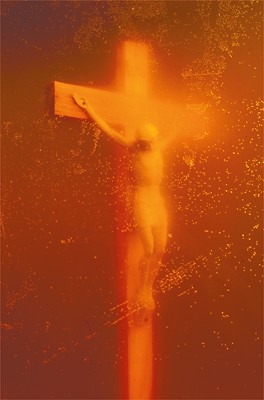
Andres Serrano - Piss Christ (1987)


A philosopher of the imagination, therefore, should follow the poet to the ultimate extremity of his images, without ever reducing this extremism, which is the specific phenomenon of the poetic impulse. In a letter to Clara Rilke, Rilke wrote: 'Works of art always spring from those who have faced the danger, gone to the very end of an experience, to the point beyond which no human being can go. The further one dares to go, the more decent, the more personal, the more unique a life becomes.' But is it necessary to go and look for "danger" other than the danger of writing, of expressing oneself? Doesn't the poet put language in danger? Hasn't the fact that, for so long, poetry has been the echo of heartache, given it a pure dramatic tonality? When we really live a poetic image, we learn to know, in one of its tiny fibres, a becoming of being that is an awareness of the being's inner disturbance. Here being is so sensitive that it is upset by a word. In the same manner, Rilke adds: 'This sort of derangement, which is peculiar to us, must go into our work.'

. . .

If, through poetry, we restore to the activity of language its free field of expression, we are obliged to supervise the use of fossilized metaphors.

From The Poetics of Space by Gaston Bachelard


Two of the many articles spawned by the above photograph:

Sacrifice, Piss Christ and Liberal Excess: Part 1 - Damien Casey (Arts and Opinion, 2004)

Sacrifice, Piss Christ and Liberal Excess: Part 2 (The Rebuttal) - Michael Casey, Anthony Fisher and Haydan Ramsey (Arts and Opinion, 2004)


Reading:

Visions of Excess: Selected Writings, 1927-1939 (ed. Allan Stoekl) - Georges Bataille

The Three Ecologies - Felix Guatarri

Chaosmosis: An Ethico-Aesthetic Paradigm - Felix Guatarri

The Deleuze Reader (ed. Constantin V. Boundas) - Gilles Deleuze

Monday, November 19, 2007

More Of Less: Part Seven


Eve Hesse - Aught, 1968


'Of course, any simplification runs the risk of mutilating reality; but it helps us establish perspectives.'

Gaston Bachelard

Tuesday, June 26, 2007

Shooting Candles Of The Night


Joseph Wright of Derby - Firework Display at the Castel Sant' Angelo in Rome (1779)


'The repose of sleep refreshes only the body. It rarely sets the soul at rest. The repose of the night does not belong to us. It is not the possession of our being. Sleep opens within us an inn for phantoms. In the morning we must sweep out the shadows.'

Gaston Bachelard

Friday, May 11, 2007

The Art Of Seeing With Someone Else's Eyes


Robert Doisneau (1912-1994) - Sidelong Glance, 1948


"Irony gives us, at little expense, the impression that we are experienced psychologists."

Gaston Bachelard

Monday, May 07, 2007

To Awaken, Perchance To Dream


Henri Julien Félix Rousseau (1844-1910) - The Dream, 1910


'The eye which dreams does not see, or at least it sees with another vision.'

Gaston Bachelard

Friday, February 09, 2007

Wide Blue Wonder


Joan Miró (1893-1983) - Blue I, 1962


'The blue of the sky, if we were to examine its many image values, would require a long study in which we would see all the types of material imagination being determined according to the basic elements of water, fire, earth, and air. In other words, we could divide poets into four classifications by their response to the single theme of celestial blue:

Those who see in an immobile sky a flowing liquid that comes to life with the smallest cloud.

Those who experience the blue sky as though it were and enormous flame - "searing" blue, as the Comtesse de Noailles describes it.

Those who contemplate the sky as if it were a solidified blue, a painted vault - "compact and hard azure", as the Comtesse de Noailles again says.

Finally those who can truly participate in the aerial nature of celestial blue.

Of course, besides the great poets who instinctively follow these basic inspirations, it would be easy to discover, with such a common image, all the rhymers for whom "blue sky" is always a concept, never a primary image. Poetry about the blue sky suffers an enormous loss on this account. We can almost appreciate Musset's scorn when he called "blue" the stupid colour. In the works of artificial poets, at least, it is the colour of pretentious innocence from which come sapphires or flax blossoms. Such images are not, of course, banned: poetry is just as much the participation of the large in the small as it is the small in the large. But no one experiences this participation by juxtaposing a terrestrial and an aerial name. Only a great poet can discover naturally, without copying a literary example, blue sky in a wildflower.

But, leaving aside the facile polemics against false or worn-out images, I would like to reflect on a fact that has often struck me. As I have read many different kinds of poets, what has surprised me was how rare were the images in which the blue sky was truly aerial. This rarity is due, first of all, to the fact that aerial imagination is much rarer than the imagination of fire, earth, or water. But even more important is the fact that, even when the immense, distant blue infinity is felt by an aerial soul, it needs to be materialised in order to be incorporated into a literary image. The word blue designates, but it does not render. The problem of the image of the blue sky is completely different for the painter than for the poet. For a writer, if the blue sky is not merely a background, if it is a poetic object, only a metaphor can bring it to life. The poet's task is not to translate a colour, but to make us dream the colour. The blue sky is so simple that no one thinks he can oneirise it without materialising it. But this process of materialisation goes too far. The blue sky is made too hard, too glaring, too searing, too compact, too burning, and too brilliant. Often the sky looks at us too fixedly. We attribute too much substance and constancy to it because the soul does not become a part of the life of primary substance. We tonalise the sky's blue by making it "vibrate" like a sonorous crystal, whereas, for truly aerial souls, there is only the sound of a breath. Thus, with excessive intensity, the Comtesse de Noailles writes: "Today the blue is so strong that it blinds you if you look at it too long; it crackles, it whirls, it becomes filled with golden tendrils, with hot frost, with sharp and radiant diamonds, with arrows, with silver flies . . . "

The hallmark of what is truly aerial is to be found, in my opinion, in another direction. It is, in fact, based on the dynamics of dematerialisation. the substantial imagination of air is truly active only on a dynamics of dematerialisation. The blue of the sky is aerial when it is dreamed as a colour that pales a bit, like a pallor that seeks finesse, a finesse that we imagine as yielding beneath our fingers like a delicate fabric as we caress, in Paul Valéry's words:

The mysterious texture of the utmost height.

That is when the blue sky counsels us to be as calm and as light as it is itself:

The sky above the roof, is
So blue, so calm!

sighs Verlaine from the depths of his prison where he is still under the weight of unforgiven memories. This calm can be filled with melancholy. The dreamer feels that the blue sky will never be a possessed good. "What good are the symbols of a basic and comforting mountaineering since I shall not, this evening, reach the blue, that blue which is so aptly called sky blue?"

But it is by following the scale of dematerialisation of celestial blue that we can see aerial reverie at work. Then we will understand that it is an aerial Einfühlung: the fusion of a dreamer with as undifferentiated a universe as possible, on that is blue and gentle, infinite and formless, with a minimum of substance.'

From The Blue Sky by Gaston Bachelard

Thursday, February 01, 2007

Unmapping The Heavens


Plates from Harmonica Macrocosmica, 1660 - Andreas Cellarius (c. 1595-1665)


"Ah what Bull, what Dog, what Bear,
What trophies of victory immense,
Once embarked on resourceless time
The soul imposes on formless space!

Charms, "Secret Ode", Paul Valery


Mathematical reverie has drawn diagrams of this immense tableau of a Cerulean night. These constellations are all false! They have grouped totally foreign stars in a dingle figure. Between real points, that is between stars that are isolated like diamond solitaires, the dream of constellations has drawn imaginary lines. Dream, that great master of abstract painting, sees all the animals of the zodiac done in a pointillism reduced to the minimum. Homo faber - a lazy maker of wheels - puts a chariot without wheels in the sky; the ploughman, dreaming of his harvests, erects a simple golden sheaf. Seeing such luxuriance produced by the powers of projective imagination, how odd this logical dictionary definition seems!

Constellations: the assembly of a certain number of fixed stars on which has been superimposed a figure, either man or animal or plant, in order to remember them better and to which has been given a name to distinguish them from other groupings of the same kind.

Naming stars to "help remember them", what a lack of appreciation for the speaking powers of dream! What ignorance of the principles of reverie's imaginary project! The zodiac is the Rorschach test for the child Humanity. Why have learned grimoires been written; why has the sky of night been replaced by the sky of books?

There are so many dreams in the sky which poetry, encumbered by old words, has not been able to name. To how many writers of the night would we like to say: "Come back to the principle of reverie; the starry sky has been given to us, not to think about, but to dream"? It is an invitation to constellating dreams, to dream about the easy and ephemeral construction of the thousand forms that our desires take. The mission of "fixed" stars is to fix some dreams, to communicate some, and to rediscover some. They prove to a dreamer the universality of oneirism. This ram, young shepherd, that your hand caresses as you dream - there he is up there, turning gently in the immense night! Then there will be two of you to sketch him, to recognise him, and to talk to him as a friend. You will find that the two of you have the same vision, the same desire, and that even in the night, in the nocturnal solitude, you will see the same ghosts pass by. How much greater life becomes when dreams are bound together!

We will understand to what an extent the imagination of the sky is falsified and impeded by book knowledge if we reread some passages in which writers have blithely lost track of dreams in exchange for "knowledge" that is as poor as it is lifeless. At that stage we will perhaps be justified in suggesting a kind of counter-psychoanalysis that might destroy the conscious mind in favour of an established oneirism, which would be the only way to restore a refreshing continuity to reverie. "Knowing" the constellations, naming them as in books, projecting a classroom map of the sky on the sky itself, is brutalising our imaginary powers and depriving us of the benefits of the stars' oneirism. If we were not burdened with the words that "help our memory"- the memory of words, the great sloth that refuses to dream - every new night would be a new reverie for us, a renewed cosmogony. An ill-formed consciousness or one that is too formal is as harmful for the dreaming soul as an amorphous or warped unconscious. The psyche must find a balance between the imagined and the known. This equilibrium cannot be satisfied by vain substitutions in which, suddenly, the imagining powers find themselves bound up with arbitrary schemata. The imagination is a primary power. It must be born in the solitude of the imagining being. As always, to understand contemplation, we must begin with the Schopenhauerean formula: the starry night is my constellation. It makes me aware of my power to form constellations. It puts in my hands, as the poet says, these weightless chalices and these flowers that grow in space."

From The Constellations by Gaston Bachelard

Saturday, November 25, 2006

Intimate Immensity: Part Three


René Magritte - The Listening Room (1958)


"Only thought can resemble. It resembles by being what it sees, hears, or knows; it becomes what the world offers it."

René Magritte

"The inner world is the world of your requirements and your energies and your structure and your possibilities that meets the outer world. And the outer world is the field of your incarnation. That's where you are. You've got to keep both going. As Novalis said, 'The seat of the soul is where the inner and outer worlds meet.' "

Joseph Campbell


"Immensity is within ourselves. It is attached to a sort of expansion of being that life curbs and caution arrests, but which starts again when we are alone. As soon as we becomes motionless, we are elsewhere; we are dreaming in a world that is immense. Indeed, immensity is the movement of the motionless man. It is one of the dynamic characteristics of quiet daydreaming.

And since we are learning philosophy from poets, here is a lesson in three lines, by Pierre Albert-Bireau:

And with a stroke of the pen I name myself
Master of the World
Unlimited man."
From The Poetics of Space by Gaston Bachelard

Friday, November 24, 2006

Intimate Immensity: Part Two


René Magritte - Personal Values (1952)


"If the dream is a translation of waking life, waking life is also a translation of the dream."

René Magritte


"The myth is the public dream and the dream is the private myth."

Joseph Campbell


"When this elsewhere is in natural surroundings, that is, when it is not lodged in the houses of the past, it is immense. And one might say that daydream is original contemplation.

If we could analyse impressions and images of immensity, or what immensity contributes to an image, we should soon enter into a region of the purest sort of phenomenology - a phenomenology without phenomena; or, stated less paradoxically, one that, in order to know the productive flow of images, need not wait for the phenomena of the imagination to take form and become stablised and completed images. In other words, since immense is not an object, a phenomonology of immense would refer us directly to our imagining consciousness. In analysing images of immensity, we should realise within ourselves the pure being of pure imagination. It then becomes clear that works of art are the by-products of this existentialism of the imagining being. In this direction of daydreams of immensity, the real product is consciousness of enlargement. We feel that we have been promoted to the dignity of the admiring being.

This being the case, in this meditation, we are not "cast into the world", since we open the world, as it were, by transcending the world seen as it is, or as it was, before we started dreaming. And even if we are aware of our own paltry selves - through the effects of harsh dialectics - we become aware of grandeur. We then return to the natural activity of our magnifying being."

From The Poetics of Space by Gaston Bachelard

Thursday, November 23, 2006

Intimate Immensity: Part One


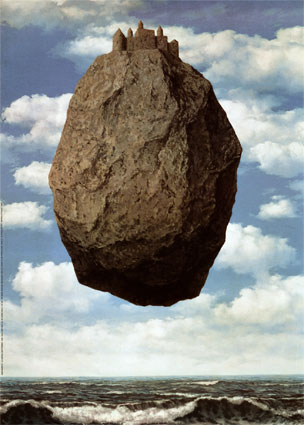
René Magritte - La Chateau des Pyrenees (1959)


"My painting is visible images which conceal nothing; they evoke mystery and, indeed, when one sees one of my pictures, one asks oneself this simple question: "What does it mean?" It does not mean anything, because mystery means nothing either. It is unknowable."

René Magritte

"Our thinking is largely discursive, verbal, linear. There is more reality in an image than a word."
Joseph Campbell


"One might say that immensity is a philosophical category of daydream. Daydream undoubtedly feeds on all kinds of sights, but through a sort of natural inclination, it contemplates grandeur. And this contemplation produces an attitude that is so special, an inner state that is so unlike any other, that the daydream transports the dreamer outside the immediate world to a world that bears the mark of infinity.

Far from the immensities of sea and land, merely through memory, we can recapture, by means of meditation, the resonances of this completion of grandeur. But is this really memory? Isn't imagination alone able to enlarge indefinitely the images of immensity? In point of fact, daydreaming, from the very first second, is an entirely constituted state. We do not see it start, and yet it always starts the same way, that is, it flees the object nearby and right away it is far off, elsewhere, in the space of elsewhere."

From The Poetics of Space by Gaston Bachelard

Tuesday, November 14, 2006

The Light Of The Mind


Georges de La Tour - Woman Catching Fleas (1630s)


"Great images have both a history and a prehistory; they are always a blend of memory and legend, with the result that we never experience an image directly. Indeed, every great image has an unfathomable oneiric depth to which the personal past adds colour. Consequently it is not until late in life that we really revere an image, when we discover that its roots plunge well beyond the history that is fixed in our memories. In the realm of absolute imagination, we remain young late in life. But we must lose our earthly Paradise in order actually to live in it, to experience it in the reality of its images, in the absolute sublimation that transcends all passion."

From The Poetics of Space by Gaston Bachelard


"When the silent vision falls into speech, and when the speech in turn, opening up a field of the nameable and the sayable, inscribes itself in that field, in its place, according to its truth - in short, when it metamorphoses the structures of the visible world and makes itself a gaze of the mind, intuitus mentis - this is always in virtue of the same fundamental phenomenon of reversibility which sustains both the mute perception and the speech."

From The Visible and The Invisible by Maurice Merleau-Ponty


"'I was going to say...'- You remember various details. But not even all of them shew your intention. It is as if a snapshot of a scene had been taken, but only a few scattered details of it were to be seen...And now it is as if we knew quite certainly what the whole picture respresented. As if I could read the darkness."

From Philosophical Investigations by Ludwig Wittgenstein

Sunday, October 15, 2006

This Is Not A Paint(h)ing: Part Three


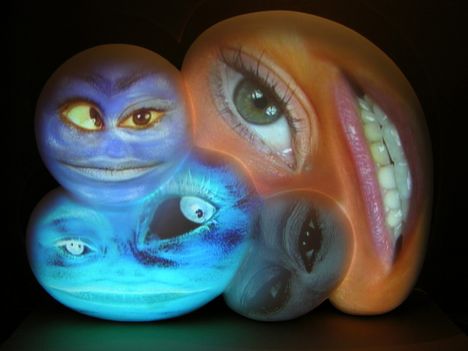
Tony Oursler - Clump (2006)


"Outside and inside form a dialectic of division, the obvious geometry of which blinds us as soon as we bring it into play in metaphorical domains. It has the sharpness of the dialectics of yes and no, which decides everything. Unless one is careful, it is made into a basis of images that govern all thoughts of positive and negative. Logicians draw circles that overlap or exclude each other, and all their rules become immediately clear. Philosophers, when confronted with outside and inside, think in terms of being and non-being. Thus profound metaphysics is rooted in an implicit geometry which - whether we will or no - confers spatiality upon thought; if a metaphysician could not draw, what would he think? Open and closed, for him, are thoughts. They are metaphors that he attaches to everything, even to his systems. In a lecture given by Jean Hyppolite on the subtle structure of denegation (which is quite different from the simple structure of negation) Hyppolite spoke of a "first myth of inside and outside". And he added: "you feel the full significance of this myth of outside and inside in alienation, which is founded on these two terms. Beyond what is expressed in their formal opposition becomes tinged with aggressivity. Formal opposition is incapable of remaining calm. It is obsessed by the myth. But this action of the myth throughout the immense domain of imagination and expression should not be studied by attributing it the false light of geometrical intuitions.

"This side" and "beyond" are faint repetitions of the dialectics of inside and outside: everything takes form, even infinity. We seek to determine being and, in so doing, transcend all situations, to give a situation of all situations. Man's being is confronted with the world's being, as though primitivity could be easily arrived at. The dialectics of here and there has been promoted to the rank of an absolutism according to which these unfortunate adverbs of place are endowed with unsupervised powers of ontological determination. Many metaphysical systems would need mapping. But in philosophy, all short-cuts are costly, and philosophical knowledge cannot advance from schematised experiments."

From The Poetics of Space by Gaston Bachelard


Further resources:

Tony Oursler Online

Tony Oursler on artnet

Tony Oursler: Projecting the Psyche - Pravin Sathe

Hallucinating with the Ears - Andrew Clifford

NGA (New Aquisitions) - Incubator (Tony Oursler, 2003)

Tony Oursler: The Presence Project - Gabriella Giannachi

Saturday, October 14, 2006

This Is Not A Paint(h)ing: Part Two


Hiraki Sawa - (still from) Going Places Sitting Down (2004)


"Psychologists - and more especially philosophers - pay little attention to the play of miniature frequently introduced into fairytales. In the eyes of the psychologist, the writer is merely amusing himself when he creates houses that can be set on a pea. But this is a basic absurdity that places the tale on a level with the merest fantasy. And fantasy precludes the writer from entering, really, into the domain of the fantastic. Indeed he himself, when he develops his facile inventions, often quite ponderously, would appear not to believe in a psychological reality that corresponds to these miniature features. He lacks that little particle of dream which could be handed on from writer to reader. To make others believe, we must believe ourselves. Is it worthwhile, then, for a philosopher to raise a phenomenological problem with regard to these literary "miniatures", these objects that are so easily made smaller through literary means? Is it possible for the conscious - of both writer and reader - to play a sincere role in the very origin of images of this kind?

Yet we are obliged to grant these images a certain objectivity, from the mere fact that they both attract and interest many dreamers. One might say that these houses in miniature are false objects that possess a true psychological objectivity. Here the process of imagination is typical, and poses a problem that must be distinguished from the general problem of geometrical similarities. The geometrician sees exactly the same thing in two similar figures, drawn to different scales. The plan of a house drawn on a reduced scale implies none of the problems that are inherent to a philosophy of the imagination. There is even no need to consider it from the general standpoint of representation, although it would be important, from this standpoint, to study the phenomenology of similarity. Our study should be specified as belonging definitely under the imagination.

Everything will be clear, for instance, if, in order to enter into the domain where we imagine, we are forced to cross the threshold of absurdity, as in the case of [Bean Treasure] , Charles Nodier's hero, who gets into a fairy's coach the size of a bean. In fact, he gets into it with six "litrons" of beans on his shoulder. There is thus a contradiction in numbers as well as in the size of the space involved. Six thousand beans fit into one. And the same thing is true when Michael - who is oversize - finds himself, to his great surprise, in the house of the [Beggar Fairy], which is hidden under a tuft of grass. But he feels at home there, and settles down. Happy at being in a small place, he realises an experience of topohilia; that is, once inside the miniature house, he sees its vast number of rooms; from the interior he discovers interior beauty. Here we have an inversion of perspective, which is either fleeting or captivating, according to the talent of the narrator, or the reader's capacity for dream. Nodier, who was often too eager to be "agreeable", and too much amused to give full reign to his imagination, allows certain badly camouflaged rationalisations to subsist. In order to explain psychologically this entry into the tiny house, he recalls the little cardboard houses that children play with. In other words, the tiny things we imagine simply take us back to childhood, to familiarity with toys and the reality of toys.

But the imagination deserves better than that. In point of fact, imagination in miniature is natural imagination which appears at all ages in the daydreams of born dreamers. Indeed, the element of amusement must be removed, if we are to find its true psychological roots.

. . .

Representation becomes nothing but a body of expressions with which to communicate our own images to others. In line with a philosophy that accepts the imagination as a basic faculty, one could say, in the manner of Schopenhauer: "The world is my imagination." The cleverer I am at miniaturising the world, the better I possess it. But in doing this, it must be understood that values become condensed and enriched in miniature. Platonic dialectics of large and small do not suffice for us to become cognizant of the dynamic virtues of miniature thinking. One must go beyond logic in order to experience what is large in what is small."

From The Poetics of Space by Gaston Bachelard


Sawa's work is currently on display at the National Gallery of Victoria until 3rd December in the New Media Gallery, Level 3, and admission is free.


Other resources:

Hiraki Sawa - Gregory Volk (UCLA Hammer Museum)

James Cohan Gallery

Artfacts.Net

Hiraki Sawa - (ed.) Katherine Wood

Friday, October 13, 2006

This Is Not A Paint(h)ing: Part One


Andres Serrano - Piss Christ (1987)


"A philosopher of the imagination, therefore, should follow the poet to the ultimate extremity of his images, without ever reducing this extremism, which is the specific phenomenon of the poetic impulse. In a letter to Clara Rilke, Rilke wrote: 'Works of art always spring from those who have faced the danger, gone to the very end of an experience, to the point beyond which no human being can go. The further one dares to go, the more decent, the more personal, the more unique a life becomes.' But is it necessary to go and look for "danger" other than the danger of writing, of expressing oneself? Doesn't the poet put language in danger? Hasn't the fact that, for so long, poetry has been the echo of heartache, given it a pure dramatic tonality? When we really live a poetic image, we learn to know, in one of its tiny fibres, a becoming of being that is an awareness of the being's inner disturbance. Here being is so sensitive that it is upset by a word. In the same manner, Rilke adds: 'This sort of derangement, which is peculiar to us, must go into our work.'

. . .

If, through poetry, we restore to the activity of language its free field of expression, we are obliged to supervise the use of fossilized metaphors."

From The Poetics of Space by Gaston Bachelard


Two of the many articles spawned by the above photograph:

Sacrifice, Piss Christ and Liberal Excess: Part 1 - Damien Casey (Arts and Opinion, 2004)

Sacrifice, Piss Christ and Liberal Excess: Part 2 (The Rebuttal) - Michael Casey, Anthony Fisher and Haydan Ramsey (Arts and Opinion, 2004)


Reading:

Visions of Excess: Selected Writings, 1927-1939 (ed. Allan Stoekl) - Georges Bataille

The Three Ecologies - Felix Guatarri

Chaosmosis: An Ethico-Aesthetic Paradigm - Felix Guatarri

The Deleuze Reader (ed. Constantin V. Boundas) - Gilles Deleuze

Wednesday, October 04, 2006

Can You Say What I'm Seeing?


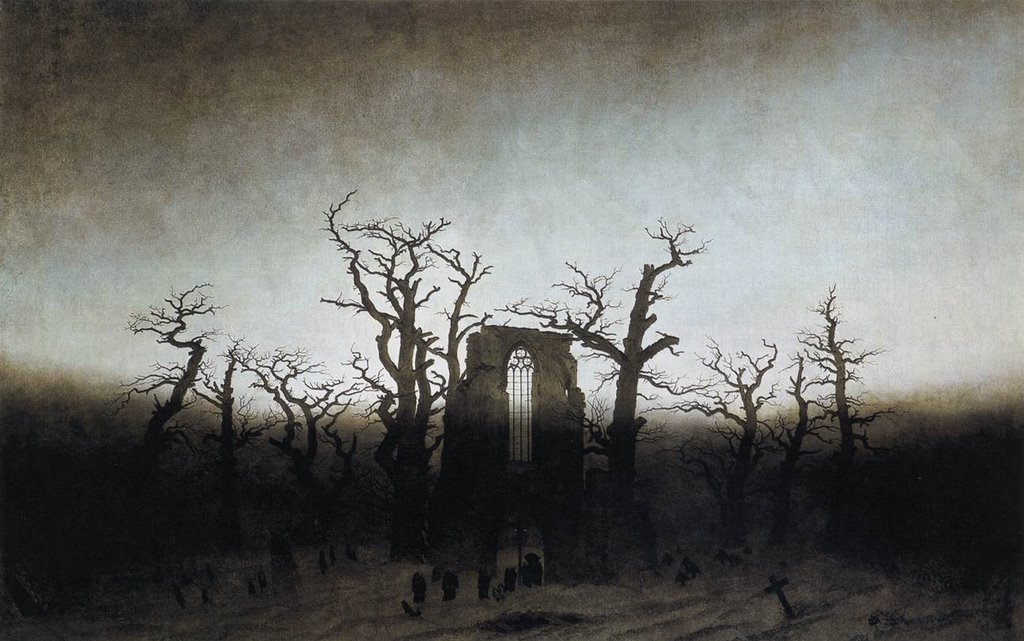
Caspar David Friedrich - The Abbey in the Oakwood (1809-10)

This and many other images by Friedrich can be accessed at: http://www.wga.hu/index1.html


'Ideas are refined and multiplied in the commerce of minds. In their splendour, images effect a very simple communion of souls.'

Gaston Bachelard