Showing posts with label Television Series. Show all posts

Saturday, April 19, 2008

Addendum II: Hermits, Perverts and Extroverts

In Praise Of Strangers To Normality


Henry Darger (In The Realms of the Unreal, 2004 - d. Jessica Yu)


Robert Crumb (Crumb, 1994 - d. Terry Zwigoff)


Julian Barratt and Noel Fielding (The Mighty Boosh, 2004-2008 . . . )

Thursday, March 27, 2008

Dying For A Laugh


Six Feet Under (b. 2001 - d. 2005)


'Comedy is tragedy plus time.'

Carol Burnett

Monday, August 20, 2007

King Of The Cocksuckers


Al Swearengen (Ian McShane) - Deadwood, 2004-6


'Swearengen's swarthy brute-ness and intelligent charm clearly relates him to some famous literary figures, most obviously Wuthering Heights' Heathcliff but also Oliver Twist's Bill Sikes. In casting McShane, Deadwood acknowledges this heritage physically: compare him, for example, with Robert Newton or Oliver Reed playing Sikes in Oliver Twist (Lean, 1948) and Oliver! (Reed, 1968). However, these figures, while not exactly one-dimensional, do not have the complexity of Swearengen. As David Ellison argues, it is important to acknowledge that Swearengen represents a "fusion of characteristics that Dickens could only distribute across characters. In other words, Swearengen is Sikes in all of his brute menace but he is also Fagin - a super-adaptive, improvisational opportunist with a dab line in self-parody." In this way, one of the major achievements of Deadwood lies in Milch's discovery of McShane's ability to nuance a British kind of villainy: one that references but also transcends (Americanizes?) the binary tic of Victorian psychology that opposes, say, Heathcliff against Edgar, Jekyll/Hyde, Picture/Dorian, Jack the Ripper/Prince Albert. [The] fortuitous casting of McShane Swearengen (the real Al was born in Iowa) allowed David Milch to articulate and realize a depth to Swearengen that not only enhanced the vividness of a real historical character but was also to overcome one of the pervasive oddities of nineteenth-century British literary characterization....Al Swearengen, as played by McShane, is a philosophic intervention into the nature of characterization itself.'

From Al Swearengen, Philosopher King by Jason Jacobs.

Thursday, January 25, 2007

The Pinocchio Syndrome


Data (Brent Spiner) - Star Trek: The New Generation


'There is a certain kind of fiction that I unfailingly experience, in Rilke's terms, as either a cat story or a dog story. This is the category of fiction marked by an unusual choice of protagonist - sometimes literally an animal, but more often some inhuman, semihuman or hybrid figure: robot, alien, swamp creature, ape man, mutant. Or one of those strange, half-formed humans we call a child. In a cat-like story, this figure remains inscrutable, and the point of the tale is to teach us a chastening lesson about that inscrutability.

...

Dog-like stories are completely different. They are sentimental tales, full of pathos, aiming above all to wring tears from the reader or viewer. Their heroes are half-humans who strive desperately, yearn terribly, for the humanity which has been denied them through the circumstances of their creation. Some of the classic figures of this sort include Pinocchio, the Tin Man in The Wizard of Oz (1939), Frankenstein's monster, No. 5 in the Short Circuit films and Edward Scissorhands.

Besides Mitsou, nothing brings tears to my eyes faster than the episodes of Star Trek: The New Generation centred on the android Data (played so well by Brent Spiner). One of the central questions driving Star Trek in all its incarnations (all the generations, in both film and TV) is: what does it mean to be fully, truly human? As in so much science fiction, the otherness of the aliens encountered by the members of the Enterprise is not often seriously explored as an issue. These very uncat-like creatures are usually deployed as symbolic mirrors to humanity, as they exemplify some ingenious, evolutionary imbalance of the basic drives, exhibiting too much libido, or placidity, or aggression, or rationality. For a long time, and as an essential ingredient of Star Trek's premise, Spock teased the limits of his comrade's comprehension with his enigmatic, unearthly mind-set - but his inexorable trajectory (whatever his gnomic protestations) was set towards becoming more and more human. In Star Trek VI: The Undiscovered Country (1991), Kirk even gets to tell Spock that 'We're all human'.

As an android, Data reraises the tricky question involved in dramatically or comically defining the borders of humanity. Like Spock, he is an inscrutable figure: his face conveys little, except when he tries too hard to mimic the facial contortions involved in a human laugh or frown. Incidental details play constantly on Data's inability to understand the most sublime levels of human achievement - art, religion, philosophy - he doggedly works on his painting, his violin playing, and the reading of the pillars of wisdom which Captain Picard (Patrick Stewart) solemnly entrusts to him. He obviously also admires the human qualities of playfulness and cleverness, since he sometimes dons the garb of Sherlock Holmes for a spin in the imaginary worlds created by the ship's Holodeck.

The show cleverly incites our desire to read into Data's sleuth-like curiosity the stirring of a more profound sentiment: yearning. And if Data yearns, isn't that the surest sign that he is already, somehow, becoming human? Yet, while certain actions that Data performs seem to indicate the magic alchemy of such a transformation, others pull us suddenly back to ground zero. He is, after all, a machine, one that we occasionally see switched off, and (as he often reminds us himself) he has no emotions of any sort. That is a condition of his being, like his autonomy, which gives him a passionless, twilight aura of existential solitude: as the only one of his kind, Data can have no sense of community or belonging.

Yet the ultimate nature of Data as a sentient being is kept alive as an open question in Star Trek: The New Generation, and many of the best episodes dramatise the ambiguity that compellingly surrounds him. In one story, a coldhearted, hyperrational scientist arrives on the Enterprise with the mission of disassembling Data, so that he can be reproduced and improved (due to a handy trick of intergalactic history, his exact technological make-up remains a mystery). When Commander Riker (Jonathan Frakes) is able to prove the presence - inexplicable as it is - of attributes in Data that at least resemble conventional emotions, Picard formally rules that henceforth, Data is to be considered neither android nor human, but a hybrid that inaugurates a new evolutionary species.

In another, extremely moving episode, Data takes the question of his reproduction into his own hands. He builds a daughter who, like her father, shows through her inability to adapt to human manners the gulf between these two species. But then she develops powerful surges of emotion that deranges her circuitry. Like man classically transgressive heroines of melodrama, she is far too much trouble for the show to keep alive; but as she dies, she assures Data that, although he cannot honestly express proper parental love, she has enough love for the both of them.

An explicit line of reference in the show compares Data to both Pinocchio and the Tin Man - casting him as that perfectly sentimental figure who lacks a heart or soul, and whose only wish is to obtain them. 'The Tin Man', however, casts a somewhat more sympathetic and accepting light on Data's hybrid nature. The plot concerns Data's relation to two unusual creatures, both of them singular beings fitted uneasily into the cosmic scheme of things. The first is a brilliant but difficult man with supreme powers of empathy and intuition. He is so open to feelings and thoughts that any interaction is a torment to him. The second is the Tin Man - a pile of discarded machinery out in space that has evolved into a sentient being with completely unknowable values and drives. Data, silently, identifies with both of them. When it comes to pass that the destiny of these two beings is to merge into one - thereby extinguishing each other's yearning - Data returns to the Enterprise and reflects that he too, at last, feels some sense of belonging.

The most intensely ambiguous of all the Data stories to date has been 'The Most Toys'. In this episode, Data is kidnapped by a sadistic, selfish collector for his museum of unique objects. Counterpointed to Data's typically cool and methodical exploration of means to escape captivity are the varied reactions of grief from his comrades back on the Enterprise, who believe he is dead. Data has explained to his captor early on that, as an android with a built-in check, he cannot murder; this is later used to taunt him, as others around him under the collector's rule are cruelly exterminated. Finally, Data faces the villain with an especially lethal gun in hand, and is told: 'If only you could feel rage . . . if only you could feel a need for revenge, then you could fire. But you're just an android. You can't feel anything, can you?'

The collector interprets Data's dilemma here - the question of whether to kill or not - as 'just another interesting intellectual puzzle for you, another of life's curiosities'; meanwhile the familiar flickerings in that passive android face seem to bear out the truth of that description. 'I cannot permit this to continue', says Data - ever the rationalist - and raises his gun to fire. At this precise moment, a transporter beam envelops Data and returns him to the Enterprise. The ship's controls indicate an energy discharge has occurred. Data - in an unreadable moment that may indicate canniness - denies that any such thing happened. Finally, he faces his captor, now in turn captured. 'It must give you great pleasure', whines the fallen megalomaniac. Data replies, 'No, sir, it does not. I do not feel pleasure.' And as the camera tracks in for dramatic underlining, he blankly parrots back the words, 'I am only an android'.'

From Dear Data by Adrian Martin.

Tuesday, January 16, 2007

American Prometheus


Alexander ('Lex') Joseph Luthor (Michael Rosenbaum) - Ep. 15, 'Nicodmeus', Smallville: Season One


'It is my good fortune that after the whole millennia of error and confusion I have rediscovered the way that leads to a Yes and a No.

I teach the No to all that makes weak - that exhausts.

I teach the Yes to all that strengthens, that stores up strength, that justifies the feeling of strength.

So far one has taught neither the one nor the other: virtue has been taught, mortification of the self, pity, even the negation of life. All these are the values of the exhausted.

Prolonged reflection on the physiology of exhaustion forced me to ask to what extent the judgements of the exhausted had penetrated the world of values.

My result was as surprising as possible, even for me who was at home in many a strange world: I found that all of the supreme value judgements - all that have come to dominate mankind, at least that part that has become tame - can be derived from the judgements of the exhausted.

Under the holiest names I pulled up destructive tendencies; one has called God what weakens, teaches weakness, infects with weakness. I found that the "good man" is one of the forms in which decadence affirms itself.

That virtue of which Schopenhauer still taught that it is the supreme, the only virtue, and the basis of all virtues - precisely pity I recognised as more dangerous that any vice. To cross as a matter of principle selection in the species and its purification of refuse - that has so far been called the virtue par excellence.

One should respect fatality - that fatality that says to the weak: perish!

One has called it God - that one resisted fatality, that one corrupted mankind and made it rot. One should not use the name of God in vain.

The race is corrupted - not by its vices but by its ignorance; it is corrupted because it did not recognise exhaustion as exhaustion: mistakes about physiological states are the sources of all ills.

Virtue is our greatest misunderstanding.

Problem: How did the exhausted come to make the laws about values? Put differently: How did those come to power who are the last? How did the instinct of the human animal come to stand on its head?'

From 'European Nihilism' (The Will to Power) by Friedrich Nietzsche

Sunday, November 26, 2006

Beastly Bonking


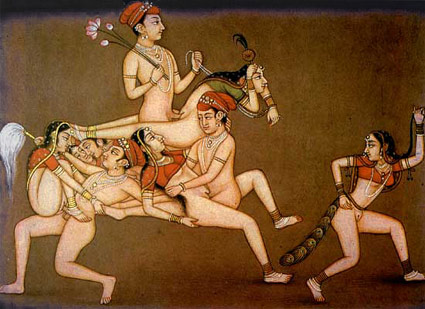
Indian - Horse Pursuing a Peacock


"The orgy was not the farthest point reached by eroticism in the pagan world. The orgy is the sacred aspect of eroticism in which the continuity of beings beyond solitude is most plainly expressed. Only in one way, however. In the orgy continuity cannot be laid hold of; individuals lose themselves at the climax, but in mingled confusion. The orgy is necessarily disappointing. Theoretically it is the complete negation of individual quality. It presupposes, it even demands equality among the participants. Not only is individuality itself submerged in the tumult of he orgy, but each participant denies the individuality of the others. All limits are completely done away with, or so it seems, but it is impossible for nothing to remain of the differences between individuals and their sexual attraction connected with those differences.

The final aim of eroticism is fusion, all barriers gone, but its first stirrings are characterised by the presence of a desirable object.

In the orgy this
object does not stand out by itself, for sexual excitement occurs through an uncontrolled urge, the opposite of habitual reserve. But everybody has this urge. It is objective but it is not perceived as an object; the person who perceives it is at the same time animated by it. On the other hand, excitement is normally roused by something distinct and objective. In the animal kingdom, the odour of the female often sets the male after her. The songs and displays of birds bring into play other kinds of perception that tell the female that the male is near and sexual shock is at hand. Smell, hearing, sight and even taste are objective signals distinct from the activity they incite. They are signals to announce the crisis. In the world of man these messages have an intense erotic value. A pretty girl stripped naked is sometimes an erotic symbol. The object of desire is different from eroticism itself; it is not eroticism in its completeness, but eroticism working through it."

From Eroticism: Death and Sensuality by Georges Bataille


The Week in Review

Viewing:


Deadwood: First Season
Ep. 1: 'Pilot - Deadwood' (w. Ted Mann, d. Mark Tinker)
Ep. 2: 'Deep Water' (w. Malcolm MacRury. d. Davis Guggenheim)
Ep. 3: 'Reconnoitering the Rim' (w. Jody Worth, d. Davis Guggenheim)
Ep. 4: 'Here Was a Man' (w. Elizabeth Sarnoff, d. Alan Taylor)
Ep. 5: 'The Trial of Jack MacCall' (w. John Belluso, d. Ed Bianchi)
Ep. 6: 'Plague' (w. Malcolm MacRury. d. Davis Guggenheim)
Ep. 7: 'Bullock Returns to the Camp' (w. Jody Worth, d. Michael Engler)
Ep. 8: 'Suffer the Little Children' (w. Elizabeth Sarnoff, d. Dan Minahan)
Ep. 9: 'No Other Sons or Daughters' (w. George Putnam, d. Ed Bianchi)
Ep. 10: 'Mr. Wu' (w. Bryan McDonald, d. Dan Minahan)
Ep. 11: 'Jewel's Boot Is Made For Walking' w. Ricky Jay. d. Steve Shill)
Ep. 12: 'Sold Under Sin' (w. Ted Mann, d. Davis Guggenheim)


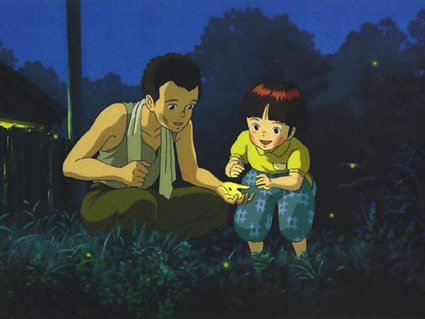
Grave of the Fireflies - w. & d. Isao Takahata (1988)


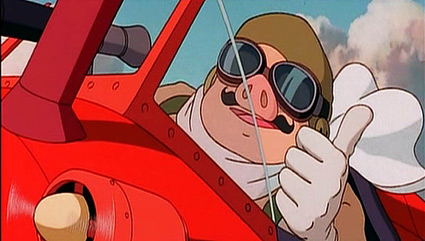
Porco Rosso - w. &
d. Hayao Miyazaki (1992)


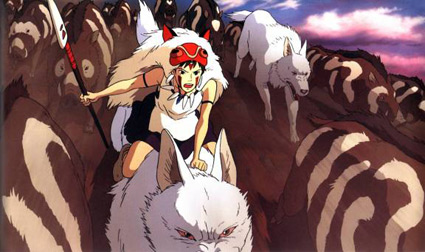
Princess Mononoke -
w. & d. Hayao Miyazaki (1997)


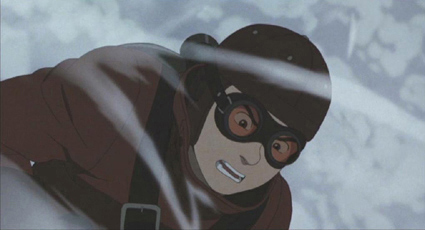
Steamboy - w. Sadayuki Murai & Katsuhiro Omoto, d. Katsuhiro Omoto (2004)


Tokyo Godfathers - w. Keiko Nobumoto & Satoshi Kon, d. Satoshi Kon (2003)


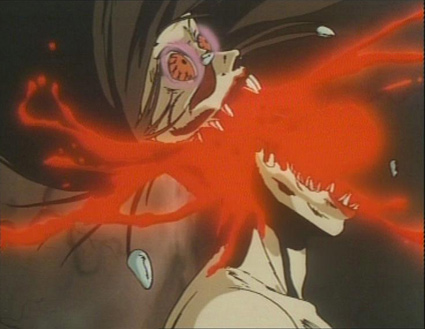
Urotsukidoji: Legend of the Overfiend & Legend of the Demon Womb - w. Noboru Aikawa, d. Hideki Takayama (1989 & 1991)


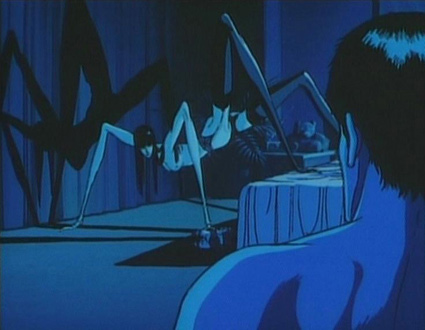
Wicked City - w. Kisei Choo, d. Yoshiaki Kawajiri (1987)


Reading:

Deleuze: An Introduction - Todd May
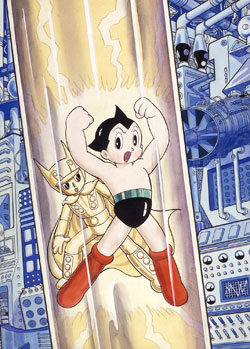
Tezuka: The Marvel of Manga (catalogue essays) - ed. Philip Brophy
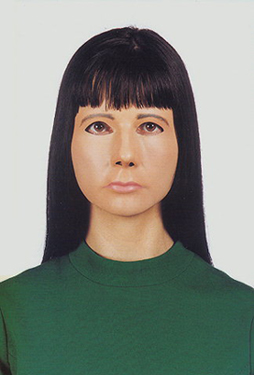
Gillian Wearing: Proof (catalogue essay) - Juliana Engberg

Listening:

The Complete String Quartets - Joseph Haydn
The Complete Symphonies - Joseph Haydn

Exhibitions:


Tezuka: The Marvel of Manga
- NGV (International)


Six Good Reasons To Stay at Home: Hiraki Sawa (video works) - NGV (International)


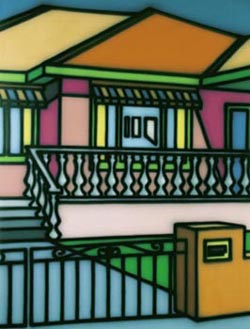
Howard Arkley -
NGV (Australia)


Light Sensitive: Contemporary Australian Photography from the Loti Smorgon Fund - NGV (Australia)


Living Proof: Gillian Wearing
- ACCA

Tuesday, November 21, 2006

Deadwood: David's Inferno


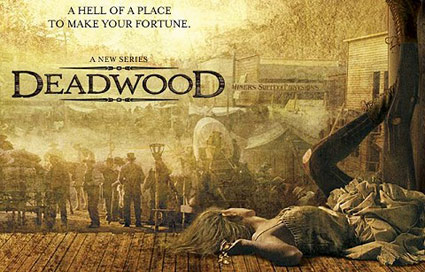
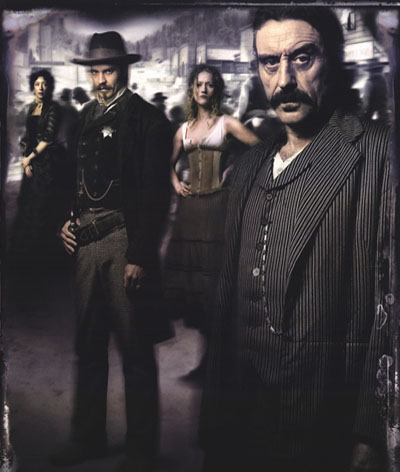
Deadwood (2004-2006) - created by David Milch


"Trust. Hell of a way to operate, huh?...Then all the ins and outs of gettin' killed...Every fuckin' beating I'm grateful for. Every fuckin' one of them. Get all the trust beat outa ya...Then you know what the fuckin' world is."

Al Swearengen (Ian McShane - above, far right)

(Deadwood, Episode Three - 'Reconnoitering the Rim': w. Jody Worth, d. Davis Guggenheim)

Al Swearengen

The proprietor of The Gem Saloon was six months ahead of everyone else in Deadwood, and he runs the town like a corrupt riverboat captain. He knows every move that every person in town makes, anticipates problems and eliminates them. His girls aren't exactly the class of the town, but he controls the most successful bar and whorehouse in all of Deadwood - bringing in $5,000 a day in 1876 - and anybody that threatens his sources of income may well end up fed to Mr. Wu's pigs.

Tim Driscoll, who helped facilitate Al's swindle of the city dude Brom Garret, met such a fate, as did Persimmon Phil, who deeds as a road agent brought too much attention to Al's enterprise. Garret himself was killed at Al's behest, though Swearengen eventually abandoned his efforts to retake the Garret claim. And when Mr. Wu came to Al to avenge a murdered opium courier, the saloon boss took care of things by personally drowning the guilty junky.

But Al's hands-on approach has earned him some enemies, and his main commercial rival, Cy Tolliver - proprietor of the more upscale Bella Union - is exploiting the Wu situation to fuel a full-on race war in Deadwood. Al suspects Tolliver of trying to expand his turf.

With outsiders expressing an interest in the wealthy outpost and government soldiers threatening to bring civilization to town, Al is under siege from several directions. And when the territory's magistrate threatens him with an outstanding murder warrant from Chicago, Al decides that the official is not to leave Deadwood alive.

For all his Mephistophelean qualities, Swearengen does have a soft spot for certain people, including the whore Trixie, Jewel, his handicapped house servant, and the brain-addled Reverend Jim, whom Al was forced to euthanize.

From HBO's Deadwood web site.