Showing posts with label Nietzsche. Show all posts

Monday, June 30, 2008

Having Left Las Vegas


Robert Delaunay - Joie de vivre, 1930


Musique Du Jour: Colours, Hot Chip


Saturday, May 03, 2008

The Thinking Person's Icarus


Caspar David Friedrich (1774 - 1840) - Wanderer Above a Sea of Mist, 1818


The higher we soar, the smaller we seem to those who cannot fly.

Friedrich Nietzsche

Replay III

Caspar David Friedrich (1774-1840): At The Crossroads of Art and Philosophy


A Walk at Dusk, c. 1830-35


We have art in order not to die of truth.

Friedrich Nietzsche

The philosopher creates, he doesn't reflect.

Gilles Deleuze

Happiness belongs to those who are sufficient unto themselves. For all external sources of happiness and pleasure are, by their very nature, highly uncertain, precarious, ephemeral and subject to chance.

Arthur Schopenhauer

Addendum IX

If Books Could Kill


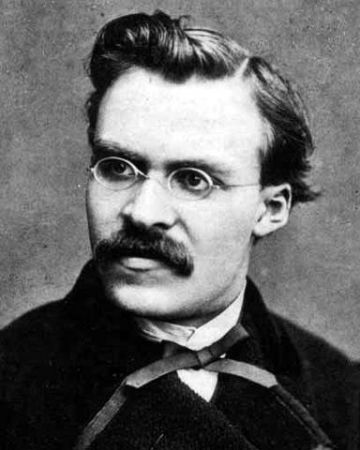
Friedrich Wilhelm Nietzsche (1844-1900) in Basel, c. 1875


All are lunatics, but he who can analyze his delusion is called a philosopher.

Ambrose Bierce

Monday, December 31, 2007

The Heroic Gaze


Jacques-Louis David - The Oath of the Horatii, 1784


'To find everything profound - that is an inconvenient trait.'

Friedrich Nietzsche

Friday, August 24, 2007

Go Mad Like It's 1899


Fight Club (soap), d. David Fincher, 1999


'Whoever has provoked men to rage against him has always gained a party in his favor, too.'

'Whoever despises himself nonetheless respects himself as one who despises.'

'There is more wisdom in your body than in your deepest philosophy.'

'The irrationality of a thing is no argument against its existence, rather a condition of it.'

'Of all that is written, I love only what a person has written with his own blood.'

Friedrich Nietzsche

Saturday, April 14, 2007

At The Crossroads Of Art And Philosophy


Caspar David Friedrich (1774-1840) - A Walk at Dusk, c. 1830-35


'We have art in order not to die of truth.'

Friedrich Nietzsche

'The philosopher creates, he doesn't reflect.'

Gilles Deleuze

'Happiness belongs to those who are sufficient unto themselves. For all external sources of happiness and pleasure are, by their very nature, highly uncertain, precarious, ephemeral and subject to chance. '

Arthur Schopenhauer

Wednesday, March 28, 2007

Black Hole Son


Charles Burns - Black Hole, 2005


"The thought of suicide is a powerful solace: by means of it one gets through many a bad night."

Friedrich Nietzsche

Thursday, February 15, 2007

The Virtues of Vicissitude


Peter Paul Rubens (1577-1640) - Prometheus Bound, 1611-12


'Whether it be hedonism, pessimism, utilitarianism, eudemonism - all of these ideas that measure the value of things according to pleasure or suffering, that is to say, according to secondary states and side-effects, are foreground ideas, and naive. Anyone conscious of having creative energies and an artist's conscience will look down on them not without mockery, but also not without pity. Pity for all of you! Although it is not pity in your sense, to be sure. It is not pity for social 'misery', for 'society' and its sick and injured, for the perennially depraved and downtrodden who lie around us everywhere; even less is it pity for the grumbling, oppressed, rebellious ranks of slaves who are looking to be masters (which they call 'being free'). Our pity is a more elevated, more far-sighted pity - we see how human beings are being reduced, how all of you are reducing them! And there are moments when we look at your pity especially with an indescribable anxiety, when we defend ourselves against this pity - when we find your seriousness more dangerous than any frivolity. If possible (and no 'if possible' can be more crazy) you want to abolish suffering! And we? - it seems that we want it to be, if anything, worse and greater than before! Well-being in your sense of the word - that certainly is no goal, it seems to us to be an end! A condition that would immediately make people ludicrous and contemptible - make us wish their downfall! The discipline of suffering, great suffering - don't you know that this discipline alone has created all human greatness to date? The tension of the soul in unhappiness, which cultivates its strength; its horror at the sight of great destruction; its inventiveness and bravery in bearing, enduring, interpreting, exploiting unhappiness, and whatever in the way of depth, mystery, mask, spirit, cleverness, greatness the heart has been granted - has it not been granted them through suffering, through the discipline of great suffering? In the human being, creature and creator are united: the human being is matter, fragment, excess, clay, filth, nonsense, chaos; but the human being is also creator, sculptor, hammer-hardness, observer-divinity, and the Seventh Day - do you not understand this opposition? Do you understand that you pity is for the 'creature in the human being', that which must be formed, broken, forged, torn, burned, annealed, purified - that which necessarily has to suffer and should suffer? And our pity - do you not understand whom our reversed pity is intended for, when it resists your pity as the worst of all possible self-indulgences and weaknesses?

Pity versus pity, then!'

From Beyond Good and Evil by Friedrich Nietzsche

Tuesday, January 16, 2007

American Prometheus


Alexander ('Lex') Joseph Luthor (Michael Rosenbaum) - Ep. 15, 'Nicodmeus', Smallville: Season One


'It is my good fortune that after the whole millennia of error and confusion I have rediscovered the way that leads to a Yes and a No.

I teach the No to all that makes weak - that exhausts.

I teach the Yes to all that strengthens, that stores up strength, that justifies the feeling of strength.

So far one has taught neither the one nor the other: virtue has been taught, mortification of the self, pity, even the negation of life. All these are the values of the exhausted.

Prolonged reflection on the physiology of exhaustion forced me to ask to what extent the judgements of the exhausted had penetrated the world of values.

My result was as surprising as possible, even for me who was at home in many a strange world: I found that all of the supreme value judgements - all that have come to dominate mankind, at least that part that has become tame - can be derived from the judgements of the exhausted.

Under the holiest names I pulled up destructive tendencies; one has called God what weakens, teaches weakness, infects with weakness. I found that the "good man" is one of the forms in which decadence affirms itself.

That virtue of which Schopenhauer still taught that it is the supreme, the only virtue, and the basis of all virtues - precisely pity I recognised as more dangerous that any vice. To cross as a matter of principle selection in the species and its purification of refuse - that has so far been called the virtue par excellence.

One should respect fatality - that fatality that says to the weak: perish!

One has called it God - that one resisted fatality, that one corrupted mankind and made it rot. One should not use the name of God in vain.

The race is corrupted - not by its vices but by its ignorance; it is corrupted because it did not recognise exhaustion as exhaustion: mistakes about physiological states are the sources of all ills.

Virtue is our greatest misunderstanding.

Problem: How did the exhausted come to make the laws about values? Put differently: How did those come to power who are the last? How did the instinct of the human animal come to stand on its head?'

From 'European Nihilism' (The Will to Power) by Friedrich Nietzsche

Monday, January 15, 2007

Smarter Than Jesus


'Genius and ideal state in contradiction. Socialists desire to produce a good life for the greatest number. If the enduring homeland of this good life, the perfect state, were really achieved, it would destroy the earth from which a man of great intellect, or any powerful individual grows: I mean great energy. When this state is achieved, mankind would have become too feeble to produce genius any longer. Should we not therefore wish that life retain its violent character, and that wild strengths and energies be called forth over and over again? Now, a warm, sympathetic heart desires precisely the elimination of that wild and violent character, and the warmest heart one can imagine would yearn for it most passionately; though this same passion would have its fire, its warmth, even its existence from that wild and violent character of life. The warmest heart, then, desires the elimination of its rationale and its own destruction; that is, it wants something illogical; it is not intelligent. The highest intelligence and the warmest heart cannot coexist in one person, and a wise man who passes judgement on life also places himself above kindness, considering it only as something to be evaluated along with everything else in the sum of life. The wise man must oppose the extravagant wishes of unintelligible kindness, because he cares about the survival of his type, and the eventual genesis of the highest intellect. At least he will not further the establishment of the "perfect state", if there is room there only for feeble individuals. Christ, on the other hand, whom we like to imagine as having the warmest of hearts, furthered men's stupidity, took the side of the intellectually weak, and kept the greatest intellect from being produced: and this was consistent. We can predict that his opposite, the absolute wise man, will just as necessarily prevent the production of a Christ.'

From 'Signs of Higher and Lower Culture' (Human, All Too Human) by Friedrich Nietzsche

Monday, December 18, 2006

Paradise Is Not A Box Of Chocolates


Friedrich Wilhelm Nietzsche (1844-1900) in Basel, c. 1875


"In heaven all the interesting people are missing."

"No price is too high for the privilege of owning yourself."

"To forget one's purpose is the commonest form of stupidity."

"Not by wrath does one kill, but by laughter."

"If you gaze long enough into the abyss, the abyss gazes back at you."

Friedrich Wilhelm Nietzsche

Friday, November 03, 2006

Thus Spake Friedrich Nietzsche


A Clockwork Orange - d. Stanley Kubrick (1971)


"God is Dead; but given the way of men, there may still be caves for thousands of years in which his shadow will be shown. And we - we still have to vanquish his shadow, too."

From Die fröhliche Wissenschaft by Friedrich Nietzsche

Thursday, October 05, 2006

The Incarnate Tartuffery Of Morals


Friedrich Wilhelm Nietzsche (1844-1900)


"All psychology has hitherto remained anchored to moral prejudices and timidities: it has not ventured into the depths. To conceive it as morphology and the development-theory of the will to power, as I conceive it - has never yet so much as entered the mind of anyone else: in so far as it is permissible to see in what has hitherto been written a symptom of what has hitherto been kept silent. The power of moral prejudices has penetrated deep into the most spiritual world, which apparently is the coldest and most free of presuppositions - and, as goes without saying, has there acted in a harmful, inhibiting, blinding, distorting fashion. A genuine physio-psychology has to struggle with unconscious resistances in the heart of the investigator, it has 'the heart' against it: even a theory of the mutual dependence of the 'good' and the 'wicked' impulses causes, as a more refined immorality, revulsion to a conscience still strong and hearty - and even more a theory of the derivation of all good impulses from wicked ones. Supposing, however, that someone goes so far as to regard the emotions of hatred, envy, covetousness, and lust for domination as life-conditioning emotions, as something which must be fundamentally and essentially be present in the total economy of life, consequently must be heightened further if life is to heightened further - he suffers from such a judgement as from seasickness. And yet even this hypothesis is far from being the strangest and most painful in this tremendous, still almost unexplored realm of dangerous knowledge - and there are in fact a hundred good reasons why everybody should keep away from it who - can! On the other hand: if your ship has driven into these seas, very well! Now clench your teeth! Keep your eyes open! Keep a firm hand on the helm! - We sail straight over morality and past it, we flatten, we crush perhaps what is left of our own morality by venturing to voyage thither - but what do we matter! Never yet has a deeper world of insight revealed itself to daring travellers and adventurers..."

From Beyond Good and Evil by Friedrich Nietzsche