Showing posts with label Magritte. Show all posts

Saturday, May 03, 2008

Coda III

The Creep of Reason Produces Cynics


René Magritte (1898-1967) - Golconde, 1953


After one look at this planet any visitor from outer space would say, "I want to see the manager."

William Burroughs

It is easy enough to say that man is immortal simply because he will endure: that when the last ding-dong of doom has clanged and faded from the last worthless rock hanging tideless in the last red and dying evening, that even then there will still be one more sound: that of his puny inexhaustible voice, still talking.

William Faulkner

The proof that man is the noblest of all creatures is that no other creature has ever denied it.

G. C. Lichtenberg

Every man bears the whole stamp of the human condition.

Michel de Montaigne

The good, say the mystics of spirit, is God, a being whose only definition is that he is beyond man's power to conceive - a definition that invalidates man's consciousness and nullifies his concepts of existence. The good, say the mystics of muscle, is Society - a thing which they define as an organism that possesses no physical form, a super-being embodied in no one in particular and everyone in general except yourself . . . The purpose of man's life, say both, is to become an abject zombie who serves a purpose he does not know, for reasons he is not to question.

Ayn Rand

The fact that man knows right from wrong proves his intellectual superiority to other creatures; but the fact that he can do wrong proves his moral inferiority to any creature that cannot.

Mark Twain

Man is a rational animal who always loses his temper when called upon to act in accordance with the dictates of reason.

Orson Welles

Friday, January 05, 2007

A Certain Nothingness


René Magritte (1898-1967) - The Treason of Images, 1928-9


'In order to understand Sartre's thought regarding the imagination, it is necessary to examine first an aspect of Husserl's phenomenology, the noetic/noematic structure of awareness. According to Husserl, it is a fact that we can be aware of the same object in different ways, of different objects in the same way, and also of different objects in different ways. For example, with respect to the object, I can perceive a table, a pen, and a framed picture; with respect to the mode of awareness, I can perceive a table, I can imagine a table, and I can remember a table - in each case, the same table. Husserl termed the object of awareness the noema and the mode of awareness of the object, the noesis. To understand Husserl's phenomenology on the problem of the imagination it is important to keep in mind that when I perceive this table or when I imagine this same table, I am aware of the same noema in two different modes. Of course, the image of he table is not the table, but by means of my apprehending the image of the table I have a secondary apprehension of the table itself. Sartre concerns himself with studying the essential difference between perception and imagination with respect to the modes in which each of these presents its object, rather than distinguishing as Husserl does between a primary and secondary apprehension. The object of perception is posited as real; that is, the object perceived is, in virtue of its being perceived, taken to be a real object. But in the case of the imagination either the object is posited as non-existent, as absent, as exiting elsewhere, or, in the neutral case, the object simply may not be posited as existing at all. Thus the characteristic possessed by an image that distinguishes the image from the object of perception is that, according to Sartre, the image ". . . involves a certain nothingness":
Alive, appealing and strong as an image is, it presents its object as not being. This does not prevent us from reacting to the image as if it were before us . . .
Regarding this distinction between perception and imagination, Sartre makes two observations. The first is that, in the case of perception, the object perceived is given against a background of total reality; the object is, as it were, the figure, and reality is the ground. The top of the desk now visible is part of the desk, itself part of what is in the room, and so on. In contrast to this mode of givenness of the perceived object is that of the imagined object. Instead of being given against the ground of the totality of the real, the imagined object is given (to take only one of the four possible modes listed above) precisely as absent, which is to say, the imagined object is given as something which is nothing in relation to the background of real things.

In virtue of this nothingness of the imagined object, it is necessary to take up the question: How is the nature of consciousness to be construed so that it will be possible to understand how consciousness can posit an image; that is, how consciousness can bring before itself an object that is nothing in relation to the contents of reality? It is Sartre's contention that, if consciousness were but one event among others in the world, and if it were also in thoroughgoing casual interaction with these other events, that there could be no awareness of images as images, as representations:
If we assume a consciousness placed at the very bosom of the world as one existence among others, we must conceive it hypothetically as completely subjected to the action of a variety of realities - without its being able to avoid the detail of these realities by an intuition which would embrace their totality. This consciousness could therefore contain only real modifications aroused by real actions and all imagination would be prohibited to it, exactly in the degree to which it would be engulfed by the real.
Sartre's thesis is that, in order for an image to be entertained as an image, consciousness must set the image over against the totality of the real, since the image is not one real item among others but merely a representation. But, in order for the imagination to posit the image as over against reality, it is necessary that consciousness not be "engulfed in the real" and determined in all its aspects by the causal efficacy of reality upon it. Consciousness has to disentangle itself from reality in order to posit the image as nothing in relation to the real, since, if such a disentanglement were not effected, the image could only be one other real item among others. As such, it would not be an image, but merely another item presented to consciousness because of the activity on consciousness of the other events that constitute reality. And it is just this ability to set itself over against the totality of the real that constitutes the freedom of consciousness:
For a consciousness to be able to imagine it must be able to escape from the world by its very nature, it must be able to by its own efforts to withdraw from the world. In a word it must be free.
This freedom from reality, this escaping from the world, is conceived by Sartre as definable correlatively to a (Heideggerian) being-in-the-world. In other words, consciousness can withdraw from the world on the ground of a logically prior being in the world. Consciousness, which has now been shown to be in essence imaginative, posits the image as a nothing in relation to the real in which consciousness is basically engaged but which, in virtue of its imaginativeness, it can transcend. . .

[The] concept of meaning for Sartre rests on his theory of imagination and therefore on the nature of freedom. Although consciousness is a being-in-the-world, there is yet a sense in which the concept of the world is not fundamental but rather derivative from the fact of the imaginativeness of consciousness. Simply stated, Sartre's point is that
The imaginary thus represents at each moment the implicit meaning of the real.
The real is what is simply there for awareness. Therefore, to apprehend the real as world, as a meaningful articulation of data, it is necessary that the real, the simply there, be surpassed toward the imaginary. The sense of this notion of surpassing toward the imaginary is that the situation directly confronted perceptually receives definition by having placed (metaphorically) alongside it an imaginative consciousness which is in an essential respect a reverse of the perceived situation. For example, I note the absence of my dictionary not simply because the dictionary is not perceptually encountered in the bookcase, but also because the imaginativeness of my consciousness places beside what I do perceive in the bookcase the image of the dictionary, an image which presents the dictionary as being absent. The real is what I immediately confront; the world is that same situation, meaningfully articulated by the imagination and set over against the consciousness that is there engaged:
. . . imagination, far from appearing as an actual characteristic of consciousness turns out to be an essential and transcendental condition of consciousness.
As well as of freedom in the world . . . '

From Existentialism as Philosophy by F. Molina

Monday, January 01, 2007

One Species (January Special)


René Magritte (1898-1967) - Portrait d'Edward James (La Reproduction Interdite), 1937


'Over the last thirty or more centuries, many things have undoubtedly been said about human beings. Yet these were often the products of reflection. What I mean by this is that Descartes, when he wanted to know what man is set about subjecting the ideas which occurred to him to critical examination. One example would be the idea of mind and body. He purified these ideas; he rid them of all trace of obscurity and confusion. Whereas most people understand spirit to be something like very subtle matter, or smoke, or breath (consistent, in this regard, with primitive peoples), Descartes showed admirably that spirit is something altogether different. He demonstrated that its nature is quite other, for smoke and breath are, in their way, things - even if very subtle ones - whereas spirit is not a thing at all, does not occupy space, is not spread over a certain extension as all things are, but on the contrary is entirely compact and indivisible - a being - the essence of which is none other than to commune with, collect and know itself. This gave rise to the concepts of pure spirit and pure matter, or things. Yet it is clear that I can only find and, so to speak, touch this absolutely pure spirit in myself. Other human beings are never pure spirit for me: I only know them through their glances, their gestures, their speech - in other words, through their bodies. Of course another human being is certainly more than simply a body to me: rather, this other is a body animated by all manner of intentions, the origin of numerous actions and words. These I remember and they go to make up my sketch of their moral character. Yet I cannot detach someone from their silhouette, the tone of their voice and its accent. If I see them for even a moment, I can reconnect with them instantaneously and far more thoroughly than if I were to go through a list of everything I know about them from experience or hearsay. Another person, for us, is a spirit which haunts a body and we seem to see a whole host of possibilities contained within this body when it appears before us; the body is the very presence of these possibilities. So the process of looking at human beings from the outside - that is, at other people - leads us to reassess a number of distinctions which once seemed to hold good such as that between mind and body.

Let us imagine what becomes of this distinction by examining a particular case. Imagine that I am in the presence of someone who, for one reason or another, is extremely annoyed with me. My interlocutor gets angry and I notice that he is expressing his anger by speaking aggressively, by gesticulating and shouting. But where is this anger? People will say that it is in the mind of the interlocutor. What this means is not entirely clear. For I could not imagine the malice and cruelty which I discern in my opponent's looks separated from his gestures, speech and body. None of this takes place in some other-worldly realm, in some shrine located beyond the body of the angry man. It really is here, in this room and in this part of the room, that the anger breaks forth. I would accept that the sense in which the place of my opponent's anger is on his face is not the same as that in which, in a moment, tears may come streaming from his eyes or a grimace may harden on his mouth. Yet anger inhabits him and it blossoms on the surface of his pale or purple cheeks, his blood-shot eyes and wheezing voice . . . And if, for one moment, I step out of my own viewpoint as an external observer of his anger and try to remember what it is like for me when I am angry, I am forced to admit that it is no different. When I reflect on my own anger, I do not come across any element that might be separated or, so to speak, unstuck, from my own body. When I recall being angry at Paul, it does not strike me that this anger was in my my mind or in my thoughts but rather, that it lay entirely between me who was doing the shouting and that odious Paul who just sat there calmly and listened with an ironic air. My anger is nothing less than the attempt to destroy Paul, one which will remain verbal if I am a pacifist and even courteous, if I am polite. The location of my anger, however, is in the space we both share - in which we exchange arguments instead of blows - and not in me. It is only afterwards, when I reflect on what anger is and remark that it involves a certain (negative) evaluation of another person, that I come to the following conclusion. Anger is, after all, a thought; to be angry is to think that the other person is odious and this thought, like all others, cannot - as Descartes has shown - reside in any piece of matter and therefore must belong to the mind. I may very well think in such terms but as soon as I turn back to the real experience of anger, which was the spur to my reflections, I am forced to acknowledge that this anger does not lie beyond my body, directing it from without, but rather that in some inexplicable sense it is bound up with my body.

There is something of everything in Descartes, as in the work of all great philosophers. And so it is that he who draws an absolute distinction between mind and body also manages to say that the soul is not simply like the pilot of a ship, the commander-in-chief of the body, but rather that it is very closely united to the body, so much so that it suffers with it, as is clear to me when I say that I have toothache.

Yet this union of mind and body can barely be spoken of, according to Descartes; it can only be experienced in everyday life. As far as Descartes is concerned, whatever the facts of the matter may be - and even if we live what he himself calls a true melange of mind and body - this does not take away from my right to distinguish absolutely between parts that are united in my experience. I can still posit, by rights, and absolute distinction between mind and body which is denied by the fact of their union. I can still define man without reference to the immediate structure of his being as he appears to himself in reflections: as thought which is somehow strangely joined to a bodily apparatus without either the mechanics of the body or the transparency of thought being compromised by their being mixed together in this way. It could be said that even Descartes' most faithful disciples have always asked themselves exactly how it is that our reflection, which concerns the human being as given, can free itself from the conditions to which it appears to have been subject at the outset.

This leaves us with a very different view of the human being and humanity from the one with which we began. Humanity is not an aggregate of individuals, a community of thinkers, each of whom is guaranteed from the outset to be able to reach agreement with the others because all participate in the same thinking essence. Nor, of course, is it a single Being in which the multiplicity of individuals are dissolved and into which these individuals are destined to be reabsorbed. As a matter of principle, humanity is precarious: each person can only believe what he recognises to be true internally and, at the same time, nobody thinks or makes up his mind without already being caught up in certain relationships with others, which leads him to opt for a a particular set of opinions. Everyone is alone and yet nobody can do without other people, not just because they are useful (which is not in dispute here) but also when it comes to happiness. There is no way of living with others which takes away the burden of being myself, which allows me to not have an opinion; there is no 'inner' life that is not a first attempt to relate to another person. In this ambiguous position, which has been forced on us because we have a body and a history (both personally and collectively), we can never know complete rest. We are continually obliged to work on our differences, to explain things we have said that have not been properly understood, to reveal what is hidden within us and to perceive other people. Reason does not lie behind us, nor is that where the meeting of minds takes place: rather, both stand before us waiting to be inherited. Yet we are no more able to reach them definitively than we are to give them up.

It is understandable that our species, charged as it is with a task that will never and can never be completed, and at which it has not necessarily been called to succeed, even in realtive terms, should find this situation both cause for anxiety and a spur to courage. In fact, these are one and the same thing. For anxiety is vigilance, it is the will to judge, to know what one is doing and what there is on offer. If there is no such thing as benign fate, then neither is there such a thing as its malign opposite. Courage consists in being reliant on oneself and others to the extent that, irrespective of differences in physical and social circumstances, all manifest in their behaviour and their relationships that very same spark which makes us recognise them, which makes us crave their assent or their criticism, the spark which means we share a common fate. It is simply that this modern form of humanism has lost the dogmatic tone of earlier centuries. We should no longer pride ourselves in being a community of pure spirits; let us look instead at the real relationships between people in our societies. For the most part, these are master-slave relationships. We should not find excuses for ourselves in our good intentions; let us see what becomes of these once they have escaped from inside us. There is something healthy about this unfamiliar gaze we are suggesting should be brought to bear on our species. Voltaire once imagined, in Micromégas, that a giant from another planet was confronted with our customs. These could only seem derisory to an intelligence higher than our own. Our era is destined to judge itself not from on high, which is mean and bitter, but in a certain sense from below. Kafka imagines a man who has metamorphosed into a strange insect and who looks at his family through the eyes of such an insect. Kafka also imagines a dog that investigates the human world which it rubs up against. He describes societies trapped in the carapace of customs which they themselves have adopted. In our day, Maurice Blanchot describes a city held fast in the grip of its laws: everyone is so compliant that all lose the sense of their difference and that of others. To look at human beings from the outside is what makes the mind self-critical and keeps it sane. But the aim should not be to suggest that all is absurd, as Voltaire did. It is much more a question of implying, as Kafka does, that human life is always under threat and of using humour to prepare the ground for those rare and precious moments at which human beings come to recognise, to find, one another.'

From 'Man Seen from the Outside' (in The World of Perception) by Maurice Merleau-Ponty

Saturday, November 25, 2006

Intimate Immensity: Part Three


René Magritte - The Listening Room (1958)


"Only thought can resemble. It resembles by being what it sees, hears, or knows; it becomes what the world offers it."

René Magritte

"The inner world is the world of your requirements and your energies and your structure and your possibilities that meets the outer world. And the outer world is the field of your incarnation. That's where you are. You've got to keep both going. As Novalis said, 'The seat of the soul is where the inner and outer worlds meet.' "

Joseph Campbell


"Immensity is within ourselves. It is attached to a sort of expansion of being that life curbs and caution arrests, but which starts again when we are alone. As soon as we becomes motionless, we are elsewhere; we are dreaming in a world that is immense. Indeed, immensity is the movement of the motionless man. It is one of the dynamic characteristics of quiet daydreaming.

And since we are learning philosophy from poets, here is a lesson in three lines, by Pierre Albert-Bireau:

And with a stroke of the pen I name myself
Master of the World
Unlimited man."
From The Poetics of Space by Gaston Bachelard

Thursday, November 23, 2006

Intimate Immensity: Part One


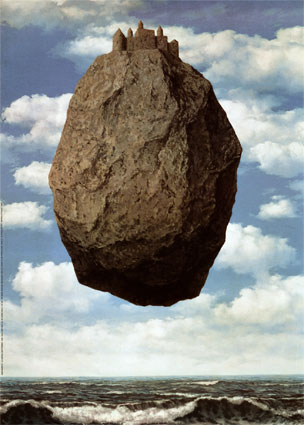
René Magritte - La Chateau des Pyrenees (1959)


"My painting is visible images which conceal nothing; they evoke mystery and, indeed, when one sees one of my pictures, one asks oneself this simple question: "What does it mean?" It does not mean anything, because mystery means nothing either. It is unknowable."

René Magritte

"Our thinking is largely discursive, verbal, linear. There is more reality in an image than a word."
Joseph Campbell


"One might say that immensity is a philosophical category of daydream. Daydream undoubtedly feeds on all kinds of sights, but through a sort of natural inclination, it contemplates grandeur. And this contemplation produces an attitude that is so special, an inner state that is so unlike any other, that the daydream transports the dreamer outside the immediate world to a world that bears the mark of infinity.

Far from the immensities of sea and land, merely through memory, we can recapture, by means of meditation, the resonances of this completion of grandeur. But is this really memory? Isn't imagination alone able to enlarge indefinitely the images of immensity? In point of fact, daydreaming, from the very first second, is an entirely constituted state. We do not see it start, and yet it always starts the same way, that is, it flees the object nearby and right away it is far off, elsewhere, in the space of elsewhere."

From The Poetics of Space by Gaston Bachelard

Saturday, November 11, 2006

Eleven Mirrors (November Special)


Hans Memling - Earthly Vanity (c. 1485)


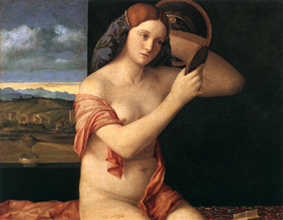
Giovanni Bellini - Naked Young Woman in Front of the Mirror (1515)


Parmigianino - Self-portrait in a Convex Mirror (c. 1524)


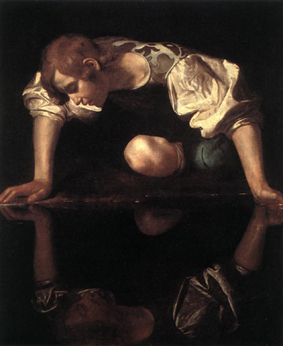
Michelangelo Merisi da Caravaggio - Narcissus (1598-99)


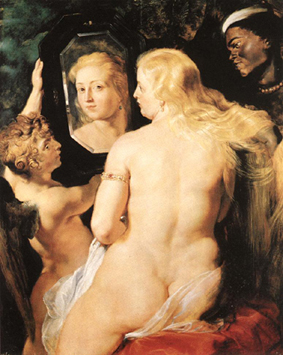
Peter Paul Rubens - Venus at a Mirror (c. 1615)


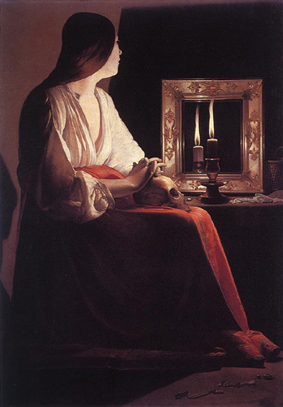
Georges de la Tour - The Penitent Magdalen (1638)


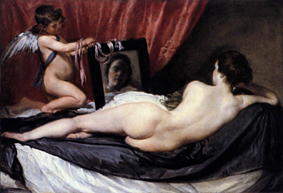
Diego Velasquez - Venus at her Mirror (1649-51)


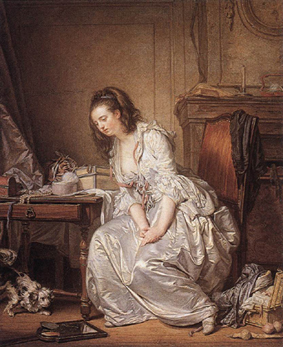
Jean- Baptiste Greuze - The Broken Mirror (1763)


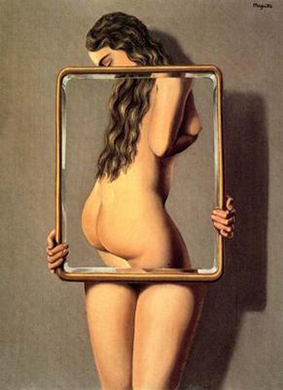
Rene Magritte - Dangerous Liaison (1926)


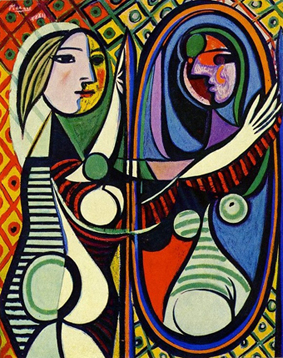
Pablo Picasso - Girl Before a Mirror (1932)


Barbara Kruger - Who's the Fairest of them All? (date unknown)


"The mirror reflects all objects without being sullied."

Confucious

Monday, October 23, 2006

The Discreet Agony of Impossible Intimacies: Part Three (Haptophobes)


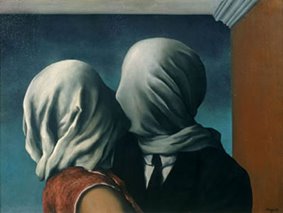
Rene Magritte - The Lovers (1928)


'What does it matter how many lovers you have if none of them gives you the universe?'

Jacques Lacan

Wednesday, October 18, 2006

The Immaterial Girl


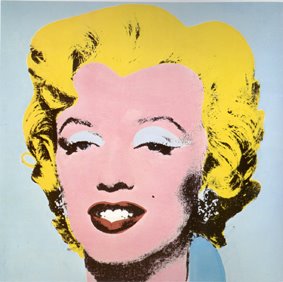
Andy Warhol - Marilyn (1964)


"Searching for Marilyn: the very title suggests not merely that Marilyn Monroe is now gone, but that she was never really there to begin with. Pop mythology has enshrined her as that poor, unfortunate woman stranded between two identities: Norma Jean and Marilyn, the real person and the fabricated Hollywood icon, the flickering candle and the imperishable myth. But the poignancy of Marilyn's story comes from the fact that she was as lost to herself as she would forever be to her idolaters. The modern pop ethos is as suspicious of pristine, innocent origins as it is in awe of transcendent, incandescent stardom. Through telemovies, songs and a flood of biographies both elevated and trashy, we rehearse the primal division of Marilyn from Norma, but we finally believe in the humanity of neither figure; both are mere creations, images. And these images consumed, to the point of death, the individual who fragilely incarnated them.

Marilyn was double, and she was also - even in her lifetime - ceaselessly redoubled. When tales of her decline began to circulate in the early '60s, ingénue Stella Stevens played a blonde, showbiz wannabe eaten away by self-doubt and hitting the barroom skids all the way to prostitution in John Cassavetes' Too Late Blues (1962). Stag movie loops from the 1950s fool even modern viewers with their naked, tawdry, look-alike Marilyns lolling about in an alcoholic, sexed-out, drug-induced haze - footage that, once recycled in Bruce Conner's 'found footage' avant garde '60s classic Marilyn Times Five or the Jennifer Jason Leigh erotic thriller Heart of Midnight (1988), now merges in the public consciousness with the latest revelations about suppressed photographs of a dissipated, partying Marilyn at some celebrity hideaway. In the '80s there was Madonna as Marilyn, the Material Girl recreating the staging of the "Diamonds Are a Girl's Best Friend" number from Gentlemen Prefer Blondes (1953) - but also, more on the independent/underground circuit, Australia's own Linda Kerridge in American movies including Mixed Blood (1984) by Warhol's ex-collaborator Paul Morrissey, a blonde bitch left alive just long enough after being shot in the head to be able to gaze on her blood-stained, white dress and laconically drawl: "I look like shit".

More than just about any another pop figure, Marilyn (like Elvis) is a mythic continuum holding together staggeringly diverse scenarios, associations and images: her early innocence and her late degradation; her inner naturalness and her prefabricated craft; her childlike charm and her 'bombshell' sexuality. She comes over as both domesticated and wild, guileless and predatory, scheming and dumb. All her most memorable movies, including Niagara (1953), Bus Stop (1956), Some Like It Hot (1959), The Misfits (1961) and Monkey Business (1952), play on the thrilling and ambiguous oscillation between these extreme possibilities contained in her persona.

Marilyn was born to cinema as a composite image in an era when - with the help of Widescreen and Technicolour - pop culture revelled in its own exaggerated artificiality and makeshift nature. Even in those years, the myth of Marilyn could scarcely be separated from the paroxysms of inspired infantilism offered by the likes of Mad magazine and Jerry Lewis comedies. It was only a small step from Marilyn to her grotesque parody, Jayne Mansfield (seized on gleefully as a screen icon by Lewis' mentor, Frank Tashlin, in The Girl Can't Help It [1956] and Will Success Spoil Rock Hunter? [1957]). Among her legion of serious commentators, Norman Mailer saw Marilyn as a forerunner (after Mae West) of camp irony, 'femininity as a masquerade'; just as Raymond Durgnat slipped easily from a study of her physical and facial mannerisms to a rumination on "the joke in female impersonation"."

Adrian Martin


"By comparing the primary effects of the Other's presence and those of his absence, we are in a position to say what the Other is. The error of philosophical theories is to reduce the Other sometimes to a particular object, and sometimes to another subject...But the Other is neither an object in the field of my perception nor a subject who perceives me: the Other is initially a structure of the perceptual field, without which the entire field could not function as it does. That this structure may be actualised by real characters, by variable subjects - me for you and you for me - does not prevent its pre-existence, as the condition of organisation in general, to the terms which actualise it in each organised perceptual field - yours and mine."

Gilles Deleuze


"I knew I belonged to the public and to the world, not because I was talented or even beautiful, but because I had never belonged to anything or anyone else."

Marilyn Monroe