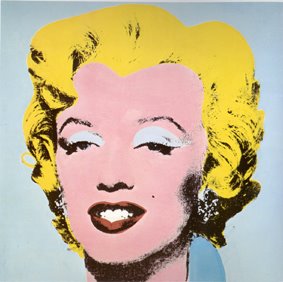
Andy Warhol - Marilyn (1964)
"Searching for Marilyn: the very title suggests not merely that Marilyn Monroe is now gone, but that she was never really there to begin with. Pop mythology has enshrined her as that poor, unfortunate woman stranded between two identities: Norma Jean and Marilyn, the real person and the fabricated Hollywood icon, the flickering candle and the imperishable myth. But the poignancy of Marilyn's story comes from the fact that she was as lost to herself as she would forever be to her idolaters. The modern pop ethos is as suspicious of pristine, innocent origins as it is in awe of transcendent, incandescent stardom. Through telemovies, songs and a flood of biographies both elevated and trashy, we rehearse the primal division of Marilyn from Norma, but we finally believe in the humanity of neither figure; both are mere creations, images. And these images consumed, to the point of death, the individual who fragilely incarnated them.
Marilyn was double, and she was also - even in her lifetime - ceaselessly redoubled. When tales of her decline began to circulate in the early '60s, ingénue Stella Stevens played a blonde, showbiz wannabe eaten away by self-doubt and hitting the barroom skids all the way to prostitution in John Cassavetes' Too Late Blues (1962). Stag movie loops from the 1950s fool even modern viewers with their naked, tawdry, look-alike Marilyns lolling about in an alcoholic, sexed-out, drug-induced haze - footage that, once recycled in Bruce Conner's 'found footage' avant garde '60s classic Marilyn Times Five or the Jennifer Jason Leigh erotic thriller Heart of Midnight (1988), now merges in the public consciousness with the latest revelations about suppressed photographs of a dissipated, partying Marilyn at some celebrity hideaway. In the '80s there was Madonna as Marilyn, the Material Girl recreating the staging of the "Diamonds Are a Girl's Best Friend" number from Gentlemen Prefer Blondes (1953) - but also, more on the independent/underground circuit, Australia's own Linda Kerridge in American movies including Mixed Blood (1984) by Warhol's ex-collaborator Paul Morrissey, a blonde bitch left alive just long enough after being shot in the head to be able to gaze on her blood-stained, white dress and laconically drawl: "I look like shit".
More than just about any another pop figure, Marilyn (like Elvis) is a mythic continuum holding together staggeringly diverse scenarios, associations and images: her early innocence and her late degradation; her inner naturalness and her prefabricated craft; her childlike charm and her 'bombshell' sexuality. She comes over as both domesticated and wild, guileless and predatory, scheming and dumb. All her most memorable movies, including Niagara (1953), Bus Stop (1956), Some Like It Hot (1959), The Misfits (1961) and Monkey Business (1952), play on the thrilling and ambiguous oscillation between these extreme possibilities contained in her persona.
Marilyn was born to cinema as a composite image in an era when - with the help of Widescreen and Technicolour - pop culture revelled in its own exaggerated artificiality and makeshift nature. Even in those years, the myth of Marilyn could scarcely be separated from the paroxysms of inspired infantilism offered by the likes of Mad magazine and Jerry Lewis comedies. It was only a small step from Marilyn to her grotesque parody, Jayne Mansfield (seized on gleefully as a screen icon by Lewis' mentor, Frank Tashlin, in The Girl Can't Help It [1956] and Will Success Spoil Rock Hunter? [1957]). Among her legion of serious commentators, Norman Mailer saw Marilyn as a forerunner (after Mae West) of camp irony, 'femininity as a masquerade'; just as Raymond Durgnat slipped easily from a study of her physical and facial mannerisms to a rumination on "the joke in female impersonation"."
Adrian Martin
"By comparing the primary effects of the Other's presence and those of his absence, we are in a position to say what the Other is. The error of philosophical theories is to reduce the Other sometimes to a particular object, and sometimes to another subject...But the Other is neither an object in the field of my perception nor a subject who perceives me: the Other is initially a structure of the perceptual field, without which the entire field could not function as it does. That this structure may be actualised by real characters, by variable subjects - me for you and you for me - does not prevent its pre-existence, as the condition of organisation in general, to the terms which actualise it in each organised perceptual field - yours and mine."
Gilles Deleuze
"I knew I belonged to the public and to the world, not because I was talented or even beautiful, but because I had never belonged to anything or anyone else."
Marilyn Monroe