Showing posts with label Kiefer. Show all posts

Saturday, May 03, 2008

Palimpsest IV


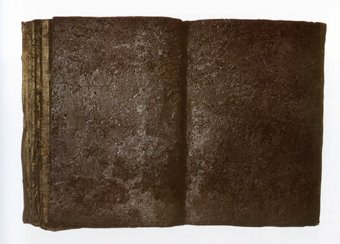
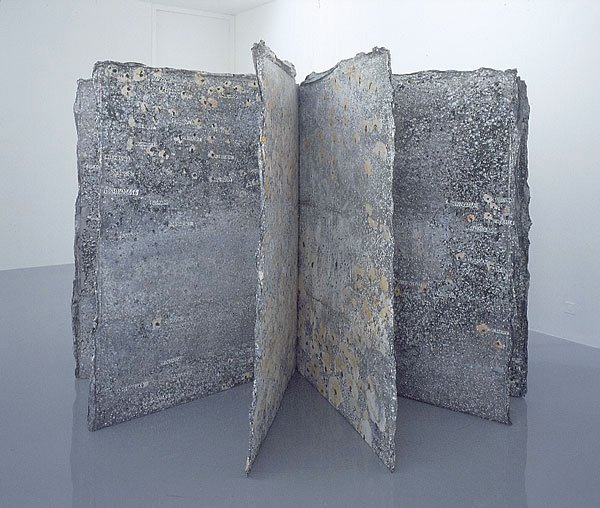
Anselm Kiefer (b. 1845) - Book With Wings, 1992-1994


Either write something worth reading or do something worth writing.

Benjamin Franklin

Friday, April 04, 2008

Eis, Wolken Und Wasser


Caspar David Friedrich (1774-1840) - The Sea of Ice, 1824


Gerhard Richter (b. 1932) - Seascape (Cloudy), 1969
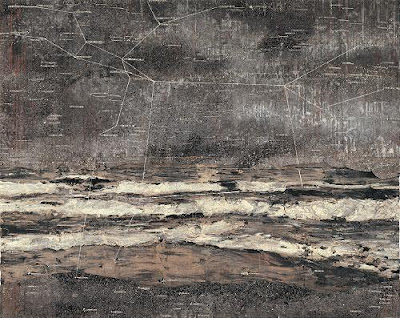


Anselm Kiefer (b. 1945) - Andromeda, 2001


1. 'We are standing at the edge of all the religions which have sprung from Catholicism. The abstractions are declining, everything is airier and lighter than that which has gone before. Everything strives towards landscape, searches for something certain in this uncertainty and does not know how to being. Those who reach back for history are wrong and only confuse themselves. Is then this new art - Landschafterey, if you want to call it that - not capable of reaching a pinnacle which will be even more beautiful than that of the previous art?'

2. 'When above me the sky swarms with with countless stars the wind blusters through the wide space, the wave breaks roaring in the wide night, over the forest the atmosphere reddens, and the sun lights up the world; the valley steams, and I throw myself on the grass sparkling with dewdrops. Every leaf and every blade of grass swarms with life, the earth is alive and stirs beneath me, everything rings in one chord, then the soul rejoices and flies in the immeasurable space around me. There is no up and no down any more, no time, no beginning and no end . . .'

3. 'This perception of the relationship of the whole universe to us; this joyful delight in the most intimate, vivid spirit in our soul; this unifying harmony, which in its buoyancy touches every string in our heart . . . We hold fast to the consummation of these feelings and in this way certain thoughts arise in us.

We express these thoughts in words, tones, or pictures and thus inspire the same feelings in the hearts of men near us.'

4. 'His work should not be for himself and his friends simply a picture, not merely a work of art, but rather should transmit the experience of nature, its processes and laws.'

5. 'The preset situation would lead much more towards the arabesque and hieroglyphs; and it is only from these that landscape must come forth - even as historical compositions also came from them . . .

It is necessary for one who wishes to express a magnificent concept through symbols and hieroglyphs, particularly if one desires to make such expressions public, that one considers the hieroglyphics as mere words which have been understood for some time and that they should be used in a new way, much like a musician who plays his instrument without being conscious of how he holds it. But if one tries to enjoy every individual aspect of the work and explain each note to others, then he will block himself off from the vital energy of the picture.'

Philipp Otto Runge (1777-1810)

Friday, July 20, 2007

Eternity Weeps When You Cut It In Half


Anselm Kiefer - Everyone Stands Under His Own Dome of Heaven, 1970


Ferdinand Victor Eugène Delacroix - Dante and Virgil in Hell, 1822


'Go to Heaven for the climate, Hell for the company.'

Mark Twain

Saturday, April 28, 2007

The Lazarus Machine


Anselm Kiefer (b. 1945) - Falling Stars, 1995


'I'm interested in reconstituting symbols. It's about connecting with an older knowledge and trying to discover continuities in why we search for heaven.'

Anselm Kiefer

Monday, October 30, 2006

Spellbound


Anselm Kiefer - The Cauterisation of the Rural District of Buchen (1974)


'Philosophy is a battle against the bewitchment of our intelligence by means of language.'

Ludwig Wittgenstein

Tuesday, October 03, 2006

What Is A Book?


Anselm Kiefer - The Secret Life of Plants (2002)


"What, in short, is the strange unit designated by the term, work? What is necessary to its composition, if a work is not something written by a person called an "author"?...If an individual is not an author, what are we to make of those things he has written or said, left among his papers or communicated to others? Is this not properly a work? What, for instance, were Sade's papers before he was consecrated as an author? Little more, perhaps, than roles of paper on which he endlessly unravelled his fantasies while in prison.

Assuming we are dealing with an author, is everything he wrote and said, everything he left behind, to be included in his work?...If we wish to publish the complete works of Nietzsche, for example, where do we draw the line? Certainly everything must be published, but can we agree on what "everything" means? We will, of course, include everything that Nietzsche himself published, along with the drafts of his works, his plans for aphorisms, his marginal notations and corrections. But what if, in a notebook filled with aphorisms, we find a reference, a reminder of an appointment, an address, or a laundry bill, should this be included in his works? Why not?...Such questions only begin to suggest the range of our difficulties, and, if some have found it convenient to bypass the individuality of the writer or his status as an author to concentrate on a work, they have failed to appreciate the equally problematic nature of the word "work" and the unity it designates."

From What is an Author? by Michel Foucault