The Grammar of Becoming
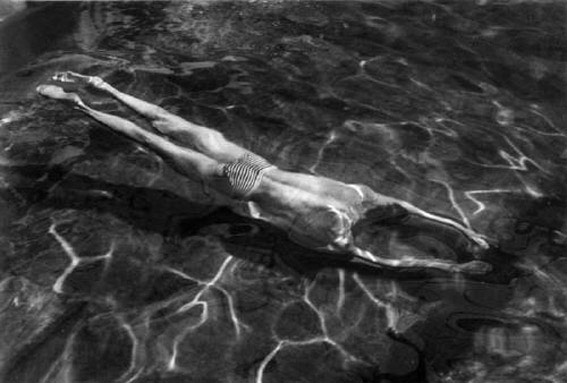
André Kertész - Underwater Swimmer (1917)
To learn is to enter into the universal of the relations which constitute the Idea, and into their corresponding singularities. The idea of the sea, for example, as Leibniz showed, is a system of liaisons or differential relations between particulars and singularities corresponding to the degree of variation among these relations - the totality of the system being incarnated in the real movement of the waves. To learn to swim is to conjugate the distinctive points of our bodies with the singular points of the objective Idea in order to form a problematic field.
From Difference and Repetition by Gilles Deleuze
What does learning consist in? Here is a traditional view: learning is a matter of memorising something that somebody else knows. It sounds simplistic, if we put it that way. But who among us has not attended high school and college and has not been subjected to this view of learning? A teacher, a professor, stands before the class, chalk or transparencies in hand. There are things you need to learn, items you need to know. Before the class period is over, these things will be transferred from the teacher's lecture notes, the professor's transparencies, to your notebook. From there, these things will be transferred to your brain. When those transfers are successful, you will be said to have learned what the teacher, the professor, has taught you.
It is a meager model of learning. It is also the most common one. It is a model that operates on some surface assumptions and a slightly deeper one. Its surface assumptions are, first, that the teacher knows what there is to know about a subject and you do not. Second, there is the assumption that the way that you learn what the teacher knows is to listen to the teacher and commit to memory what he or she has to say. Last, on the teacher's side, there is the assumption that by talking or using other media to substitute for talking, the teacher can impart to the student what needs to be known.
The slightly deeper assumption has to do with the dogmatic image of thought. It is the assumption that what is to be learned comes in discrete packets of identities. There are particular somethings that need to be known. These somethings may be related to one another or they may not. In either case, they are independent enough from one another to be isolated each to a sentence, a paragraph, or a chapter. These somethings are then represented by the sentences spoken by the teacher or professor, and then arrive at your ear or on your paper. If the learning us successful, there will have been no alteration, no damage, of any of these somethings along the way. Their identities will retain their integrity. And if you do your job you will be able to repeat or manipulate these identities when test time comes around.
There is another view of learning that does not start with the assumption that what is to be learned has the character of an identity or group of identities. It starts instead from the assumption that what there is to be learned has the character of difference rather than identity. If what is to be learned does not have the character of identity, then the learning itself is not a project of transferring identities from the knower to the one who seeks to know. It is instead a project of experimentation.
Swimmers do not learn facts about the water and about their bodies and then apply them to the case in hand. The water and their bodies are swarms of differences. In order to navigate their bodies through the water they will need to acquire a skill: to "conjugate" their bodies with the water in such a way as to stay on its surface. This skill involves no memorisation. It involves an immersion, a finding one's way through things, coming through one's body to understand what one is capable of in the water. There is no one way to do this, and different ways may lead to different kinds of success. There are also failures; water may be composed of differences, but not every path through those differences will keep one afloat.
Swimmers apprentice themselves to the water. They get a feel for the water, for how it moves and what possibilities it offers them. They get a feel for their bodies in the water. And they conjugate one against the other. The couplet body/water is a problematic field...Particular ways of swimming are solutions within that problematic field. They do not solve the problem of swimming. For there is no single problem of swimming. There is instead a problematic field of body/water, of which particular ways of swimming are solutions. They are experiments in conjugation of this problematic field, much of which takes place below the level of conscious thought, beneath the identities representation offers us: "'learning' always takes place in and through the unconscious, thereby establishing a profound complicity between nature and mind." [Deleuze, Difference and Repetition]
What does learning how to think consist in? Unlike learning how to swim, it first requires the abandonment of bad habits. These habits are the ones instilled in all of us by the dogmatic image of thought and its representational view of language and the world. We must discover this image and this view; we must see what roles they play in preventing us from really thinking.
But that is not all. That is only the negative task, the clearing of the ground. Alongside this abandonment we must also experiment in ways of thinking. We must conjugate our thought and our world, our thought and our language.
There are those who have gone before us, who have swum in this water before: Spinoza, Bergson, Nietzsche among them. They may help ease us into the water, teach us some of the strokes, so we don't drown before we get started. We can apprentice ourselves to them. Sooner or later, however, we must push off from the shore and conjugate things for ourselves...[We] must do it for ourselves, each of us...
There are two mistakes we might make in considering the prospect of learning to think. The first mistake would be to assume that thinking, unlike swimming, is a purely conscious activity, that thinking is a manipulation of thought. That mistake is our inheritance from the dogmatic image of thought. We feel our way into thinking in much the same way as we feel our way into swimming. Thinking is at least as unconscious as it is conscious, and it is no less an experiment...The second mistake would be to assume that each of us must face this task alone. In fact, we can face it in groups, conjugating ourselves with one another as well as with the world. Thinking does not need to be a solitary activity, and it surely does not take place in a world which we do not share with others...[We might] consider our place among others in the world, to think about it, or with it, or in it.
From Gilles Deleuze: An Introduction by Todd May
Philosophy is a battle against the bewitchment of our intelligence by means of language.
To learn is to enter into the universal of the relations which constitute the Idea, and into their corresponding singularities. The idea of the sea, for example, as Leibniz showed, is a system of liaisons or differential relations between particulars and singularities corresponding to the degree of variation among these relations - the totality of the system being incarnated in the real movement of the waves. To learn to swim is to conjugate the distinctive points of our bodies with the singular points of the objective Idea in order to form a problematic field.
From Difference and Repetition by Gilles Deleuze
What does learning consist in? Here is a traditional view: learning is a matter of memorising something that somebody else knows. It sounds simplistic, if we put it that way. But who among us has not attended high school and college and has not been subjected to this view of learning? A teacher, a professor, stands before the class, chalk or transparencies in hand. There are things you need to learn, items you need to know. Before the class period is over, these things will be transferred from the teacher's lecture notes, the professor's transparencies, to your notebook. From there, these things will be transferred to your brain. When those transfers are successful, you will be said to have learned what the teacher, the professor, has taught you.
It is a meager model of learning. It is also the most common one. It is a model that operates on some surface assumptions and a slightly deeper one. Its surface assumptions are, first, that the teacher knows what there is to know about a subject and you do not. Second, there is the assumption that the way that you learn what the teacher knows is to listen to the teacher and commit to memory what he or she has to say. Last, on the teacher's side, there is the assumption that by talking or using other media to substitute for talking, the teacher can impart to the student what needs to be known.
The slightly deeper assumption has to do with the dogmatic image of thought. It is the assumption that what is to be learned comes in discrete packets of identities. There are particular somethings that need to be known. These somethings may be related to one another or they may not. In either case, they are independent enough from one another to be isolated each to a sentence, a paragraph, or a chapter. These somethings are then represented by the sentences spoken by the teacher or professor, and then arrive at your ear or on your paper. If the learning us successful, there will have been no alteration, no damage, of any of these somethings along the way. Their identities will retain their integrity. And if you do your job you will be able to repeat or manipulate these identities when test time comes around.
There is another view of learning that does not start with the assumption that what is to be learned has the character of an identity or group of identities. It starts instead from the assumption that what there is to be learned has the character of difference rather than identity. If what is to be learned does not have the character of identity, then the learning itself is not a project of transferring identities from the knower to the one who seeks to know. It is instead a project of experimentation.
Swimmers do not learn facts about the water and about their bodies and then apply them to the case in hand. The water and their bodies are swarms of differences. In order to navigate their bodies through the water they will need to acquire a skill: to "conjugate" their bodies with the water in such a way as to stay on its surface. This skill involves no memorisation. It involves an immersion, a finding one's way through things, coming through one's body to understand what one is capable of in the water. There is no one way to do this, and different ways may lead to different kinds of success. There are also failures; water may be composed of differences, but not every path through those differences will keep one afloat.
Swimmers apprentice themselves to the water. They get a feel for the water, for how it moves and what possibilities it offers them. They get a feel for their bodies in the water. And they conjugate one against the other. The couplet body/water is a problematic field...Particular ways of swimming are solutions within that problematic field. They do not solve the problem of swimming. For there is no single problem of swimming. There is instead a problematic field of body/water, of which particular ways of swimming are solutions. They are experiments in conjugation of this problematic field, much of which takes place below the level of conscious thought, beneath the identities representation offers us: "'learning' always takes place in and through the unconscious, thereby establishing a profound complicity between nature and mind." [Deleuze, Difference and Repetition]
What does learning how to think consist in? Unlike learning how to swim, it first requires the abandonment of bad habits. These habits are the ones instilled in all of us by the dogmatic image of thought and its representational view of language and the world. We must discover this image and this view; we must see what roles they play in preventing us from really thinking.
But that is not all. That is only the negative task, the clearing of the ground. Alongside this abandonment we must also experiment in ways of thinking. We must conjugate our thought and our world, our thought and our language.
There are those who have gone before us, who have swum in this water before: Spinoza, Bergson, Nietzsche among them. They may help ease us into the water, teach us some of the strokes, so we don't drown before we get started. We can apprentice ourselves to them. Sooner or later, however, we must push off from the shore and conjugate things for ourselves...[We] must do it for ourselves, each of us...
There are two mistakes we might make in considering the prospect of learning to think. The first mistake would be to assume that thinking, unlike swimming, is a purely conscious activity, that thinking is a manipulation of thought. That mistake is our inheritance from the dogmatic image of thought. We feel our way into thinking in much the same way as we feel our way into swimming. Thinking is at least as unconscious as it is conscious, and it is no less an experiment...The second mistake would be to assume that each of us must face this task alone. In fact, we can face it in groups, conjugating ourselves with one another as well as with the world. Thinking does not need to be a solitary activity, and it surely does not take place in a world which we do not share with others...[We might] consider our place among others in the world, to think about it, or with it, or in it.
From Gilles Deleuze: An Introduction by Todd May
Philosophy is a battle against the bewitchment of our intelligence by means of language.
Ludwig Wittgenstein