Showing posts with label Bacon. Show all posts

Sunday, April 20, 2008

Palimpsest I

With A Little Help From His Replicators


Maurizio Cattelan (b. 1960) - Untitled, 2002


The Little Artists - Maurizio Cattelan's La Ballata di Trotsky (The Ballad of Trotsky), 1996


'You see, all art has now become completely a game by which man distracts himself; and you may say it has always been like that, but now it's entirely a game. And I think that that is the way things have changed, and what is fascinating now is that it's going to become much more difficult for the artist, because he must really deepen the game to be any good at all.'

Francis Bacon

Tuesday, April 15, 2008

Trilogies Of Obscene Beauty And Operatic Carnage


Francis Bacon (1909-1992) - Second Version of Triptych 1944, 1988


'I've always been very moved by pictures about slaughterhouses and meat, and to me that belong very much to the whole thing of the Crucifixion. There've been extraordinary photographs which have been done of animals just being taken up before they were slaughtered; and the smell of death. We don't know, of course, but it appears by these photographs that they're so aware of what is going to happen to them, they do everything to attempt to escape. I think these pictures were very much based on that kind of thing, which to me is very, very near this whole thing of the Crucifixion. I know for religious people, for Christians, the Crucifixion has a totally different significance. But as a non-believer, it was just an act of man's behaviour, a way of behaviour to another.' FB

'Well, of course, you're working then about you're own feelings and sensations, really. You might say it's almost nearer to a self portrait. You're working on all sorts of very primitive feelings about behaviour and about the way life is. . . . If you go to some of those great stores, where you just go through those great halls of death, you can see meat and fist and birds and everything else all lying dead there. And, of course, one has to remember as a painter that there is great beauty in the colour of meat.' FB

'Well, of course, we are meat, we are potential carcasses. If I go into a butcher's shop I always think it's surprising that I wasn't there instead of the animal.' FB


'Pity the meat! Meat is undoubtedly the chief object of Bacon's pity, his only object of pity, is Anglo-Irish pity. . . . Meat is not dead flesh; it retains the sufferings and assumes all the colourings of living flesh. It manifests such convulsive pain and vulnerability, but also such delightful invention, colour, and acrobatics. Bacon does not say, "Pity the beasts", but rather that every man who suffers is a piece of meat. Meat is the common zone of man and the beast, their zone of indiscernibility; it is a "fact", a state where the painter identifies with the objects of his horror and his compassion. The painter is certainly a butcher, but he goes to a butcher shop as if it were a church, with meat as the crucified victim.'

Gilles Deleuze


'Their anatomy was half-human, half-animal, and they were confined in a low-ceilinged, windowless and oddly proportioned space. They could bite, probe, and suck, and they had very long eel-like necks, but their functioning in other respects was mysterious. Ears and mouths they had, but two at least were sightless. One was bandaged. The left-hand figure had the hairstyle of a female jail-bird. At shoulder-level it had what might have been mutilated wing-stumps. An inch or two below these there was drawn tight what might have been either a shower curtain or a pair of outsized pajama trousers. Set down on what looked like a metal stool, the figure was trashing round as if to savage whatever came within biting distance. The central figure, anatomically somewhat like a dis-feathered ostrich, had a human mouth, heavily bandaged, set at the end of its long, thick tubular neck.

What that neck might have looked like without the bandage was indicated by the right-handed figure. It had big ears at the corner of its mouth, and was able to open that mouth to an angle of about ninety degrees. It's one visible leg was as much a sofa-leg as an animal leg, and the patch of grass on which it stood was nearer to a bed of nails than to the shaven lawns of Oxford and Cambridge.

Common to all three figures was a mindless voracity, an automatic unregulated gluttony, a ravening undifferentiated capacity for hatred. Each was if as cornered, and only waiting for the chance to drag the observer down to its own level.'

John Russell


'With hindsight, it is evident that the Crucifixion theme in Bacon's art evolved in several distinct stages. First, there are his early attempts to address the subject in largely abstract terms, with the aim of modernising it or giving it a contemporary twist. Second, there is the revolt against the motif, which is seen as nothing but a hollow convention: the figures rise up against it, repudiating it and categorically denying its authenticity. This is followed by a transitional phase in which the theme appears to have been abandoned; but in fact, it returns through the back door, in a different and disturbing guise. The crucified body is 'costumed' as a carcass, a piece of butcher's meat. Golgotha has moved to the abattoir.

In the fourth phase the Crucifixion theme is grafted onto the triptych form. This development is ushered in by Three studies for a Crucifixion, painted in 1962 at the end of an eighteen-year period when the triptych was effectively eliminated from Bacon's repertoire. From the mid-1960s onwards, the format was Bacon's most important vehicle of artistic expression: that he should abandon it again became quite unthinkable. At the same time, the theme of the Crucifixion began to recede into the background. It was as if the subject had dissolved into something more general, as a ground or premise underlying all the subsequent triptychs but no longer requiring explicit mention.'

Wieland Schmeid

Monday, April 14, 2008

God's Butcher And His Unholy Worm


Francis Bacon (1909-1992) - Crucifixion, May 1962


DAVID SYLVESTER: Now, in some of your most recent paintings you've both been using strong background colours and gone back to precise and sculptural sort of forms...Do you have a general desire now to make the form more clear and precise?

FRANCIS BACON: Oh yes, the clearer and more precise the better. Of course, how to be clear and precise is a terribly difficult thing now. And I think that's the problem for all painters now, or at any rate painters who are absorbed in a subject in a figurative thing. They just want to make it it more and more precise; but of a very ambiguous precision.

DS: In painting this Crucifixion, did you have the three canvases up simultaneously, or did you work on them quite separately?

FB: I worked on them separately and, gradually, as I finished them, I worked on the three across the room together. It was a thing that I did in about a fortnight, when I was in a bad mood of drinking, and I did it under tremendous hangovers and drink; I sometimes hardly knew what I was doing. And it's one of the only pictures that I've been able to do under drink. I think perhaps the drink made me feel a bit freer.

DS: Have you been able to do the same in any picture that you've done since?

FB: I haven't. But I think with great effort I'm making myself freer. I mean, you either have to do it through drugs or drink.

DS: Or extreme tiredness?

FB: Extreme tiredness? Possibly. Or will.

DS: The will to lose one's will?

FB: Absolutely. The will to make oneself completely free. Will is the wrong word, because in the end you could call it despair. Because it really comes out of an absolute feeling of it's impossible to do these things, so I might as well just do anything. And out of this, one sees what happens.

DS: Did the actual placing of the figures change while you were doing this triptych, or did you see them before you started painting?


FB: I did, but they did change continuously. But I did see them, and the figure on the right is something which I have wanted to do for a long time. You know the great Cimabue Crucifixion? I always think of that as an image - as a worm crawling down a cross. I did try to make something of feeling which I've sometimes had from that picture of this image just moving, undulating down the cross.


Cimabue (c. 1240 - c. 1302) - Crucifixion, 1287-88


DS: And of course this is one of a number of existing images you've used.

FB: Yes, they breed other images for me. And of course one's always hoping to renew them.

Monday, April 07, 2008

Energies And Enigmas Of The Visible


Francis Bacon (1909-1992) - Figure in Frame, 1950


'FRANCIS BACON: I always think of myself not so much as a painter but as medium for accident and chance.

DAVID SYLVESTER: Why do you say that?

FB: Because...I don't think I'm gifted. I think I'm just receptive.

DS: To some energy in the ether, so to speak?

FB: I think I'm energetic in myself and I think I'm very receptive to energy. By all this I hope you won't get the idea that I think I'm inspired. I just think I receive.'

From The Brutality of Fact: Interviews with Francis Bacon by David Sylvester


'In short, it is not movement that explains the levels of sensation, it is the levels of sensation that explain what remains of movement. And in fact, what interests Bacon is not exactly movement, although his painting makes movement very intense and violent. But in the end, it is a movement "in-place", a spasm, which reveals a completely different problem characteristic of Bacon: the action of invisible forces in the body (hence the bodily deformations, which are due to this more profound cause).'

From Francis Bacon: The Logic of Sensation by Gilles Deleuze

Monday, January 22, 2007

Bill's Bounty


Willem van Aelst (1627-1683) - Still Life with Fruit, c. 1660


"The sun, with all those plants revolving around it and dependent upon it, can still ripen a bunch of grapes as if it had nothing else in the universe to do."

Galileo Galilei

"Nature, to be commanded, must be obeyed."

Francis Bacon (Novum Organum)

"I've made an odd discovery. Every time I talk to a savant I feel quite sure that happiness is no longer a possibility. Yet when I talk with my gardener, I'm convinced of the opposite."

Bertrand Russell

"And this our life, exempt from public haunt,
Finds tongues in trees, books in the running brooks,
Sermons in stones, and good in everything."

William Shakespeare (As You Like It)

"What nature requires is obtainable, and within easy reach. It is for the superfluous that we sweat."

Seneca (Letters to Lucilius)

Thursday, December 07, 2006

Planet Of The Meat Puppets


Francis Bacon (1909-1992) - Self Portrait, 1971


"The moment you know what to do you're just making another sort of illustration."

"An illustrational form tells you through the intelligence immediately what the form is about, whereas a non-illustrational form works first upon sensation and then leaks back into the fact."

"The job of the artist is always to deepen the mystery."

"There is an area of the nervous system to which the texture of paint communicates more violently than anything else."

"When I am painting I am ageless. I just have the difficulty or pleasure of painting."

"Before I start painting I have a slightly ambiguous feeling: happiness is a special excitement because unhappiness is always possible a moment later."

"You could say that I have no inspiration, that I only need paint."

"My painting is not violent; it's life that is violent."

"The creative process is a cocktail of instinct, skill, culture and a highly creative feverishness. It's not like a drug; it is a particular state when everything happens very quickly, a mixture of consciousness and unconsciousness, of fear and pleasure; it's a little like making love, the physical act of love."

"It (painting) can be as violent as fucking, like an orgasm or ejaculation. The result is often disappointing, but the process is highly exciting."

Francis Bacon

Wednesday, November 29, 2006

Forgotten Faces


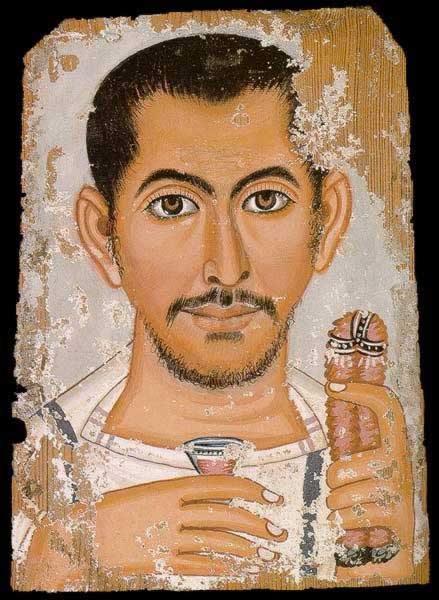
Funerary Portrait Painting of a Man from the Roman Period. (This portrait dates from the third to the fourth centuries AD. The narrow stripes on the man's tunic identify his rank as equestrian, and he holds a glass of red wine and a rose petal wreath.)


"Be absolute for death; either death or life
Shall thereby be the sweeter. Reason thus with life:
If I do lose thee, I do lose a thing
That none but fools would keep: a breath thou art,
Servile to all the skyey influences,
That dost this habitation, where thou keep'st,
Hourly afflict: merely, thou art death's fool;
For him thou labour'st by thy flight to shun
And yet runn'st toward him still. Thou art not noble;
For all the accommodations that thou bear'st
Are nursed by baseness. Thou'rt by no means valiant;
For thou dost fear the soft and tender fork
Of a poor worm. Thy best of rest is sleep,
And that thou oft provokest; yet grossly fear'st
Thy death, which is no more. Thou art not thyself;
For thou exist'st on many a thousand grains
That issue out of dust. Happy thou art not;
For what thou hast not, still thou strivest to get,
And what thou hast, forget'st. Thou art not certain;
For thy complexion shifts to strange effects,
After the moon. If thou art rich, thou'rt poor;
For, like an ass whose back with ingots bows,
Thou bear's thy heavy riches but a journey,
And death unloads thee. Friend hast thou none;
For thine own bowels, which do call thee sire,
The mere effusion of thy proper loins,
Do curse the gout, serpigo, and the rheum,
For ending thee no sooner. Thou hast nor youth nor age,
But, as it were, an after-dinner's sleep,
Dreaming on both; for all thy blessed youth
Becomes as aged, and doth beg the alms
Of palsied eld; and when thou art old and rich,
Thou hast neither heat, affection, limb, nor beauty,
To make thy riches pleasant. What's yet in this
That bears the name of life? Yet in this life
Lie hid moe thousand deaths: yet death we fear,
That makes these odds all even."


Duke Vincentio from Measure for Measure (III, i) by William Shakespeare


"Ay, but to die, and go we know not where;
To lie in cold obstruction and to rot;
This sensible warm motion to become
A kneaded clod; and the delighted spirit
To bathe in fiery floods, or to reside
In thrilling region of thick-ribbed ice;
To be imprison'd in the viewless winds,
And blown with restless violence round about
The pendent world; or to be worse than worst
Of those that lawless and incertain thought
Imagine howling: 'tis too horrible!
The weariest and most loathed worldly life
That age, ache, penury and imprisonment
Can lay on nature is a paradise
To what we fear of death."

Claudio from Measure for Measure (III, i) by William Shakespeare


"Because I could not stop for Death,
He kindly stopped for me.
The Carriage held but just ourselves
And Immortality"

Emily Dickinson


"People do not die for us immediately, but remain bathed in a sort of aura of life which bears no relation to true immortality but through which they continue to occupy our thoughts in the same way as when they were alive. It is as though they were travelling abroad."

Marcel Proust


"For life in the present there is no death. Death is not an event in life. It is not a fact in the world."

Ludwig Wittgenstein


"Life is pleasant. Death is peaceful. It's the transition that's troublesome."

Isaac Asimov


"Most people think life sucks, and then you die. Not me. I beg to differ. I think life sucks, then you get cancer, then your dog dies, your wife leaves you, the cancer goes into remission, you get a new dog, you get remarried, you owe ten million dollars in medical bills but you work hard for thirty five years and you pay it back and then one day you have a massive stroke, your whole right side is paralyzed, you have to limp along the streets and speak out of the left side of your mouth and drool but you go into rehabilitation and regain the power to walk and the power to talk and then one day you step off a curb at Sixty-seventh Street, and BANG you get hit by a city bus and then you die. Maybe."

Denis Leary


"A man's dying is more the survivors' affair than his own."

Thomas Mann


"Men fear death as children fear to go in the dark; and as that natural fear in children is increased with tales, so is the other."

Francis Bacon


"I don't want to achieve immortality through my work. I want to achieve it through not dying."

Woody Allen


Links:

Ancient Faces: Mummy Portraits from Roma Egypt (Metropolitan Museum of Art, New York)

Fayum Portraits Website

Proportion and Personality in Fayum Portraits by A. J. N. W. Prag (PDF)