Monday, December 11, 2006

For Those Days When Art Just Gives You The Shits


Piero Manzoni (1933-63) - Merda d'artista (Artist's Shit), 1961


"Piero Manzoni was an Italian artist who died at the age of 29 in 1963. But before he went he got some excrement - his own - and put it in a tin can. 'Excellent!' he said, in Italian, 'I think I'll call it Merda d'artista!'

Manzoni's canned shit is well known now, or the idea of it is. It's an idea as powerful in the popular imagination as the idea of blank canvases. In fact the actual cans are not all that well known. There are many of them. Each one contains an amount of the artist's own shit. On the label it says 30 grams but of course no one can really tell. The labels are quite detailed and well designed, with the name of the work in three languages, plus the date, the artist's signature and the name of the collector who owns the individual can - all this is part of the look. PIERO MANZONI is printed on the label in light grey letters on a grey ground, with the name repeating so it makes a mantra of the artist's name, as well as a grey and yellow pattern.

When they were first sold they cost their weight in gold. Now they're worth much more. If one came on the market today it would cost about 30,000 pounds. So while a pile of them was shown in a vitrine in London's Serpentine Gallery recently, it was a pile of shit but it was nearly a million pound's worth. . .

Money, shit, art: the holy trinity. Manzoni took jokes to a higher plane than Duchamp, in that he elevated them to the spiritual plane which was somewhere Duchamp never really wanted to go. Manzoni transubstantiated the things of the earth into mystery things. His signature was his magic medium. With it he could turn balloons filled with his breath into saintly relics or make women into artworks. He signed them and issued them with a certificate so that they knew what class of living art work they were - temporary, permanent, intermittent and so on. Each state was symbolised by stamp of a different colour on the certificate - for example, a state of permanent art was symbolised by a red stamp. The women had no special duties as works of art but they did become prisoners of Manzoni, prisoners of his idea.

He wanted to make the world into a prisoner too, with a metal cube inscribed with the words 'Base of the world', which he exhibited upside down on the floor, making the earth into a sculpture, one that floated in infinite space."

From This Is Modern Art by Matthew Collings

Sunday, December 10, 2006

Not Being There - Or, We Like To Be Watched


Gilbert and George (b, 1943 and 1942) - Spat On , 1996


"We don't have anything to say except with our pictures."

"We don't want to think. It's exhausting enough without that."

"We try not to have ideas, preferring accidents. To create, you must empty yourself of every artistic thought."

"We don't want to know what we're doing. It's much better not to know."

"A clergyman once said to us, 'Jealousy is a bad thing'. But I must confess that I am sometimes jealous of the artist because the artist is closer to creation."

Gilbert and George


The Week in Review

Viewing:

All About My Mother - d. Pedro Almodóvar (1999)
Bad Education - d. Pedro Almodóvar(2004)
Il Bidone - d. Federico Fellini (1955)
Heat - d. Michael Mann (1995)
The Insider - d. Michael Mann (2004)
Jezebel - d. William Wyler (1938)
Now, Voyager - d. Irving Rapper (1942)
Palindromes - d. Todd Solondz (2004)
Pickpocket - d. Robert Bresson (1959)
Thief - d. Michael Mann (1981)


Reading:

Dada and Surrealist Film - ed. Rudolph E. Kuenzli
Forces of Desire: A Theory and Analysis of Surrealist Film - Linda Williams
From Enchantment to Rage: The Story of Surrealist Cinema - Steven Kovacs
Surrealism and Film - J. H. Matthews


Listening:

Different Trains - Steve Reich (1990)
Desert Music - Steve Reich (1990)
The Cave - Steve Reich (1995)
Music for 18 Musicians - Steve Reich (2000)


Exhibitions:


Saturday, December 09, 2006

I Have Heard The Absinthe Singing


Henri de Toulouse-Lautrec (1864-1901) - At The Moulin Rouge, 1892


"Of course, one should not drink much - but often."

"I paint things as they are. I don't comment. I record."

"These people annoy me. They want me to finish things. But I see them in such a way and paint them accordingly. Look, it is easy to finish things . . . Nothing is simpler than to complete pictures in a superficial sense. Never does one lie so cleverly as then."

"In our time there are many artists who do something because it is new. They see their value and their justification in this newness. They are deceiving themselves. Novelty is seldom the essential. This has to do with only one thing - making a subject better from its intrinsic nature."

"I had placed my stick on the table, as I do every evening. It had been especially made to suit my height, to enable me to walk without much difficulty. As I was standing to get up, a customer called to me: 'Monsieur, don't forget your pencil.' It was very unkind, but most funny."

Henri de Toulouse-Lautrec

Friday, December 08, 2006

A Line Is A Dot That Went For A Walk


Paul Klee (1879-1940) - Southern (Tunisian) Gardens, 1919


"He has found his style when he cannot do otherwise."

"A painter should not paint what he sees, but what will be seen."

"Art does not reproduce the visible - it makes visible."

"To emphasise only the beautiful seems to me to be like a mathematical system that concerns itself only with positive numbers."

"A single day is enough to make us a littler larger or, another time, a little smaller."

Paul Klee


"Transcendentalism was the common interest of the painters who formed the Expressionist group known as Der Blaue Reiter (The Blue Rider) in 1910. It was also a deep-set part of Bauhaus thought and practice, for nothing could be further from the truth than the idea that the Bauhaus represented some kind of logic opposed to the world-transforming aspirations of Expressionism. When Kandinsky taught at the Bauhaus, so did a Swiss artist named Paul Klee. And though Klee was not a Theosophist he was, like Kandinsky, devoted to an ideal of painting that stemmed from German idealist metaphysics.

The monument of Klee's obsession with this metaphysics was a singular book, The Thinking Eye, written during his teaching years at the Bauhaus - one of the most detailed manuals on the "science" of design ever written, conceived in terms of an all embracing theory of visual "equivalents" for spiritual states which, in its knotty elaboration, rivalled Kandinsky's. Klee tended to see the world as a model, a kind of orrery run up by the cosmic clockmaker - a Swiss God - to demonstrate spiritual truth. This helps account for the toylike character of his fantasies; if the world had no final reality, it could be represented with the freest, most schematic wit, and this Klee set out to do. Hence his reputation as a petit-maître.

Like Kandinsky, Klee valued the "primitive," and especially the art of children. He envied their polymorphous freedom to create signs, and respected their innocence and directness. 'Do not laugh, reader! Children also have artistic ability, and there is wisdom in their having it! The more helpless they are, the more instructive are the examples they furnish us . . .' In his desire to paint 'as though newborn, knowing absolutely nothing about Europe,' Klee was a complete European. His work ferreted around in innumerable crannies of culture, bringing back small trophies and emblems from botany, astronomy, physics, and psychology. Music had a special influence on him. He believed that eighteenth-century counterpoint (his favourite form) could be translated quite directly into gradations of colour and value, repetitions and changes of motif; his compositions of stacked forms, fanned out like decks of cards or colour swatches, are attempts to freeze time in a static composition, to give visual motifs the "unfolding" quality of aural ones - and this sense of rhythmic disclosure, repetition, and blossoming transferred itself, quite naturally, to Klee's images of plants and flowers. He was the compleat Romantic, hearing the Weltgeist in every puff of wind, reverent before nature but careful to stylize it. Klee's assumptions were unabashedly transcendentalist. 'Formerly we used to represent things visible on earth,' he wrote in 1920, 'things we either liked to look at or would have liked to see. Today we reveal the reality that is behind visible things, thus expressing the belief that the visible world is merely an isolated case in relation to the universe and that there are many more other, latent realities . . .'

Klee's career was a search for the symbols and metaphors that would make this belief visible. More than any other painter outside the Surrealist movement (with which his work had many affinities - its interest in dreams, in primitive art, in myth, and cultural incongruity), he refused to draw hard distinctions between art and writing. Indeed, many of his paintings are a form of writing: they pullulate with signs, arrows, floating letters, misplaced directions, commas, and clefs; their code for any object, from the veins of a leaf to the grid pattern of Tunisian irrigation ditches, makes no attempt at sensuous description, but instead declares itself to be a purely mental image, a hieroglyph existing in emblematic space. So most of the time Klee could get away with a shorthand organization that skimped the spatial grandeur of high French modernism while retaining its unforced delicacy of mood. Klee's work did not offer the intense feelings of Picasso's, or the formal mastery of Matisse's. The spidery, exact line, crawling and scratching around the edges of his fantasy, works in a small compass of post-Cubist overlaps, transparencies, and figure-field play-offs. In fact, most of Klee's ideas about pictorial space came out of Robert Delaunay's work, especially the Windows. The paper, hospitable to every felicitous accident of blot and puddle in the watercolour washes, contains the images gently. As the art historian Robert Rosenblum has said, 'Klee's particular genius [was] to be able to take any number of the principal Romantic motifs and ambitions that, by the early twentieth century, had often swollen into grotesquely Wagnerian dimensions, and translate them into a language appropriate to the diminutive scale of a child's enchanted world.'

If Klee was not one of the great formgivers, he was still ambitious. Like a miniaturist, he wanted to render nature permeable, in the most exact way, to the language of style - and this meant not only close but ecstatic observation of the natural world, embracing the Romantic extremes of the near and the far, the close-up detail and the "cosmic" landscape. At one end, the moon and mountains, the stand of jagged dark pines, the flat mirroring seas laid in a mosaic of washes; at the other, a swarm of little graphic inventions, crystalline or squirming, that could only have been made in the age of high-resolution microscopy and the close-up photograph. There was a clear link between some of Klee's plant motifs and the images of plankton, diatoms, seeds, and micro-organisms that German scientific photographers were making at the same time. In such paintings, Klee tried to give back to art a symbol that must have seemed lost forever in the nightmarish violence of World War I and the social unrest that followed. This was the Paradise-Garden, one of the central images of religious romanticism - the metaphor of Creation itself, with all species growing peaceably together under the eye of natural (or divine) order."

From The Shock of the New by Robert Hughes

Thursday, December 07, 2006

Planet Of The Meat Puppets


Francis Bacon (1909-1992) - Self Portrait, 1971


"The moment you know what to do you're just making another sort of illustration."

"An illustrational form tells you through the intelligence immediately what the form is about, whereas a non-illustrational form works first upon sensation and then leaks back into the fact."

"The job of the artist is always to deepen the mystery."

"There is an area of the nervous system to which the texture of paint communicates more violently than anything else."

"When I am painting I am ageless. I just have the difficulty or pleasure of painting."

"Before I start painting I have a slightly ambiguous feeling: happiness is a special excitement because unhappiness is always possible a moment later."

"You could say that I have no inspiration, that I only need paint."

"My painting is not violent; it's life that is violent."

"The creative process is a cocktail of instinct, skill, culture and a highly creative feverishness. It's not like a drug; it is a particular state when everything happens very quickly, a mixture of consciousness and unconsciousness, of fear and pleasure; it's a little like making love, the physical act of love."

"It (painting) can be as violent as fucking, like an orgasm or ejaculation. The result is often disappointing, but the process is highly exciting."

Francis Bacon

Wednesday, December 06, 2006

The Man Who Painted Shoes


Vincent van Gogh - Shoes (1888)


"Great things are not done by impulse, but by a series of small things brought together."

"I dream my painting, and then I paint my dream."

"I want to touch people with my art. I want them to say 'he feels deeply, he feels tenderly'."

"The emotions are sometimes so strong that I work without knowing it. The strokes come like speech."

"I am not an adventurer by choice but by fate."

Vincent van Gogh

Tuesday, December 05, 2006

Holy Doppelganger, Batman!


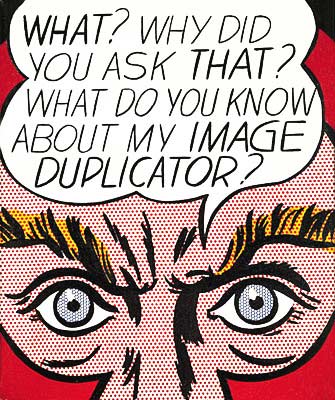
Roy Lichtenstein - Image Duplicator (1963)


"Art doesn't transform. It just plain forms."

"I don't have big anxieties. I wish I did. I'd be much more interesting."

"I like to pretend that my art has nothing to do with me."

"I'm not really sure what social message my art carries, if any. And I don't really want it to carry one. I'm not interested in the subject matter to try to teach society anything, or to try to better our world in any way."

"What interests me is to paint the kind of anti-sensitivity that impregnates modern civilization."

Roy Lichtenstein

Monday, December 04, 2006

The Colours Of Ecstacy


Emile Nolde - Dance Around the Golden Calf (1910)


"What an artist learns matters little. What he himself discovers has a real worth for him, and gives him the necessary incitement to work."

"The artist need not know very much; best of all let him work instinctively and paint as naturally as he breathes or walks."

"The art of an artist must be his own art. It is always a continuous chain of little inventions, little technical discoveries of one's own, in one's relation to the tool, the material and the colours."

"Clever people master life; the wise illuminate it and create fresh difficulties."

"Art is exalted above religion and race. Not a single solitary soul these days believes in the religions of the Assyrians, the Egyptians and the Greeks . . . Only their art, whenever it was beautiful, stands proud and exalted, rising above all time."

Emile Nolde (1867-1956)

Saturday, December 02, 2006

Soulful, Sexy, And Very Spanish


Pedro Almodóvar
- Talk to Her (2002)

"Those who follow closely the trajectory of Spanish director Pedro Almodóvar will probably agree that he entered a phase of cinematic maturity with the release of the film The Flower of My Secret (1995), when the strident camp of his earlier work gave way to more sophisticated, subtle and multi-layered works (Live Flesh, 1997, All About My Mother, 1999). With Talk to Her, he reaches a pinnacle, and while the film does not have the same exhilarating effect as, for example, High Heels (1991), it proves that Almodóvar has perfected the art of looking for the absurd and making it absolutely plausible. Almodóvar probably is the last great European auteur, combining old-school integrity and vision with a post-modern bite.

Talk to Her takes us back to one of Almodóvar favourite scenarios, the hospital, which is used as a metaphor for many of his favourite motives: loneliness, soul-baring impromptu meetings and desperation, and the absurd humour that can be wrought out of this combination. During a Pina Bausch performance of Café Muller, Benigno (Javier Camara) notices that Marco (the quintessential Latin new man Dario Grandinetti) is shedding a tear of joyful emotion (which is quite often Almodóvar's way of establishing sexual ambiguity, even when there isn't an obvious one and just leaving it there). Jump cut to Benigno working in a hospital where 24 hours a day he looks after Alicia (Leonor Watling), a dancer who's been in a deep coma for four years. One of the things Benigno does for his comatose object of desire is to pursue her favourite cultural activities on her behalf, such as art house cinema and dance shows (hence the reason why he went to see Pina Bausch in the first place) and then 'tell' her what he's seen (hence the title). We also find out that Benigno had been obsessed with her ever since he was unleashed from a homebound existence looking after his ailing mother. Meanwhile, Marco finds love with Lydia (Rosario Flores), a celebrity bullfighter who also goes into a coma after being gored by a bull. That is when their lives cross again, and Benigno remembers Marco from the Pina Bausch performance (for those who ever saw Pausch's Café Muller and Mazurca Fogo, the film will provide an extra ingredient of pleasure).

Here starts the second part of the film, when the lives of the two leading men ironically hinge on the lives of two comatose women, and Benigno's character grows increasingly dense and psychotic as he leads the narrative to an unexpected turn. At this point Almodovar treats the audience to a fantastic narrative experiment: he weaves in a short black and white silent film called Amante Menguante (Shrinking Lover), which takes up about seven minutes of the film and which is used as a distraction for a defining moment in the plot. With this structural interference, Almodóvar proves for good that he is a symbolist of the highest order. While it would be a crime to reveal the details, the finale is once again in the hands of Pina Bausch, with a dancer letting out long, deep sighs. It's a cathartic end to a film so rich that it leaves the audience gasping for air and which makes you want to go out and tell your friends about. Just like Benigno does."


Antonio Pasolini (kamera.co.uk)


Filmography:

Pepi, Luci, Bom y las otras chicas del montón (1980)

Laberinto de pasiones (Labyrinth of Passions) (1982)

Entre tinieblas (Dark Habits) (1983)

¿Qué he hecho yo para merecer esto? (What Have I Done to Deserve This?) (1984)

Matador (1986)

La ley de deseo (The Law of Desire) (1987)

Mujeres al borde de un ataque de nervios (Women On the Verge of a Nervous Breakdown) (1988)

¡Átame! (Tie Me Up, Tie Me Down) (1989)

Tacones lejanos (High Heels) (1991)

La flor de mi secreto (The Flower of My Secret) (1994)

Kika (1996)

Carne trémula (Live Flesh) (1997)

Todo sobre mi madre (All About My Mother) (1999)

Hable con ella (Talk To Her) (2002)

La mala educación (Bad Education) (2004)

Volver (Return) (2006)


Links:

Pedro Almodóvar - Steven Marsh (Senses of Cinema)

The Guardian (interview)

'All About My Father', The Guardian (interview)

Pedro Almodóvar, Guardian Unlimited (interview)

'All About Pedro's Women', The Observer

The Passion of Pedro (interview)

Pedro Almodóvar Official Website

Almodóvarlandia

Friday, December 01, 2006

The Marriage Of Order And Chaos


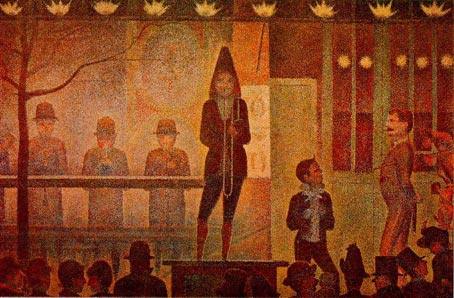
Georges-Pierre Seurat - Circus Sideshow (1887-88)


"Some say they see poetry in my paintings; I see only science."

Georges-Pierre Seurat


"We require just a little order to protect us from chaos. Nothing is more distressing than a thought that escapes itself, than ideas that fly off, that disappear hardly formed, already eroded by forgetfulness or precipitated into others that we no longer master. These are infinite variabilities, the appearing and disappearing of which coincide. They are infinite speeds that blend into the immobility of the colourless and silent nothingness they traverse, without nature or thought. This is the instant of which we do not know whether it is too long or too short for time. We receive sudden jolts that beat like arteries. We constantly lose our ideas. This is why we want to hang on to fixed opinions so much. We ask only that our ideas are linked together according to a minimum of constant rules. All that the association of ideas has ever meant is providing us with these protective rules - resemblance, continuity, causality - which enable us to put some order into ideas, preventing our "fantasy" (delirium, madness) from crossing the universe in an instant, producing winged horses and dragons breathing fire. But there would not be a little order in ideas if there was not also a little order in things or states of affairs, like an objective antichaos: "If cinnabar were sometimes red, sometimes black, sometimes light, sometimes heavy. . . my empirical imagination would never find opportunity when representing red colour to bring to mind heavy cinnabar." [Immanuel Kant, Critique of Pure Reason] And finally, at the meeting point of things and thought, the sensation must recur - that of heaviness whenever we hold cinnabar in our hands, that of red whenever we look at it - as proof or evidence of their agreement with our bodily organs that do not perceive the present without imposing on it a conformity with the past. This is all that we ask for in order to make an opinion for ourselves, like a sort of "umbrella", which protects us from chaos.

Our opinions are made up from all this. But art, science, and philosophy require more: they cast planes over the chaos. . . . Philosophy, science, and art want us to tear open the firmament and plunge into the chaos. We defeat it only at this price. . . . The philosopher, the scientist, and the artist seem to return from the land of the dead. . . . The artist brings back from the chaos varieties that no longer constitute a reproduction of the sensory in the organ but set up a being of the sensory, a being of sensation, on an anorganic plane of composition that is able to restore the infinite. . . . Painters go through a catastrophe, or through a conflagration, and leave the trace of this passage on the canvas, as of the leap leads them from chaos to composition. . . . It is as if the struggle against chaos does not take place without an affinity with the enemy, because another struggle develops and takes on more importance - the struggle against opinion, which claims to protect us from chaos itself."

From What is Philosophy? by Gilles Deleuze and Félix Guatarri


"A parade, the free entertainment offered at the entrance of a travelling theatre, is intended to attract a crowd and encourage the sale of tickets. Seurat painted this extraordinary work during six months in 1887–88 and showed it at the fourth exhibition of the Society of Independent Artists, in 1888. It was his first attempt to render the effects of artificial light at night using the Pointillist technique and seems to have been inspired by a lecture on artificial light by James McNeill Whistler that was translated into French and published by the poet Stephen Mallarmé. Seurat achieved an unprecedented effect in the rendering of the illumination from the row of gas jets. Circus Sideshow is also Seurat's first systematic application of the scientific theories of Charles Henry (1859–1926) regarding the relationship between aesthetics and the physiology and psychology of the senses. By 1890 Seurat had formulated an aesthetic based on these theories that explains his intentions in Circus Sideshow: 'Art is Harmony. Harmony is the analogy of contrary and similar elements of tone, of colour, and of line, considered according to their dominants and under the influence of light, in gay, calm, or sad combinations . . . . Gaiety of tone is given by the luminous dominant; of colour, by the warm dominant; of line, by lines above the horizontal.'"

From the Metropolitan Museum of Art website.

Thursday, November 30, 2006

Devilish Thrills


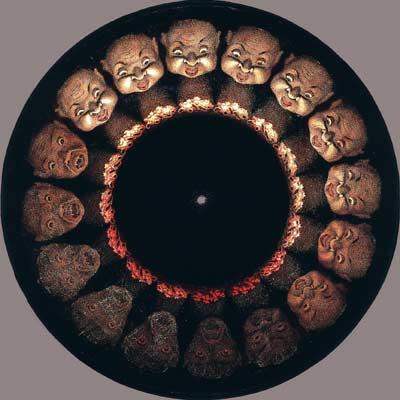
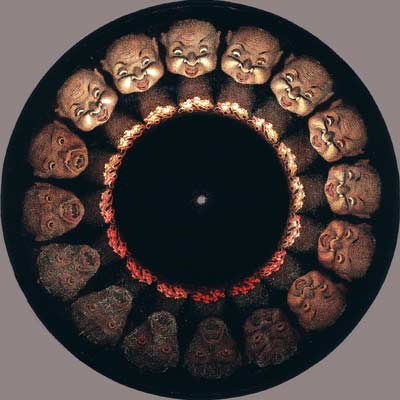
Phenakistiscope (19th Century) from the Joseph Plateau Collection


"In the medieval Christian tradition, the devil is a mimic, an actor, a performance artist, and he imitates the wonders of nature and the divine work of creation. Unlike God, he can only conjure visions as illusions, as he did when, in the person of Mephistopheles, he summoned the pageant of the deadly sins for Doctor Faustus and then seduced him with the appearance of Helen of Troy.

The Devil summons images in the mind's eye, playing on desires and weaknesses; the word "illusion" comes from ludere, "to play" in Latin. Conjurers mimic his tricks: an early Christian Father, denouncing magicians, gives a vivid account of the lamps and mirrors or basins of water they used, how they even conjured the stars by sticking fish scales or the skins of sea horses to the ceiling.

From the first showings of magic lantern slides, optical illusions were ascribed to the Devil's mischief. In the mid-17th century, when the Jesuit polymath Athanasius Kircher began experimenting with shadows, lenses and reflections, he made images of devils with pitchforks, Mister Death brandishing his scythe, a soul burning in purgatory and other supernatural scenes, as if the new technology inevitably involved phantasms and spectres.

Optical illusions are not supernatural, however, as Kircher was intent on demonstrating through his experiments. But illusions also kept disrupting the boundaries between reality and fantasy. Demonstrating tricks of perception, especially through the use of mirrors (the art of catoptrics), Kircher showed how he could manipulate the natural properties of light and play on the limits of human faculties to create seductive and wonderful delusions.

Running through the history of magic and the anxiety that it stirred runs a parallel history of optics: if the Devil was able to conjure appearances whereas God truly performed prodigies, it was imperative to establish the truth status of the vision.

The collection that Werner Nekes has made over the past 30 years, displayed in the coming Hayward Gallery exhibition Eyes, Lies and Illusion, gives a fascinating insight into the enchanted enigma of appearances, and into the history of optical investigation into these mysteries. It's a rich repository of human thought about vision and all that it implies, and it includes the whole range of optical devices, playing with every kind of effect, from supernatural apparitions to visual puns and cracker fillers, from the highest accomplishments of human intelligence to the most light-hearted eye-twisters or visual jokes. His assorted wonders of instruments, images, machines, toys, illusions and effects span more than four centuries of human ingenuity and invention at its most lively, ranging from an exquisite prism said to have belonged to the philosopher Blaise Pascal to an 1898 automated flip book-cum-peepshow of a female dancer dimpling and flirting.

"The soul never thinks without a mental image," declared Aristotle. Trying to enhance human physical capacities with lenses and apparatus of various kinds has been a strong motive behind optical inventions. But the desire to reproduce mental imagining has been an equally powerful engine behind inquiries into the working of eye and brain. Robert Fludd, an Oxford philosopher and esoteric neoplatonist of the generation before Kircher, imagined the "eye of the imagination" as a prototype film projector, beaming images on to a screen floating in virtual space, somewhere at the back of the eyes. Descartes declared, "First, it is the soul that sees, not the eye...", and this primacy of the imagination offered some explanation for dreams and visions and apparitions.

In the field of optics, many instruments were created to analyse and reproduce vision, such as the camera lucida, the lens of which projects a reflected image onto the artist's paper or canvas. But optics also reflects ideas about consciousness at any given period; it expresses the potential of the inward eye for every generation, the concepts of cognition and mental projection, and the tendency of the mind to assemble random marks into intelligible data.

In 1784, the landscape painter Alexander Cozens advised fellow artists to follow the promptings of fantasy and create images from blots of ink on crumpled paper: this astonishingly modern idea about chance and composition echoed Leonardo da Vinci's practice, nearly three centuries earlier. Leonardo was in fact quoting his fellow artist, Botticelli: "By merely throwing a sponge full of diverse colours at a wall, it left a stain on that wall, where a fine landscape was seen." But Cozens arrived at his "New Method" on his own, without prior knowledge of his Renaissance precursors, and made startlingly expressionist images. Werner Nekes has a rare album of 1885 filled with drawings of imps and devils that were doodled by workmen following the drips and splashes of coffee on the walls they were plastering.

Anxiety about the unreliability of vision continued long after most believers in the Devil's antics had faded away, and after the 17th century it spurred closer analysis of the human faculties, especially sight. These discoveries led to the society of surveillance on the one hand, and of mass media on the other. But it is also the case that new technologies created a mass of popular illusions that no longer alarmed their consumers, but amused them hugely. These were diversions and spectacles, and they were pure pleasure.

In 1827, John Ayrton Paris created the thaumatrope (from Greek "wonder" combined with "motion"), a round disc threaded on a string with one picture on one side and another on the reverse; when the disc was spun, the images merged. The thaumatrope was crucial to the development of moving pictures, which would eventually give the impression of life itself flowing past when projected on to a screen at the rate of 24 frames a second. Phantasmagoria shows began touring Europe at the end of the 18th century. In the wake of the Terror in France, the brilliant impresario, balloonist and cinematic pioneer Etienne-Gaspard Robertson inaugurated the thrills of the horror movies when he projected spectres on to smoke - including the severed head of Danton, then a recent victim of the guillotine.

The Victorian audience was travelling vicariously in the footsteps of explorers who continued to open up continents: the natural magic of the lantern slide beamed natural wonders from all round the world. Many different kinds of shows revealed worlds near and far through spectacular illusions. In 1821, in order to make a panoramic painting of London, the Hull-born artist Thomas Hornor climbed to the top of the cross on the dome of St Paul's Cathedral, and built a crow's nest. From here, where Hornor bivouacked for the time it took, he made a 360-degree picture of London. He used a telescope to examine details, and calculated the perspective to position the viewer convincingly in the scene.

In Edinburgh in 1835, Maria Theresa Short, daughter of an optical instrument maker, created one of the very first popular public camera obscuras. It is still there, on Castle Hill, and it captures through a periscope and angled lenses the thronged scenes of the streets below, projected by light rays alone onto a white convex dish. The projection is still an astonishing effect, and it brings into being, with no more magic than a series of angled lenses, ancient dreams of summoning absent sights through gazing into a bowl of water or an oracular mirror.

Optical media of communication available today have opened paths to new forms of beauty in reflection and projection, distortion and illusion. When Tony Oursler, on display in the exhibition, projects lopsided spectral faces uttering messages from the ether, or angels ascend through streaming water in Bill Viola's films, or Gary Hill materialises eerie apparitions that loom and then fade, they are claiming this territory for art in our era, and pressing optics into the service of a new metaphysics.

The taming of illusion through deeper understanding and ever more ingenious techniques of simulation has only been partial. There has remained something stubbornly weird about the images optical devices can create, especially with the advent of cinema when they became so clever at producing the appearance of the real.

Werner Nekes's collection plays a range of effects as if on a giant organ of visual phenomena, from profound investment in the objective truth of vision to an equally strong engagement with radical subjectivity. However, as we move nearer our era, his artefacts and devices reveal how the media of visual trickery, deception and illusion move away from scientific scrutiny towards distraction, leisure and entertainment. At the same time, the perfection of visual technologies has destabilised experience until we cannot be sure if we are not the dreamers but the dreamed, as in a recursive fable by Jorge Luis Borges. On television in the US, footage sometimes carries the heading "Metaphorical Images" to warn that the film does not communicate what is actually occurring. As The Matrix films dramatise, illusion has turned us into wanderers in "the desert of the real".

The world accessible to the senses began to fall away a very long time ago, perhaps in Plato's cave; it began turning into an insubstantial pageant of optical illusion, placing the observer in the dislocating yet oddly pleasurable situation of not knowing where reality begins and ends."


Marina Warner, The Guardian, Saturday September 25, 2004


Note: Eyes, Lies & Illusions, drawn from the Werner Nekes collection - and based on an exhibition originally devised by the Hayward Gallery, South Bank Centre, London - is now on show at at ACMI (Australian Centre for the Moving Image) until 11 February 2007.


Wednesday, November 29, 2006

Forgotten Faces


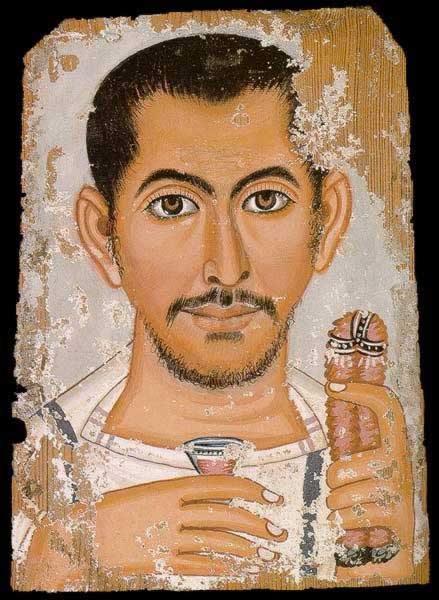
Funerary Portrait Painting of a Man from the Roman Period. (This portrait dates from the third to the fourth centuries AD. The narrow stripes on the man's tunic identify his rank as equestrian, and he holds a glass of red wine and a rose petal wreath.)


"Be absolute for death; either death or life
Shall thereby be the sweeter. Reason thus with life:
If I do lose thee, I do lose a thing
That none but fools would keep: a breath thou art,
Servile to all the skyey influences,
That dost this habitation, where thou keep'st,
Hourly afflict: merely, thou art death's fool;
For him thou labour'st by thy flight to shun
And yet runn'st toward him still. Thou art not noble;
For all the accommodations that thou bear'st
Are nursed by baseness. Thou'rt by no means valiant;
For thou dost fear the soft and tender fork
Of a poor worm. Thy best of rest is sleep,
And that thou oft provokest; yet grossly fear'st
Thy death, which is no more. Thou art not thyself;
For thou exist'st on many a thousand grains
That issue out of dust. Happy thou art not;
For what thou hast not, still thou strivest to get,
And what thou hast, forget'st. Thou art not certain;
For thy complexion shifts to strange effects,
After the moon. If thou art rich, thou'rt poor;
For, like an ass whose back with ingots bows,
Thou bear's thy heavy riches but a journey,
And death unloads thee. Friend hast thou none;
For thine own bowels, which do call thee sire,
The mere effusion of thy proper loins,
Do curse the gout, serpigo, and the rheum,
For ending thee no sooner. Thou hast nor youth nor age,
But, as it were, an after-dinner's sleep,
Dreaming on both; for all thy blessed youth
Becomes as aged, and doth beg the alms
Of palsied eld; and when thou art old and rich,
Thou hast neither heat, affection, limb, nor beauty,
To make thy riches pleasant. What's yet in this
That bears the name of life? Yet in this life
Lie hid moe thousand deaths: yet death we fear,
That makes these odds all even."


Duke Vincentio from Measure for Measure (III, i) by William Shakespeare


"Ay, but to die, and go we know not where;
To lie in cold obstruction and to rot;
This sensible warm motion to become
A kneaded clod; and the delighted spirit
To bathe in fiery floods, or to reside
In thrilling region of thick-ribbed ice;
To be imprison'd in the viewless winds,
And blown with restless violence round about
The pendent world; or to be worse than worst
Of those that lawless and incertain thought
Imagine howling: 'tis too horrible!
The weariest and most loathed worldly life
That age, ache, penury and imprisonment
Can lay on nature is a paradise
To what we fear of death."

Claudio from Measure for Measure (III, i) by William Shakespeare


"Because I could not stop for Death,
He kindly stopped for me.
The Carriage held but just ourselves
And Immortality"

Emily Dickinson


"People do not die for us immediately, but remain bathed in a sort of aura of life which bears no relation to true immortality but through which they continue to occupy our thoughts in the same way as when they were alive. It is as though they were travelling abroad."

Marcel Proust


"For life in the present there is no death. Death is not an event in life. It is not a fact in the world."

Ludwig Wittgenstein


"Life is pleasant. Death is peaceful. It's the transition that's troublesome."

Isaac Asimov


"Most people think life sucks, and then you die. Not me. I beg to differ. I think life sucks, then you get cancer, then your dog dies, your wife leaves you, the cancer goes into remission, you get a new dog, you get remarried, you owe ten million dollars in medical bills but you work hard for thirty five years and you pay it back and then one day you have a massive stroke, your whole right side is paralyzed, you have to limp along the streets and speak out of the left side of your mouth and drool but you go into rehabilitation and regain the power to walk and the power to talk and then one day you step off a curb at Sixty-seventh Street, and BANG you get hit by a city bus and then you die. Maybe."

Denis Leary


"A man's dying is more the survivors' affair than his own."

Thomas Mann


"Men fear death as children fear to go in the dark; and as that natural fear in children is increased with tales, so is the other."

Francis Bacon


"I don't want to achieve immortality through my work. I want to achieve it through not dying."

Woody Allen


Links:

Ancient Faces: Mummy Portraits from Roma Egypt (Metropolitan Museum of Art, New York)

Fayum Portraits Website

Proportion and Personality in Fayum Portraits by A. J. N. W. Prag (PDF)

Tuesday, November 28, 2006

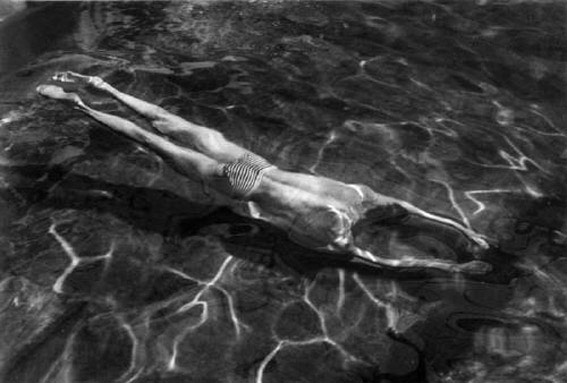
The Grammar Of Becoming


Andr
é Kertész - Underwater Swimmer (1917)


"To learn is to enter into the universal of the relations which constitute the Idea, and into their corresponding singularities. The idea of the sea, for example, as Leibniz showed, is a system of liaisons or differential relations between particulars and singularities corresponding to the degree of variation among these relations - the totality of the system being incarnated in the real movement of the waves. To learn to swim is to conjugate the distinctive points of our bodies with the singular points of the objective Idea in order to form a problematic field."

From Difference and Repetition by Gilles Deleuze


"What does learning consist in? Here is a traditional view: learning is a matter of memorising something that somebody else knows. It sounds simplistic, if we put it that way. But who among us has not attended high school and college and has not been subjected to this view of learning? A teacher, a professor, stands before the class, chalk or transparencies in hand. There are things you need to learn, items you need to know. Before the class period is over, these things will be transferred from the teacher's lecture notes, the professor's transparencies, to your notebook. From there, these things will be transferred to your brain. When those transfers are successful, you will be said to have learned what the teacher, the professor, has taught you.

It is a meager model of learning. It is also the most common one. It is a model that operates on some surface assumptions and a slightly deeper one. Its surface assumptions are, first, that the teacher knows what there is to know about a subject and you do not. Second, there is the assumption that the way that you learn what the teacher knows is to listen to the teacher and commit to memory what he or she has to say. Last, on the teacher's side, there is the assumption that by talking or using other media to substitute for talking, the teacher can impart to the student what needs to be known.

The slightly deeper assumption has to do with the dogmatic image of thought. It is the assumption that what is to be learned comes in discrete packets of identities. There are particular somethings that need to be known. These somethings may be related to one another or they may not. In either case, they are independent enough from one another to be isolated each to a sentence, a paragraph, or a chapter. These somethings are then represented by the sentences spoken by the teacher or professor, and then arrive at your ear or on your paper. If the learning us successful, there will have been no alteration, no damage, of any of these somethings along the way. Their identities will retain their integrity. And if you do your job you will be able to repeat or manipulate these identities when test time comes around.

There is another view of learning that does not start with the assumption that what is to be learned has the character of an identity or group of identities. It starts instead from the assumption that what there is to be learned has the character of difference rather than identity. If what is to be learned does not have the character of identity, then the learning itself is not a project of transferring identities from the knower to the one who seeks to know. It is instead a project of experimentation.

Swimmers do not learn facts about the water and about their bodies and then apply them to the case in hand. The water and their bodies are swarms of differences. In order to navigate their bodies through the water they will need to acquire a skill: to "conjugate" their bodies with the water in such a way as to stay on its surface. This skill involves no memorisation. It involves an immersion, a finding one's way through things, coming through one's body to understand what one is capable of in the water. There is no one way to do this, and different ways may lead to different kinds of success. There are also failures; water may be composed of differences, but not every path through those differences will keep one afloat.

Swimmers apprentice themselves to the water. They get a feel for the water, for how it moves and what possibilities it offers them. They get a feel for their bodies in the water. And they conjugate one against the other. The couplet body/water is a problematic field...Particular ways of swimming are solutions within that problematic field. They do not solve the problem of swimming. For there is no single problem of swimming. There is instead a problematic field of body/water, of which particular ways of swimming are solutions. They are experiments in conjugation of this problematic field, much of which takes place below the level of conscious thought, beneath the identities representation offers us: "'learning' always takes place in and through the unconscious, thereby establishing a profound complicity between nature and mind." [Deleuze, Difference and Repetition]

What does learning how to think consist in? Unlike learning how to swim, it first requires the abandonment of bad habits. These habits are the ones instilled in all of us by the dogmatic image of thought and its representational view of language and the world. We must discover this image and this view; we must see what roles they play in preventing us from really thinking.

But that is not all. That is only the negative task, the clearing of the ground. Alongside this abandonment we must also experiment in ways of thinking. We must conjugate our thought and our world, our thought and our language.

There are those who have gone before us, who have swum in this water before: Spinoza, Bergson, Nietzsche among them. They may help ease us into the water, teach us some of the strokes, so we don't drown before we get started. We can apprentice ourselves to them. Sooner or later, however, we must push off from the shore and conjugate things for ourselves...[We] must do it for ourselves, each of us...

There are two mistakes we might make in considering the prospect of learning to think. The first mistake would be to assume that thinking, unlike swimming, is a purely conscious activity, that thinking is a manipulation of thought. That mistake is our inheritance from the dogmatic image of thought. We feel our way into thinking in much the same way as we feel our way into swimming. Thinking is at least as unconscious as it is conscious, and it is no less an experiment...The second mistake would be to assume that each of us must face this task alone. In fact, we can face it in groups, conjugating ourselves with one another as well as with the world. Thinking does not need to be a solitary activity, and it surely does not take place in a world which we do not share with others...[We might] consider our place among others in the world, to think about it, or with it, or in it."

From Gilles Deleuze: An Introduction by Todd May


"Philosophy is a battle against the bewitchment of our intelligence by means of language."

Ludwig Wittgenstein

Monday, November 27, 2006

The Fragile Afterlife Of Images


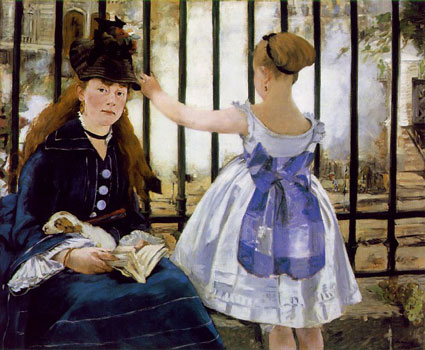
Edouard Manet - Gare Saint-Lazare (1873)


"It is not enough to know your craft - you have to have feeling."

Edouard Manet


"The young man will smile on the canvas for as long as the canvas lasts. Blood throbs under the skin of the woman's face, the wind shakes a branch, a group of men prepare to leave. In a novel or film, the young man will stop smiling, but he will start to smile again when we turn this page or that moment. Art preserves, and it is the only thing in the world that is preserved. It preserves and is preserved itself (quid juris?) , although it actually lasts no longer than its support and materials - stone, canvas, chemical colour, and so on (quid facti?) The young girl maintains the pose that she has had for five thousand years, a gesture that no longer depends on whoever made it. The air still has the turbulence, the gust of wind, and the light that it had that day last year, and it no longer depends on whoever was breathing it that morning. If art preserves it does not do so like industry, by adding a substance to make the thing last. The thing became independent of its "model" from the start, but it is also independent of other possible personae who are themselves artists-things, personae of painting breathing the air of this painting. And it is no less independent of the viewer or hearer, who only experience it after, if they have the strength for it. What about the creator? It is independent of the creator through the self-positing of the created, which is preserved in itself. What is preserved - the thing or the work of art - is a bloc of sensations, that is to say, a compound of percepts and affects.

Percepts are no longer perceptions; they are independent of a state of those who experience them. Affects are no longer feelings or affections; they go beyond the strength of those who undergo them. Sensations, percepts, and affects are beings whose validity lies in themselves and exceeds any lived. They could be said to exits in the absence of man because man, as he is caught in stone, on the canvas, or by words, is himself a compound of percepts and affects. The work of art is a being of sensation and nothing else: it exists in itself."

From What is Philosophy? by Gilles Deleuze and Félix Guatarri


". . . the differences which exist between every one of our real impressions - the differences which explain why a uniform depiction of life cannot bear much resemblance to reality - derive probably from the following cause: the slightest word that we have said, the most insignificant action that we have performed at any one epoch of our life was surrounded by, and coloured by the reflection of, things which logically had no connection with it and which later have been separated from it by our intellect which could make nothing of it for its own rational purposes, things, however, in the midst of which - here the pink reflection of the evening upon the flower-covered wall of a country restaurant, a feeling of hunger, a desire for women, the pleasure of luxury; there the blue volutes of the morning sea and, enveloped in them, phrases of music half emerging like the shoulders of water-nymphs - the simplest act or gesture remains immured as within a thousand vessels, each of them filled with things of a colour, a scent, a temperature that are absolutely different one from another, vessels, moreover, which being disposed over the whole range of our years, during which we have never ceased to change if only in our dreams and thoughts, are situated at the most various moral altitudes and give us sensation of extraordinarily diverse atmospheres."

From Remembrance of Things Past by Marcel Proust

Sunday, November 26, 2006

Beastly Bonking


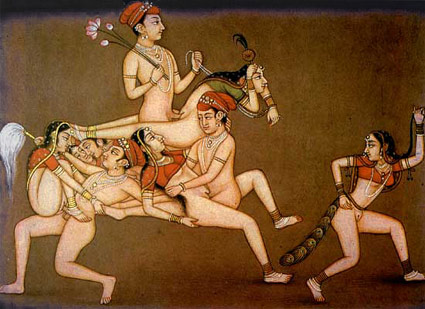
Indian - Horse Pursuing a Peacock


"The orgy was not the farthest point reached by eroticism in the pagan world. The orgy is the sacred aspect of eroticism in which the continuity of beings beyond solitude is most plainly expressed. Only in one way, however. In the orgy continuity cannot be laid hold of; individuals lose themselves at the climax, but in mingled confusion. The orgy is necessarily disappointing. Theoretically it is the complete negation of individual quality. It presupposes, it even demands equality among the participants. Not only is individuality itself submerged in the tumult of he orgy, but each participant denies the individuality of the others. All limits are completely done away with, or so it seems, but it is impossible for nothing to remain of the differences between individuals and their sexual attraction connected with those differences.

The final aim of eroticism is fusion, all barriers gone, but its first stirrings are characterised by the presence of a desirable object.

In the orgy this
object does not stand out by itself, for sexual excitement occurs through an uncontrolled urge, the opposite of habitual reserve. But everybody has this urge. It is objective but it is not perceived as an object; the person who perceives it is at the same time animated by it. On the other hand, excitement is normally roused by something distinct and objective. In the animal kingdom, the odour of the female often sets the male after her. The songs and displays of birds bring into play other kinds of perception that tell the female that the male is near and sexual shock is at hand. Smell, hearing, sight and even taste are objective signals distinct from the activity they incite. They are signals to announce the crisis. In the world of man these messages have an intense erotic value. A pretty girl stripped naked is sometimes an erotic symbol. The object of desire is different from eroticism itself; it is not eroticism in its completeness, but eroticism working through it."

From Eroticism: Death and Sensuality by Georges Bataille


The Week in Review

Viewing:


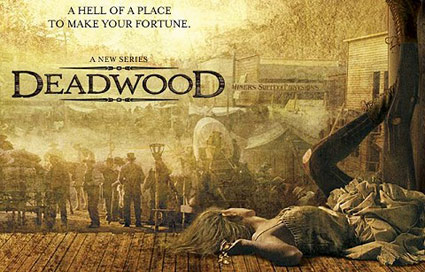
Deadwood: First Season
Ep. 1: 'Pilot - Deadwood' (w. Ted Mann, d. Mark Tinker)
Ep. 2: 'Deep Water' (w. Malcolm MacRury. d. Davis Guggenheim)
Ep. 3: 'Reconnoitering the Rim' (w. Jody Worth, d. Davis Guggenheim)
Ep. 4: 'Here Was a Man' (w. Elizabeth Sarnoff, d. Alan Taylor)
Ep. 5: 'The Trial of Jack MacCall' (w. John Belluso, d. Ed Bianchi)
Ep. 6: 'Plague' (w. Malcolm MacRury. d. Davis Guggenheim)
Ep. 7: 'Bullock Returns to the Camp' (w. Jody Worth, d. Michael Engler)
Ep. 8: 'Suffer the Little Children' (w. Elizabeth Sarnoff, d. Dan Minahan)
Ep. 9: 'No Other Sons or Daughters' (w. George Putnam, d. Ed Bianchi)
Ep. 10: 'Mr. Wu' (w. Bryan McDonald, d. Dan Minahan)
Ep. 11: 'Jewel's Boot Is Made For Walking' w. Ricky Jay. d. Steve Shill)
Ep. 12: 'Sold Under Sin' (w. Ted Mann, d. Davis Guggenheim)


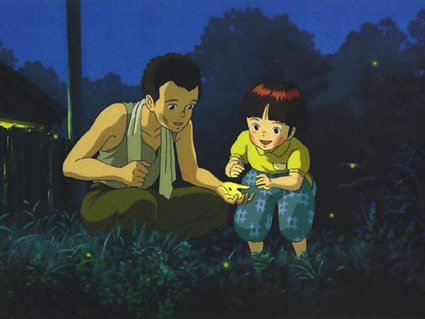
Grave of the Fireflies - w. & d. Isao Takahata (1988)


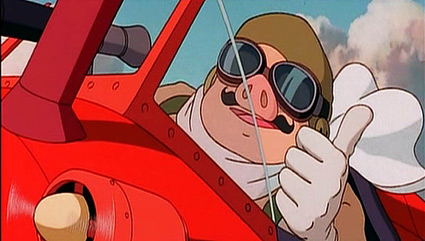
Porco Rosso - w. &
d. Hayao Miyazaki (1992)


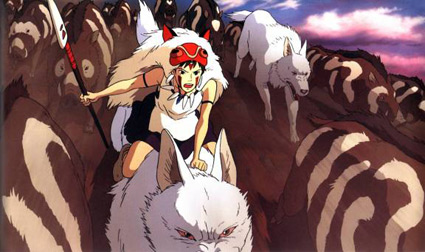
Princess Mononoke -
w. & d. Hayao Miyazaki (1997)


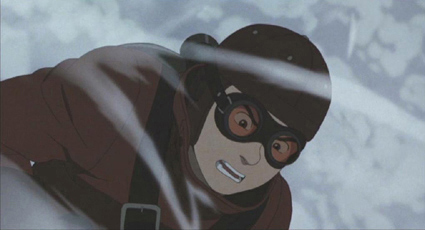
Steamboy - w. Sadayuki Murai & Katsuhiro Omoto, d. Katsuhiro Omoto (2004)


Tokyo Godfathers - w. Keiko Nobumoto & Satoshi Kon, d. Satoshi Kon (2003)


Urotsukidoji: Legend of the Overfiend & Legend of the Demon Womb - w. Noboru Aikawa, d. Hideki Takayama (1989 & 1991)


Wicked City - w. Kisei Choo, d. Yoshiaki Kawajiri (1987)


Reading:

Deleuze: An Introduction - Todd May
Tezuka: The Marvel of Manga (catalogue essays) - ed. Philip Brophy
Gillian Wearing: Proof (catalogue essay) - Juliana Engberg

Listening:

The Complete String Quartets - Joseph Haydn
The Complete Symphonies - Joseph Haydn

Exhibitions:


Tezuka: The Marvel of Manga
- NGV (International)


Six Good Reasons To Stay at Home: Hiraki Sawa (video works) - NGV (International)


Howard Arkley -
NGV (Australia)


Light Sensitive: Contemporary Australian Photography from the Loti Smorgon Fund - NGV (Australia)


Living Proof: Gillian Wearing
- ACCA

Saturday, November 25, 2006

Intimate Immensity: Part Three


René Magritte - The Listening Room (1958)


"Only thought can resemble. It resembles by being what it sees, hears, or knows; it becomes what the world offers it."

René Magritte

"The inner world is the world of your requirements and your energies and your structure and your possibilities that meets the outer world. And the outer world is the field of your incarnation. That's where you are. You've got to keep both going. As Novalis said, 'The seat of the soul is where the inner and outer worlds meet.' "

Joseph Campbell


"Immensity is within ourselves. It is attached to a sort of expansion of being that life curbs and caution arrests, but which starts again when we are alone. As soon as we becomes motionless, we are elsewhere; we are dreaming in a world that is immense. Indeed, immensity is the movement of the motionless man. It is one of the dynamic characteristics of quiet daydreaming.

And since we are learning philosophy from poets, here is a lesson in three lines, by Pierre Albert-Bireau:

And with a stroke of the pen I name myself
Master of the World
Unlimited man."
From The Poetics of Space by Gaston Bachelard