Thursday, October 12, 2006

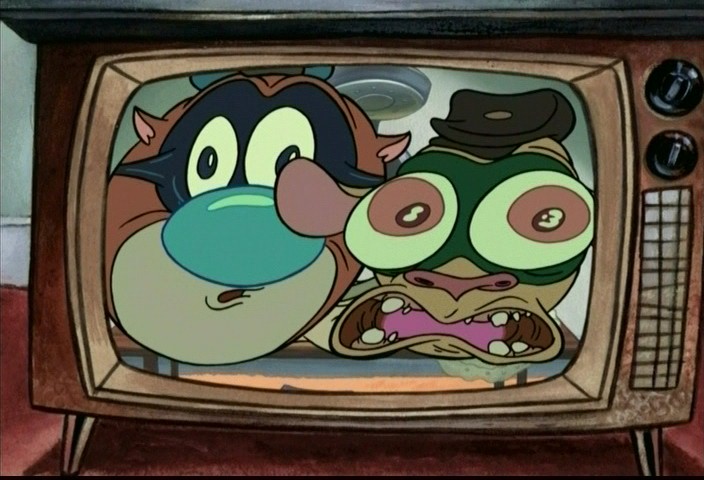
The Last Days Of The "Idiot Box"?


Ren and Stimpy - (from the episode) Altruists!


"The argument, then, is that television produces the conditions of an ironic knowingness, at least as a possibility...[which] may offer a way of thinking subjectivity free of subjection...Most of all, it opens identity to diversity, and escapes the notion of cultural identity as a fixed volume...But if it does all this, it does not do it in that utopia of guaranteed resistance which assumes the progressiveness of naturally oppositional readers who will get it right in the end. It does, rather, with terms hung in suspension. . .tactics of empowerment, games of subordination with neither term fixed in advance."

From Playing at Being American:Game and Tactics by John Caughie (1990)

Tuesday, October 10, 2006

The Skin Of The Screen


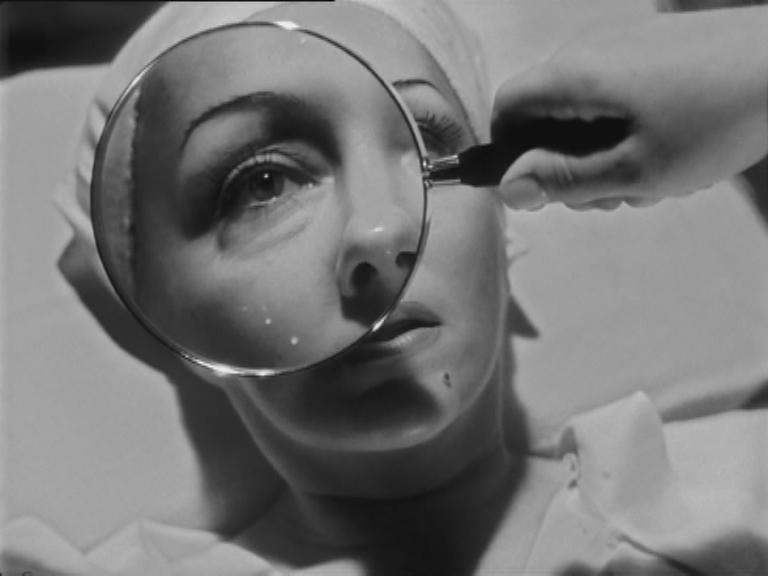
Gloria Swanson (as Norma Desmond) in Sunset Boulevard (1950) - d. Billy Wilder


"What does it mean to think of glamour as a mask? It means apprehending the body beautiful - and especially a beautiful face - as a special, heightened metaphor of the human being who possesses it. Edgar Morin in his 1957 book The Stars once grumbled over the historical tendency that has led us to invest so much in the face - the eyes are the window of the soul, and all that - a tendency given absolute aesthetic form in our rapture before the screen close-up of a gorgeous movie star. Morin's worry is valid: something of the full, earthy body - and that body in motion - is surely lost in those ethereally frozen, twilight moments of the supremely beautiful human face, images wrought from movies into that even more impossibly perfect art of the Hollywood still photographer's glamour portrait.

But there is another way to dream in front of images of glamour. Here's an example: the generation of surrealists who excavated the imagery of popular culture with such passion in the 1950s was also deeply into glamour. Inspired by the aphorisms of Malcolm de Chazal - a visionary philosopher of the human face who saw all the forces and systems of the natural world reflected there - these surrealists grasped beauty not as an objective, frozen commodity, but as a private revelation, an amorous fantasy that must endlessly be recreated in words and homages, dreamed out aloud. The reveries of the surrealists may strike us as rather perverse inversions of conventional beauty codes - Andre Breton, for instance, was given to extolling his wife's 'sexual organs of seaweed and old sweets' - but these reveries were more like mad hallucinations. It is as if everyone, on screen or off, had been touched by the dreamlike magic made possible by the luminous magnifications of the camera lens."

From Glamour: The Confession Of A Mask by Adrian Martin

Monday, October 09, 2006

Portrait Of The Artist As An Ageing Imbecile


Andy Warhol - Self Portrait (1986)


"Stupidity is contemplated: sight penetrates its domain and becomes fascinated; it carries one gently along and its action is mimed in the abandonment of oneself; we support ourselves upon its amorphous fluidity; we await the first leap of an imperceptible difference, and blankly, without fever, we watch to see the glimmer of light return. Error demands rejection - we can erase it; we accept stupidity - we see it, we repeat it, and softly, we call for total immersion.

This is the greatness of Warhol with his canned foods, senseless accidents, and his series of advertising smiles."

From Language, Counter-Memory, Practice by Michel Foucault

Sunday, October 08, 2006

Furniture Of The Mind


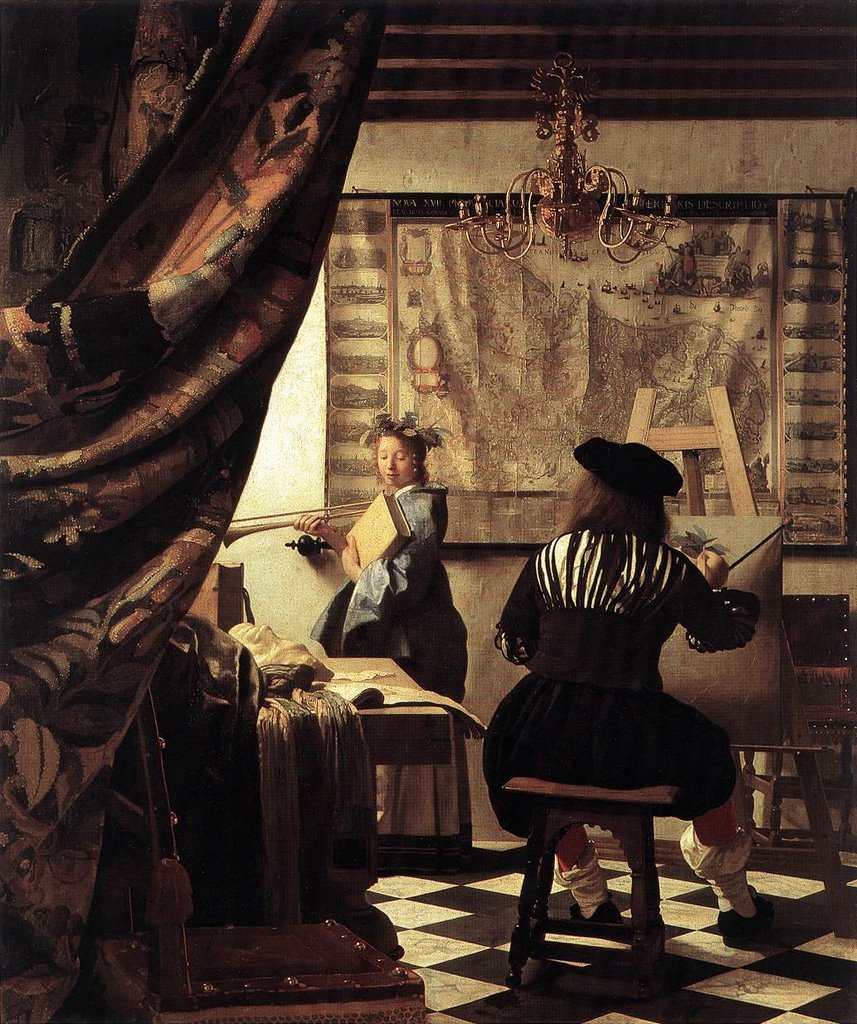
Jan Vermeer van Delft - The Art of Painting (1665-67)

Other works by this artist can be accessed at: http://www.wga.hu/index1.html

"The things of the world are not simply neutral objects which stand before us for our contemplation. Each one of them symbolises or recalls a particular way of behaving, provoking in us reactions which are either favourable or unfavourable. This is why people's tastes, character, and the attitude they adopt in the world and to particular things can be deciphered from the objects with which they choose to surround themselves, their preferences for certain colours or the places where they like to go for walks...The objects which haunt our dreams are meaningful in the same way. Our relationship with things is not a distant one: each speaks to our body and to the way we live. They are clothed in human characteristics (whether docile, soft, hostile or resistant) and conversely they dwell within us as emblems of forms of life we either love or hate. Humanity is invested in the things of the world and these are invested in it. To use the language of psychoanalysis, things are complexes. This is what Cezanne meant when he spoke of the particular 'halo' of things which it is the task of painting to capture."

From The World of Perception by Maurice Merleau-Ponty

Saturday, October 07, 2006

Make 'Em Smile


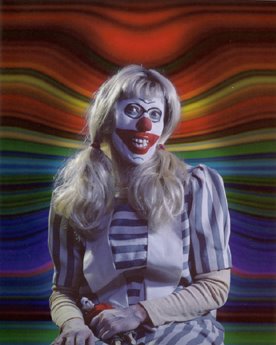
Cindy Sherman - Untitled # 412 (2003)


"In her most recent work,...[Cindy] Sherman has created a group of images of clowns that were initially inspired by an article of clothing - pyjamas with fur-like buttons - which she had purchased at a yard sale a decade earlier. Sherman has commented that she wanted to make new characters that were 'intense, with a nasty side or an ugly side, but also with a real pathos about [them] - and [clowns] have an underlying sense of sadness while they're trying to cheer people up. Clowns are sad, but they're also psychotically, hysterically happy.' In light of Sherman's career-long interest in artifice and masquerade, this subject mirrors her self- transformation through costumes, make-up, wigs and prosthetics. What is strikingly similar between Sherman's creative process and the way clowns create personas is the hermetic approach they take: like the artist in her work, 'a clown is their [sic] own writer, director, costumer, make-up artist, and prop-man.'"

From Cindy Sherman - (exhibition catalogue with text) by Rochelle Steiner and Lorrie Moore

Friday, October 06, 2006

The Truth Is Rarely Pure And Never Simple


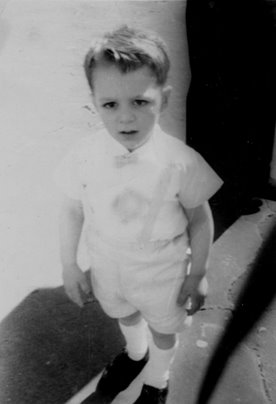
The Boy I Was (and hope to be again some day)


"As children, we have all suspected it: perhaps we are all, moving strangely beneath the sky, victims of a trap, a joke whose secret we will one day know. This reaction is certainly infantile and we turn away from it, living in a world imposed on us as though it were "perfectly natural", quite different from the one that used to exasperate us. As children, we did not know if we were going to laugh or cry but, as adults, we "possess" this world, we make endless use of it, it is made of intelligible and utilisable objects. It is made of earth, stone, wood, plants, animals. We work the earth, we build houses, we eat bread and wine. We have forgotten, out of habit, our childish apprehensions. In a word, we have ceased to mistrust ourselves.

Only a few of us, amid the great fabrications of society, hang on to our really childish reactions, still wonder naively what we are doing on the earth and what sort of joke is being played on us. We want to decipher skies and paintings, go behind these starry backgrounds or these painted canvases and, like kids trying to find a gap in a fence, try to look through the cracks in the world."

From The Cruel Practice of Art by Georges Bataille (1949)

Thursday, October 05, 2006

The Incarnate Tartuffery Of Morals


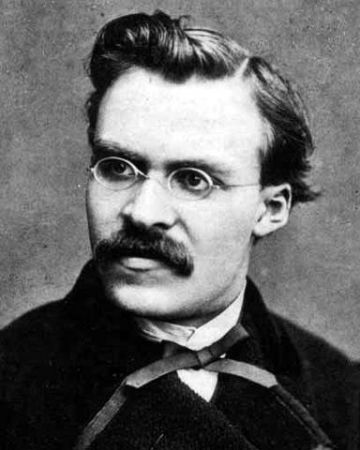
Friedrich Wilhelm Nietzsche (1844-1900)


"All psychology has hitherto remained anchored to moral prejudices and timidities: it has not ventured into the depths. To conceive it as morphology and the development-theory of the will to power, as I conceive it - has never yet so much as entered the mind of anyone else: in so far as it is permissible to see in what has hitherto been written a symptom of what has hitherto been kept silent. The power of moral prejudices has penetrated deep into the most spiritual world, which apparently is the coldest and most free of presuppositions - and, as goes without saying, has there acted in a harmful, inhibiting, blinding, distorting fashion. A genuine physio-psychology has to struggle with unconscious resistances in the heart of the investigator, it has 'the heart' against it: even a theory of the mutual dependence of the 'good' and the 'wicked' impulses causes, as a more refined immorality, revulsion to a conscience still strong and hearty - and even more a theory of the derivation of all good impulses from wicked ones. Supposing, however, that someone goes so far as to regard the emotions of hatred, envy, covetousness, and lust for domination as life-conditioning emotions, as something which must be fundamentally and essentially be present in the total economy of life, consequently must be heightened further if life is to heightened further - he suffers from such a judgement as from seasickness. And yet even this hypothesis is far from being the strangest and most painful in this tremendous, still almost unexplored realm of dangerous knowledge - and there are in fact a hundred good reasons why everybody should keep away from it who - can! On the other hand: if your ship has driven into these seas, very well! Now clench your teeth! Keep your eyes open! Keep a firm hand on the helm! - We sail straight over morality and past it, we flatten, we crush perhaps what is left of our own morality by venturing to voyage thither - but what do we matter! Never yet has a deeper world of insight revealed itself to daring travellers and adventurers..."

From Beyond Good and Evil by Friedrich Nietzsche

Wednesday, October 04, 2006

Can You Say What I'm Seeing?


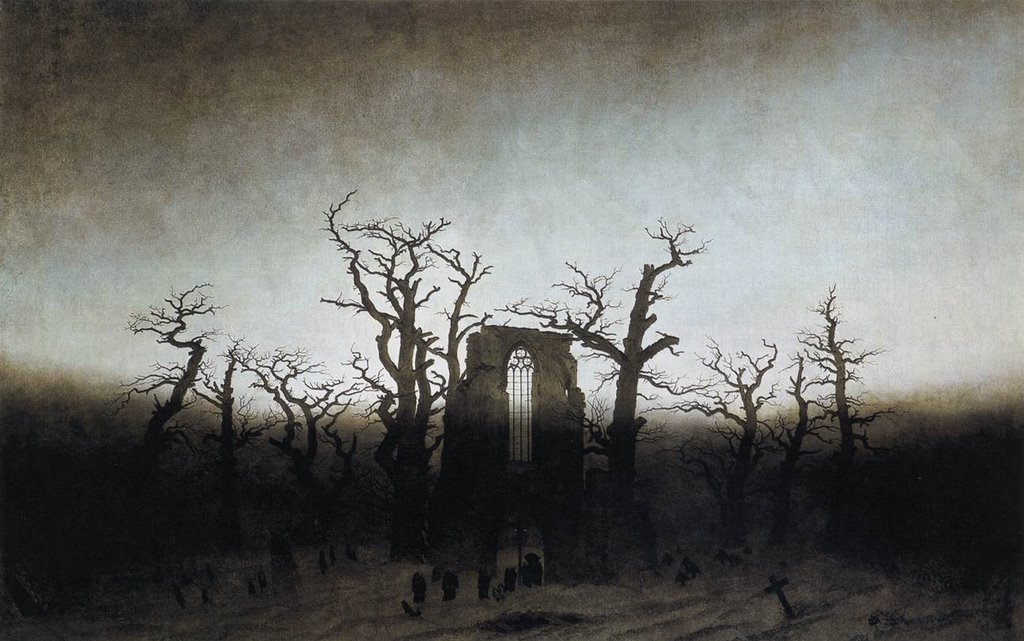
Caspar David Friedrich - The Abbey in the Oakwood (1809-10)

This and many other images by Friedrich can be accessed at: http://www.wga.hu/index1.html


'Ideas are refined and multiplied in the commerce of minds. In their splendour, images effect a very simple communion of souls.'

Gaston Bachelard

Tuesday, October 03, 2006

What Is A Book?


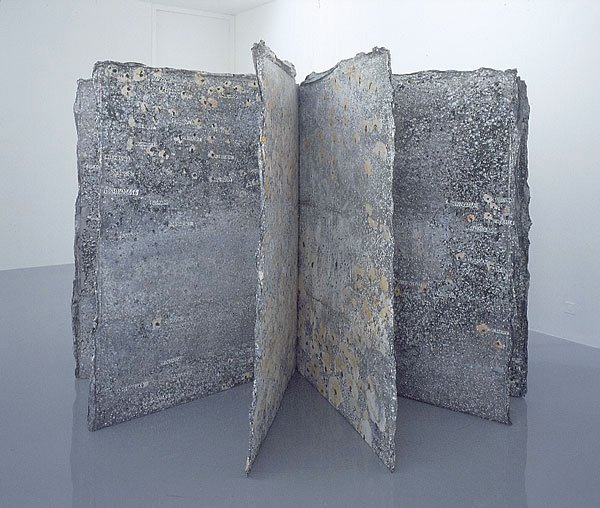
Anselm Kiefer - The Secret Life of Plants (2002)


"What, in short, is the strange unit designated by the term, work? What is necessary to its composition, if a work is not something written by a person called an "author"?...If an individual is not an author, what are we to make of those things he has written or said, left among his papers or communicated to others? Is this not properly a work? What, for instance, were Sade's papers before he was consecrated as an author? Little more, perhaps, than roles of paper on which he endlessly unravelled his fantasies while in prison.

Assuming we are dealing with an author, is everything he wrote and said, everything he left behind, to be included in his work?...If we wish to publish the complete works of Nietzsche, for example, where do we draw the line? Certainly everything must be published, but can we agree on what "everything" means? We will, of course, include everything that Nietzsche himself published, along with the drafts of his works, his plans for aphorisms, his marginal notations and corrections. But what if, in a notebook filled with aphorisms, we find a reference, a reminder of an appointment, an address, or a laundry bill, should this be included in his works? Why not?...Such questions only begin to suggest the range of our difficulties, and, if some have found it convenient to bypass the individuality of the writer or his status as an author to concentrate on a work, they have failed to appreciate the equally problematic nature of the word "work" and the unity it designates."

From What is an Author? by Michel Foucault

Monday, October 02, 2006

Dead Man Carving: Part Two


Ricky Swallow - Come Together (2002)

“Sculptural realism's paradoxical power is to conjure presence in absence, lightness in weight, the softness of flesh or fabric in stone or wood. Come Together (2002) is Swallow's hard-core homage to Baroque realism and its apparitions of the soft in the hard. Rudolph Wittkower's big book on the Baroque master Gianlorenzo Bernini is never far away in Swallow's studio, and Come Together is a knee-high tribute to the meeting of skull and baldachin in Bernini's Tomb of Pope Alexander VII. Call it a rec-room entombment. The bag sits there in a frozen slump, on initial viewing no more than a banal, 1970s suburban object, and you need to get close to see the embedded skull. You don't see it, though, so much as take its weight; it's an indisputable object. The first impression of a plummeting impact- the skull winding the bag like a meteorite - is pushed back by the illusion of a geologically slow entrapment from below, as if the bag grew into shape around the skull.

In this, the second carving he made, Swallow seems torn between the attempt to renovate the vanitas still life in all its pathos, and the impulse to mock the seriousness of that attempt by burying the skull in its own plinth. Since the seventeenth century in Holland, a time and place newly glutted with objects, still life has been used to calibrate the life of things and the lives of those who own them - to measure shelf-life against after-life. Four hundred years since the genre's heyday, in a period so design drunk and object-fetishising that it makes gilded-age Amsterdam look frugal, Swallow began to import his cargo of lifestyle objects into wood’s peculiar time-zone.”

From Ricky Swallow: Field Recordings by Justin Paton

Friday, September 29, 2006

Dead Man Carving: Part One


Ricky Swallow - Everything is Nothing (2003)


'Everything is Nothing...is a portrait of the artist as a dead man. All that sets this skull apart from all the others in the world is a nick in its front tooth. It replicates a chip in Swallow's. All that pins the skull to our time is an adidas ski-hat. The skull wears it like a second skin.

Everything is Nothing
began its life as a stump not much bigger than a football. It was strange to watch as the artist slowly worked toward his head with his hands. Early on, the object looked muffled and gnawed-at, as if fashioned by an impatient beaver. Swallow took back the wood with scoops and chisels, boring into its surface and creating chunky ridges and valleys. Then he brought out rasps and scrapers to reduce the ridges to scars, which in their turn got worn toward smoothness by sheet after sheet of sandpaper. From 320 grains per sheet to 600, then from 1000 to 1600, the advance through the wood grew slower. At some point carpentry became manicure, and the steady fall of chips and shavings slowed into occasional drifts of powder. There at last, its surface polished smooth as marble, was Ricky Swallow's grinning skull - toppled from its body, one ear to the ground, softly wrapped in its fabric helmet.

The sculpture puts us face-to-face with a paradox. Its emergence is also a disappearance. It gives absence an absolutely vivid presence. Less a producer than a reducer - an un-maker, a subtraction artist - Swallow has given time to the wood, and the result shows what time will take from him. Of course, every carving makes something by taking something away, and every self-portrait is haunted by its maker's absence. But, by sculpting himself from the future's point of view, Swallow puts that absence at the heart of the matter. The result is a self-portrait, 'finished' in both senses, which seems to wait for the artist to catch up. In the meantime the object makes an irresistible offer to onlookers. The raised edge of the ski-hat is a sly, beckoning detail. As if gingerly lifted by an invisible finger, it invites queasy, contemplative inspection of the skull inside - its crenellations, fault-lines and crumple zones, the blade of its septum, the empty air of its orbits, and above all its lock-jawed grin. Through its wooden silence, this sculpture has something to tell us about the tests of time, the patience of objects, and the ratio of loss to gain.'

From Ricky Swallow: Field Recordings by Justin Paton

Thursday, September 28, 2006

Where Have All The Children Gone?


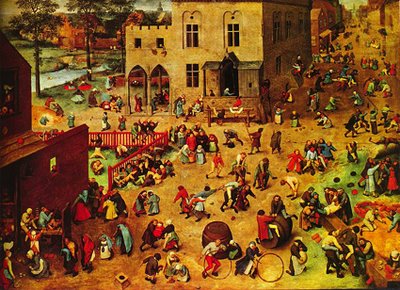
Pieter Brueghel - Children's Games (1559-60)

This image can be accessed at: http://www.wga.hu/index1.html


The Echoing Green

The sun does arise
And make happy the skies;
The merry bells ring
And welcome the spring;
The skylark and thrush
The birds of the bush,
Sing louder around
To the bell's cheerful sound,
While our sports shall be seen
On the Echoing Green.

Old John with white hair,
Does laugh away care,
Sitting under the oak,
Among the old folk.
And soon they all say:
"Such, such were the joys
When we all, girls and boys,
In our youth time were seen
On the Echoing Green."

Till the little ones, weary,
No more can be merry;
The sun does descend,
And our sports have an end.
Round the laps of their mothers,
Many sisters and brother,
Like birds in their nest,
Are ready for rest,
And sport no more seen,
On the darkening green.

William Blake (1757-1827)

Wednesday, September 27, 2006

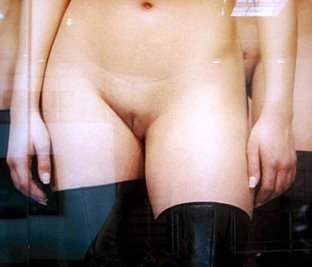
The Muff Manifesto: Part Two


Vanessa Beecroft, VB 45, 2001 (detail)


“The shaved, waxed, trimmed and otherwise depilated female pubis that has become a cultural norm might be called a Pandora's box of conflicting fears and desires. On the one hand, there's the fear of hair or chaetophobia. Hair is a sign of maturity and strength, which far too many men find scary in women. Removing pubic hair may be a wish to infantilise women - to make them look more like little girls. Which, if taken further, comes uncomfortably close to paedophilia.”

From Pudenda Agenda by Jerry Saltz (Artnet Magazine Features)


Reading:

From the Beast to the Blonde: On Fairytales and Their Tellers - Marina Warner

Razor Wire Pubic Hair - Carlton Mellick III

Tuesday, September 26, 2006

The Muff Manifesto: Part One


'Nowadays vagina envy has been joined by pudenda power. One famous expression of it is Courbet's 1866 spread-eagle crotch shot, The Origin of the World [above], which scandalized not only because it displayed a flash of pink, but because it portrayed the female sex in its full hairy glory, rather than classicised and bare. Then there's real life: John Ruskin, who on his wedding night fled at the sight of his wife's pubic hair. This was before photography (and Courbet's painting), and the only female nudes he'd seen had been in art, and carefully tonsured. He thought his wife was grossly deformed, a freak.'

From Pudenda Agenda by Jerry Saltz (Artnet Magazine Features).


Reading:

The Sadeian Woman - Angela Carter

The History of Sexuality Vol. 1: An Introduction - Michel Foucault

The History of Sexuality Vol. 2: The Use of Pleasure - Michel Foucault

The History of Sexuality Vol. 3: Care of the Self - Michel Foucault

Viewing:

That Obscure Object of Desire (1977) - d. Luis Bunuel

Monday, September 25, 2006

Teratomania: Part Two


Patricia Piccinini (b. 1965) - Leo, 2006


'I am as interested in the emotional outcomes of such transformations as I am in the conceptual or ethical. Sometimes I worry that my work isn’t ‘cool’ enough; it is warm, cute, emotive, melodramatic even. Nowhere is this more evident than in my drawings...These drawings explore one of the central themes of my practice; our relationship with the things that we create, in this case my helper creatures. There is a combination of innocence, trust and vulnerability in the children that I find quite apposite as a way to express our relationship with much of the new technologies that now impact on our world and our bodies. I love the way that they seem to get on so well together, but it also worries me a little.'

Patricia Piccinini (from Nature's Little Helpers)


Teratomania: Part One


Patricia Piccinini (b. 1965) - Undivided, 2005


'Some things, once done, are not easily undone. We might recognise later that we should not have done them in the first place, however undoing them is not so easy. Like an egg, which once broken cannot be unbroken, when something is created, it is difficult to contain. This stands as much for a work of art as it does for a genetically modified creature. Anyone who thinks that they can maintain control of the things that they create is fooling themselves. Whether it is genetically modified canola, the cane toad, a work on the secondary market or an image on the internet, once the thing leaves our hands all we can do is watch.'

Patricia Piccinini (from Nature's Little Helpers)

Essays and images are available at: http://www.patriciapiccinini.net/

Sunday, September 24, 2006

When The Void Becomes Eloquent


Roland Barthes
(1915-1980)


'We know now that a text is not a line of words releasing a single 'theological' meaning (the 'message' of the Author-God) but a multidimensional space in which a variety of writings, none of them original, blend and clash. The text is a tissue of quotations drawn from the innumerable centres of culture.'

Roland Barthes (1915-1980), The Death of the Author (1968) [published in Image-Music-Text, 1977]

Admirers of Barthes' essay should also read: What is an Author? - Michel Foucault (1969)


Reading:

The Phenomenology of Perception
- Maurice Merleau-Ponty

The World of Percpetion -
Maurice Merleau-Ponty

Viewing:

King Kong (1933) - d. Merian C. Cooper and Ernest B. Schoedsack