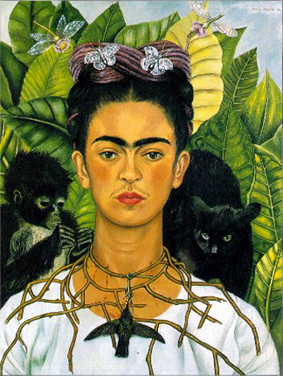
Frida Kahlo - Self-Portrait with Thorn Necklace and Hummingbird (1940)
"I paint self-portraits because I am so often alone, because I am the person I know best."
"I paint self-portraits because I am so often alone, because I am the person I know best."
Frida Kahlo
"Frida Kahlo used the often traumatic and harrowing iconography of her Mexican heritage to paint herself and the pain which had become an integral part of her life after, at age eighteen, a streetcar accident left her crippled. From then on she underwent a series of operations and, because of her severely injured pelvis, a number of miscarriages and abortions. Her physical disability never inhibited Kahlo's flair for theatrics, and this, combined with the tempestuous relationship with her philandering husband, the mural painter Diego Rivera, established her as a tragically romantic and exotic figure. As a result, Kahlo's works have been exhaustively psychoanalysed and thereby whitewashed of their bloody, brutal, and overtly political content. Kahlo's personal pain should not eclipse her commitment to Mexico and the Mexican people. As she sought her own roots, she also voiced concern for her country as it struggled for an independent cultural identity. Her life and even her death were political.
Kahlo's representation of the skeletal figure and death can be understood only in relation to their iconography in Aztec work. The Coatlicue sculpture provides a clue to understanding their use in Kahlo's painting. Pasztory writes that Coatlicue "embodies the duality of Mexican consciousness...At the very centre of the figure is a contrast of quintessential opposites: breasts seen behind a skull, the two images of life and death." Although Kahlo seldom included an actual representation of Coatlicue in her work, the enigmatic goddess recurs in symbolic form in a number of Kahlo's self-portraits. For example, in Self-Portrait with Thorn Necklace and Hummingbird, 1940, Kahlo's thorn necklace draws blood from her neck. Aztec priests performed self-mutilation with agave thorns and stingray spines, and Coatlicue's neck also bleeds. The dead hummingbird is sacred to the chief god of Tenochtitlan, Huitzilopichtli, the god of the sun and war. It also represents the soul or spirit of the warrior who died in battle or on the sacrificial stone."
From Culture, Politics and Identity in the Paintings of Frida Kahlo - Janice Helland
"Of course, the line between art and life is a particularly hard one to draw in Kahlo's case. The majority of her work is self-portraiture; her aesthetic concerns grew from her fascination with the falsity of appearance. Dressing up, role playing and masquerade form the conceptual basis of Kahlo's work."
From 'Her Dress Hangs There': De-frocking the Kahlo Cult by Oriana Baddeley
. . .
Kahlo's representation of the skeletal figure and death can be understood only in relation to their iconography in Aztec work. The Coatlicue sculpture provides a clue to understanding their use in Kahlo's painting. Pasztory writes that Coatlicue "embodies the duality of Mexican consciousness...At the very centre of the figure is a contrast of quintessential opposites: breasts seen behind a skull, the two images of life and death." Although Kahlo seldom included an actual representation of Coatlicue in her work, the enigmatic goddess recurs in symbolic form in a number of Kahlo's self-portraits. For example, in Self-Portrait with Thorn Necklace and Hummingbird, 1940, Kahlo's thorn necklace draws blood from her neck. Aztec priests performed self-mutilation with agave thorns and stingray spines, and Coatlicue's neck also bleeds. The dead hummingbird is sacred to the chief god of Tenochtitlan, Huitzilopichtli, the god of the sun and war. It also represents the soul or spirit of the warrior who died in battle or on the sacrificial stone."
From Culture, Politics and Identity in the Paintings of Frida Kahlo - Janice Helland
"Of course, the line between art and life is a particularly hard one to draw in Kahlo's case. The majority of her work is self-portraiture; her aesthetic concerns grew from her fascination with the falsity of appearance. Dressing up, role playing and masquerade form the conceptual basis of Kahlo's work."
From 'Her Dress Hangs There': De-frocking the Kahlo Cult by Oriana Baddeley