Sunday, November 26, 2006

Beastly Bonking


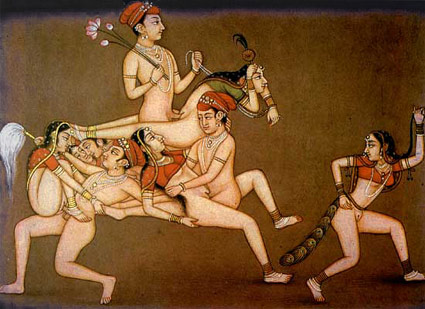
Indian - Horse Pursuing a Peacock


"The orgy was not the farthest point reached by eroticism in the pagan world. The orgy is the sacred aspect of eroticism in which the continuity of beings beyond solitude is most plainly expressed. Only in one way, however. In the orgy continuity cannot be laid hold of; individuals lose themselves at the climax, but in mingled confusion. The orgy is necessarily disappointing. Theoretically it is the complete negation of individual quality. It presupposes, it even demands equality among the participants. Not only is individuality itself submerged in the tumult of he orgy, but each participant denies the individuality of the others. All limits are completely done away with, or so it seems, but it is impossible for nothing to remain of the differences between individuals and their sexual attraction connected with those differences.

The final aim of eroticism is fusion, all barriers gone, but its first stirrings are characterised by the presence of a desirable object.

In the orgy this
object does not stand out by itself, for sexual excitement occurs through an uncontrolled urge, the opposite of habitual reserve. But everybody has this urge. It is objective but it is not perceived as an object; the person who perceives it is at the same time animated by it. On the other hand, excitement is normally roused by something distinct and objective. In the animal kingdom, the odour of the female often sets the male after her. The songs and displays of birds bring into play other kinds of perception that tell the female that the male is near and sexual shock is at hand. Smell, hearing, sight and even taste are objective signals distinct from the activity they incite. They are signals to announce the crisis. In the world of man these messages have an intense erotic value. A pretty girl stripped naked is sometimes an erotic symbol. The object of desire is different from eroticism itself; it is not eroticism in its completeness, but eroticism working through it."

From Eroticism: Death and Sensuality by Georges Bataille


The Week in Review

Viewing:
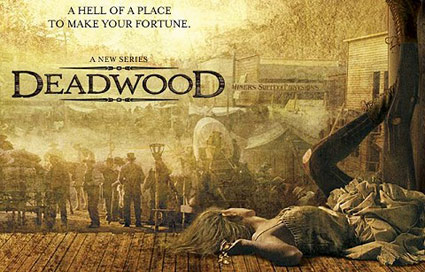


Deadwood: First Season
Ep. 1: 'Pilot - Deadwood' (w. Ted Mann, d. Mark Tinker)
Ep. 2: 'Deep Water' (w. Malcolm MacRury. d. Davis Guggenheim)
Ep. 3: 'Reconnoitering the Rim' (w. Jody Worth, d. Davis Guggenheim)
Ep. 4: 'Here Was a Man' (w. Elizabeth Sarnoff, d. Alan Taylor)
Ep. 5: 'The Trial of Jack MacCall' (w. John Belluso, d. Ed Bianchi)
Ep. 6: 'Plague' (w. Malcolm MacRury. d. Davis Guggenheim)
Ep. 7: 'Bullock Returns to the Camp' (w. Jody Worth, d. Michael Engler)
Ep. 8: 'Suffer the Little Children' (w. Elizabeth Sarnoff, d. Dan Minahan)
Ep. 9: 'No Other Sons or Daughters' (w. George Putnam, d. Ed Bianchi)
Ep. 10: 'Mr. Wu' (w. Bryan McDonald, d. Dan Minahan)
Ep. 11: 'Jewel's Boot Is Made For Walking' w. Ricky Jay. d. Steve Shill)
Ep. 12: 'Sold Under Sin' (w. Ted Mann, d. Davis Guggenheim)
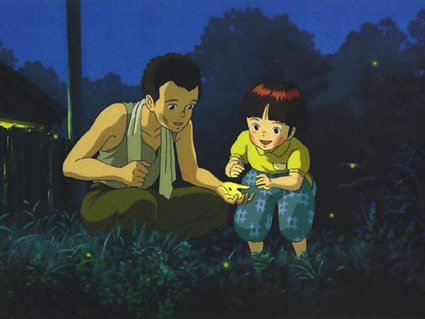


Grave of the Fireflies - w. & d. Isao Takahata (1988)
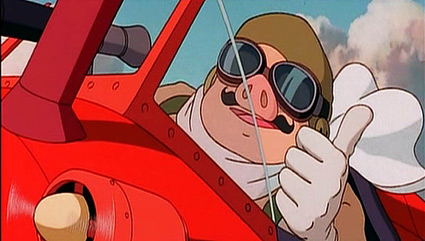


Porco Rosso - w. &
d. Hayao Miyazaki (1992)



Princess Mononoke -
w. & d. Hayao Miyazaki (1997)



Steamboy - w. Sadayuki Murai & Katsuhiro Omoto, d. Katsuhiro Omoto (2004)


Tokyo Godfathers - w. Keiko Nobumoto & Satoshi Kon, d. Satoshi Kon (2003)



Urotsukidoji: Legend of the Overfiend & Legend of the Demon Womb - w. Noboru Aikawa, d. Hideki Takayama (1989 & 1991)
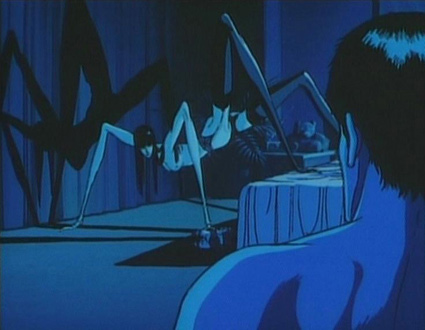


Wicked City - w. Kisei Choo, d. Yoshiaki Kawajiri (1987)


Reading:

Deleuze: An Introduction - Todd May
Tezuka: The Marvel of Manga (catalogue essays) - ed. Philip Brophy
Gillian Wearing: Proof (catalogue essay) - Juliana Engberg

Listening:

The Complete String Quartets - Joseph Haydn
The Complete Symphonies - Joseph Haydn

Exhibitions:



Tezuka: The Marvel of Manga
- NGV (International)


Six Good Reasons To Stay at Home: Hiraki Sawa (video works) - NGV (International)


Howard Arkley -
NGV (Australia)



Light Sensitive: Contemporary Australian Photography from the Loti Smorgon Fund - NGV (Australia)



Living Proof: Gillian Wearing
- ACCA

Saturday, November 25, 2006

Intimate Immensity: Part Three


René Magritte - The Listening Room (1958)


"Only thought can resemble. It resembles by being what it sees, hears, or knows; it becomes what the world offers it."

René Magritte

"The inner world is the world of your requirements and your energies and your structure and your possibilities that meets the outer world. And the outer world is the field of your incarnation. That's where you are. You've got to keep both going. As Novalis said, 'The seat of the soul is where the inner and outer worlds meet.' "

Joseph Campbell


"Immensity is within ourselves. It is attached to a sort of expansion of being that life curbs and caution arrests, but which starts again when we are alone. As soon as we becomes motionless, we are elsewhere; we are dreaming in a world that is immense. Indeed, immensity is the movement of the motionless man. It is one of the dynamic characteristics of quiet daydreaming.

And since we are learning philosophy from poets, here is a lesson in three lines, by Pierre Albert-Bireau:

And with a stroke of the pen I name myself
Master of the World
Unlimited man."
From The Poetics of Space by Gaston Bachelard

Friday, November 24, 2006

Intimate Immensity: Part Two


René Magritte - Personal Values (1952)


"If the dream is a translation of waking life, waking life is also a translation of the dream."

René Magritte


"The myth is the public dream and the dream is the private myth."

Joseph Campbell


"When this elsewhere is in natural surroundings, that is, when it is not lodged in the houses of the past, it is immense. And one might say that daydream is original contemplation.

If we could analyse impressions and images of immensity, or what immensity contributes to an image, we should soon enter into a region of the purest sort of phenomenology - a phenomenology without phenomena; or, stated less paradoxically, one that, in order to know the productive flow of images, need not wait for the phenomena of the imagination to take form and become stablised and completed images. In other words, since immense is not an object, a phenomonology of immense would refer us directly to our imagining consciousness. In analysing images of immensity, we should realise within ourselves the pure being of pure imagination. It then becomes clear that works of art are the by-products of this existentialism of the imagining being. In this direction of daydreams of immensity, the real product is consciousness of enlargement. We feel that we have been promoted to the dignity of the admiring being.

This being the case, in this meditation, we are not "cast into the world", since we open the world, as it were, by transcending the world seen as it is, or as it was, before we started dreaming. And even if we are aware of our own paltry selves - through the effects of harsh dialectics - we become aware of grandeur. We then return to the natural activity of our magnifying being."

From The Poetics of Space by Gaston Bachelard

Thursday, November 23, 2006

Intimate Immensity: Part One


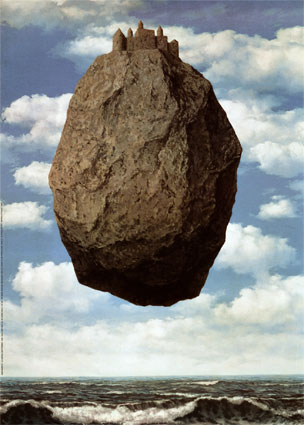
René Magritte - La Chateau des Pyrenees (1959)


"My painting is visible images which conceal nothing; they evoke mystery and, indeed, when one sees one of my pictures, one asks oneself this simple question: "What does it mean?" It does not mean anything, because mystery means nothing either. It is unknowable."

René Magritte

"Our thinking is largely discursive, verbal, linear. There is more reality in an image than a word."
Joseph Campbell


"One might say that immensity is a philosophical category of daydream. Daydream undoubtedly feeds on all kinds of sights, but through a sort of natural inclination, it contemplates grandeur. And this contemplation produces an attitude that is so special, an inner state that is so unlike any other, that the daydream transports the dreamer outside the immediate world to a world that bears the mark of infinity.

Far from the immensities of sea and land, merely through memory, we can recapture, by means of meditation, the resonances of this completion of grandeur. But is this really memory? Isn't imagination alone able to enlarge indefinitely the images of immensity? In point of fact, daydreaming, from the very first second, is an entirely constituted state. We do not see it start, and yet it always starts the same way, that is, it flees the object nearby and right away it is far off, elsewhere, in the space of elsewhere."

From The Poetics of Space by Gaston Bachelard

Wednesday, November 22, 2006

The Author Has Left The Text


Erica Baum - Mr. 5 17 37 (2004)

1. “To this day, the “author” remains an open question…”

2. “Beckett supplies a direction: “What matter who’s speaking, someone said, what matter who’s speaking.” . . . [Writing] as an ongoing process [that] slights our customary attention to the finished product . . . [The] writing of our day has freed itself from the necessity of expression”; it only refers to itself, yet it is not restricted to the confines of interiority. On the contrary, we recognise it in its exterior deployment. This reversal transforms writing into an interplay of signs, regulated less by the content it signifies than by the very nature of the signifier. Moreover, it implies an action that is always testing the limits of its regularity, transgressing and reversing an order that it accepts and manipulates. Writing unfolds like a game that inevitably moves beyond its own rules and finally leaves them behind. Thus, the essential basis of this writing is not the exalted emotions related to the act of composition or the insertion of the subject into language. Rather, it is primarily concerned with creating an opening where the writing subject endlessly disappears.”

3. “Writing is now linked to sacrifice and to the sacrifice of life itself; it is a voluntary obliteration of the self that does not require representation in books because it takes place in the everyday existence of the writer. Where a work had the duty of creating immortality, it now attains the right to kill, to become the murderer of its author. . . If we wish to know the writer in our day, it will be through the singularity of his absence and in his links to death, which has transformed him into a victim of his own writing.”

4. “It is obviously insufficient to repeat empty slogans: the author has disappeared; God and man died a common death. Rather, we should re-examine the empty space left by the author’s disappearance; we should attentively observe, along its gaps and fault lines, its new demarcations, and the reapportionment of this void; we should await the fluid functions released by this disappearance.”

5. “Yet - and it is here that the specific difficulties attending the author’s name appear - the link between a proper name and the individual being named and the link between an author’s name and that which it names are not isomorphous and do not function in the same way; and these differences require clarification . . .

Its presence is functional in that it serves as a means of classification. A name can group together a number of texts and thus differentiate them from others. A name also establishes different forms of relationship among texts . . . Finally, the author’s name characterises a particular manner of existence of discourse. Discourse that possesses an author’s name is not to be immediately consumed and forgotten; neither is it accorded the momentary attention given to ordinary, fleeting words. Rather, this status and its manner of reception are regulated by the culture in which it circulates.

We can conclude that, unlike a proper name, which moves from the interior of a discourse to the real person outside who produced it, the name of the author, defining their form, and characterising their mode of existence. It points to the existence of certain groups of discourse and refers to the status of this discourse within a society and culture. The author’s name is not a function of a man’s civil status, nor is it fictional; it is situated in the breach, among the discontinuities, which give rise to new groups of discourse and their singular mode of existence. Consequently, we can say that in our culture, the name of the author is a variable that accompanies only certain texts to the exclusion of others . . . In this sense, the function of an author is to characterise the existence, circulation, and operation of certain discourses within society.”

6. “In dealing with the “author” as a function of discourse, we must consider the characteristics of a discourse that support this use and determine its difference from other discourses.

First, they are the objects of appropriation; the form of property they have become is of a particular type whose legal codification was accomplished some years ago.

Secondly, the “author-function” is not universal or constant in all discourse.

The third point concerning this “author-function” is that it is not formed spontaneously through the simple attribution of an individual. It results from a complex operation whose purpose is to construct the rational entity we can call an author. Undoubtedly, this construction is assigned a “realistic” dimension as we speak of an individual’s “profundity” or “creative” power, his intentions or the original inspiration manifested in the writing. Nevertheless, these aspects of an individual, which we designate as an author (or which comprise an individual as an author), are projections, in terms always more or less psychological, of our way of handling texts: in the comparisons we make, the traits we extract as pertinent, the continuities we assign, or the exclusions we practice. In addition, all these operations vary according to the period and the form of discourse concerned.”

7. “The author explains the presence of certain events within a text, as well as their transformations, distortions, and their various modifications (and this through an author’s biography or by reference to his particular point of view, in the analysis of his social preferences and his position within a class or by delineating his fundamental objectives). The author also constitutes a principle of unity in writing where any unevenness of production is ascribed to changes caused by evolution, maturation, or outside influence. In addition, the author serves to neutralise the contradictions that are found in a series of texts. Governing this function is the belief that there must be - at a particular level of an author’s thought, of his conscious or unconscious desire - a point where contradictions are resolved, where the incompatible elements can be shown to relate to one another or to cohere around a fundamental; and originating contradiction. Finally, the author is a particular sources of expression who, in more or less finished forms, is manifested equally well, and with similar validity, in a text, in letters, fragments, drafts, and so forth.”

8. “However, it would be false to consider the function of the author as a pure and simple reconstruction after the fact of a text given as passive material, since a text always bears a number of signs that refer to the author. . .

[All] discourse that supports this “author-function” is characterised by this plurality of egos.

9. [The] “author-function” is tied to the legal and institutional systems that circumscribe, determine, and articulate the realm of discourses; it does not operate in a uniform manner in all discourses, at all times, and in any given culture; it is not defined by the spontaneous attribution of a text to its creator, but through a series of precise and complex procedures; it does not refer, purely and simply, to an actual individual insofar as it simultaneously gives rise to a variety of egos and to a series of subjective positions that individuals of any class may come to occupy.”

10. “[There] undoubtedly exist specific discursive properties or relationships that are irreducible to the rules of grammar and logic and to the laws that govern objects. These properties require investigation if we hope to distinguish the larger categories of discourse. The different forms of relationship (or nonrelationships) that an author can assume are evidently one of these discursive properties.

This form of investigation might also permit the introduction of an historical analysis of discourse. Perhaps the time has come to study not only the expressive value and formal transformations of discourse, but its mode of existence: the modifications and variations, within any culture, of modes of circulation, valorisation, attribution and appropriation. Partially at the expense of themes and concepts that an author places in his work, the “author-function” could also reveal the manner in which discourse is articulated on the basis of social relationships.

Is it not possible to re-examine, as a legitimate extension of this kind of analysis, the privileges of the subject? Clearly, in undertaking an internal and architectonic analysis of a work (whether it be a literary text, a philosophical system, or a scientific work) and in delimiting psychological and biographical references, suspicions arise concerning the absolute nature and creative role of the subject. But the subject should not be entirely abandoned. It should be reconsidered, not to restore the theme of an originating subject, but to seize its functions, its interventions in discourse, and its system of dependencies. We should suspend the typical questions: how does a free subject penetrate the density of things and endow them with meaning; how does it accomplish its design by animating the rules of discourse from within? Rather, we should ask: under what conditions and through what forms can an entity like the subject appear in the course of discourse; what position does it occupy; what functions does it exhibit; and what rules does it follow in each type of discourse? In short, the subject (and its substitutes) must be stripped of its creative role and analysed as a complex and variable function of discourse.

The author - or what I have called the “author-function” - is undoubtedly only one of the possible specifications of the subject and, considering past historical transformations, it appears that the form, complexity, and even the existence of this function are far from immutable. We can easily imagine a culture where discourse would circulate without any need for an author. Discourses, whatever their status, form, or value, and regardless of our manner of handling them, would unfold in a pervasive anonymity.”

From What is an Author? by Michel Foucault.

Tuesday, November 21, 2006

Deadwood: David's Inferno


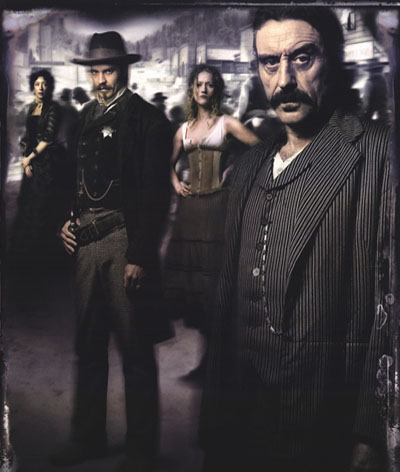
Deadwood (2004-2006) - created by David Milch


"Trust. Hell of a way to operate, huh?...Then all the ins and outs of gettin' killed...Every fuckin' beating I'm grateful for. Every fuckin' one of them. Get all the trust beat outa ya...Then you know what the fuckin' world is."

Al Swearengen (Ian McShane - above, far right)

(Deadwood, Episode Three - 'Reconnoitering the Rim': w. Jody Worth, d. Davis Guggenheim)

Al Swearengen

The proprietor of The Gem Saloon was six months ahead of everyone else in Deadwood, and he runs the town like a corrupt riverboat captain. He knows every move that every person in town makes, anticipates problems and eliminates them. His girls aren't exactly the class of the town, but he controls the most successful bar and whorehouse in all of Deadwood - bringing in $5,000 a day in 1876 - and anybody that threatens his sources of income may well end up fed to Mr. Wu's pigs.

Tim Driscoll, who helped facilitate Al's swindle of the city dude Brom Garret, met such a fate, as did Persimmon Phil, who deeds as a road agent brought too much attention to Al's enterprise. Garret himself was killed at Al's behest, though Swearengen eventually abandoned his efforts to retake the Garret claim. And when Mr. Wu came to Al to avenge a murdered opium courier, the saloon boss took care of things by personally drowning the guilty junky.

But Al's hands-on approach has earned him some enemies, and his main commercial rival, Cy Tolliver - proprietor of the more upscale Bella Union - is exploiting the Wu situation to fuel a full-on race war in Deadwood. Al suspects Tolliver of trying to expand his turf.

With outsiders expressing an interest in the wealthy outpost and government soldiers threatening to bring civilization to town, Al is under siege from several directions. And when the territory's magistrate threatens him with an outstanding murder warrant from Chicago, Al decides that the official is not to leave Deadwood alive.

For all his Mephistophelean qualities, Swearengen does have a soft spot for certain people, including the whore Trixie, Jewel, his handicapped house servant, and the brain-addled Reverend Jim, whom Al was forced to euthanize.

From HBO's Deadwood web site.

Monday, November 20, 2006

The Monster's Bride: Part Six


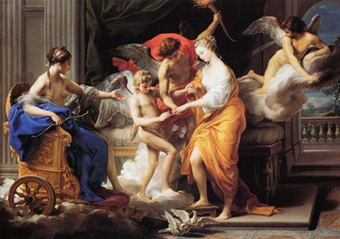
Pompeo Batoni
- The Marriage of Eros and Psyche (1756)


"Apuleius' tale is the earliest extant forerunner of the Beauty and the Beast fairy tale in Western literature, and a founding myth of sexual difference. It includes episodes the fairy tale 'La Belle et la bête' has made famous, from children's versions to films: the mysterious menacing lover, the jealous sisters, the enchanted castle where disembodied voices serve every wish and 'nectarous wines and appetising dishes appeared by magic, floating up to her of their own accord.' It echoes stories of Pandora and Eve when it relies on female curiosity as the dynamic of the plot, and the overriding motive force of the female sex. Punished for her disobedience, Psyche then has to prove her love through many adventures and ordeals; pregnant by Cupid, she struggles through one test of her loyalty after another until, finally, this Beauty is reunited with her Beast and adapts him, the god of Love, to the human condition of marriage, and they have a daughter, called Voluptas - Pleasure."

From The Beast to the Blonde by Marina Warner

Sunday, November 19, 2006

The Monster's Bride: Part Five


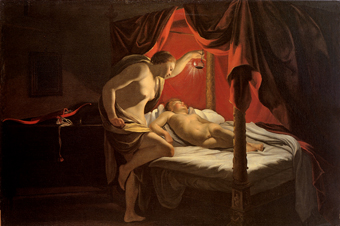
Simon Vouet - Psyche Discovering Cupid's Identity (early 1600s)


'Psyche is forbidden to look at [Cupid]. When she can resist no longer and breaks her prohibition, lighting a candle to look at her lover while he sleeps, he vanishes, and with him all her enchanted surroundings. But Eros, mysterious, unknown, feared, exceeds all imaginable degree of charm when Psyche sees him in the night:

There lay the gentlest and sweetest of all wild creatures . . . his golden hair, washed in nectar and still scented with it, thick curls straying over white neck and flushed cheeks and falling prettily entangled on either side of his head . . . soft wings of purest whie . . . the tender down fringing the feathers quivered naughtily all the time. The rest of his body was so smooth and beautiful that Venus cold never be ashamed to acknowledge him as her son.

Psyche's failure to trust, and to obey, has cost her his adorable presence.'

From The Beast to the Blonde by Marina Warner


The Week in Review


Reading:

Immortal Monster: The Mythical Evolution of the Fantastic Beast in Modern Fiction and Film - Joseph D. Adriano

Interpreting the Moving Image - Noel Carroll

Tracking King Kong: A Hollywood Icon in World Culture - Cynthia Erb

Kiss of the Beast: From Paris Salon to King Kong - Tedd Gott and Kathryn Weir

The Dread of Difference: Gender and the Horror Film - (ed.) Barry Keith Grant

The Third Eye: Race, Cinema, and Ethnographic Spectacle - Fatimah Rony

From the Beast to the Blonde - Marina Warner

Managing Monsters: Six Myths of Our Time - Marina Warner

Unlikely Couples: Movie Romance as Social Criticism - Thomas E. Wartenberg

Viewing:

Rebecca - d. Alfred Hitchcock (1940)

Shadow of a Doubt - d. Alfred Hitchcock (1943)

Rear Window - d. Alfred Hitchcock (1954)

The Wrong Man - d. Alfred Hitchcock (1956)

Vertigo - d. Alfred Hitchcock (1958)

North by Northwest - d. Alfred Hitchcock (1959)

Psycho - d. Alfred Hitchcock (1960)

Listening:

Murder Ballads - Nick Cave and the Bad Seeds

The Boatman's Call - Nick Cave and the Bad Seeds

The Good Son - Nick Cave and the Bad Seeds

Abattoir Blues/The Lyre of Orpheus - Nick Cave and the Bad Seeds

Saturday, November 18, 2006

The Monster's Bride: Part Four


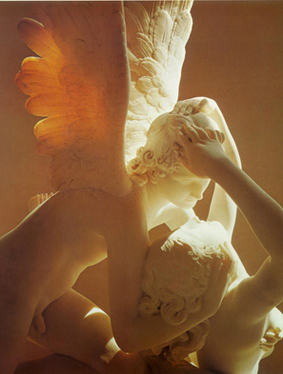
Antonio Canova - Amor and Psyche (1796)

I never may believe
These antic fables, nor these fairy toys.
Lovers and madmen have such seething brains,
Such shaping fantasies, that apprehend
More than cool reason ever apprehends . . .
And as imagination bodies forth
The forms of things unknown, the poet's pen
Turns them to shapes, and gives to aery nothing
A local habitations and a name . . .

A Midsummer Night's Dream, V, 1 - William Shakespeare

'The first beast of the West was Eros, the god of love himself. In the romance of Cupid and Psyche, Eros/Cupid makes love, unseen in the dark, to a mortal Beauty - Psyche - who rivals his own mother Venus in seductiveness . . .'

From The Beast to the Blonde by Marina Warner

Friday, November 17, 2006

The Monster's Bride: Part Three


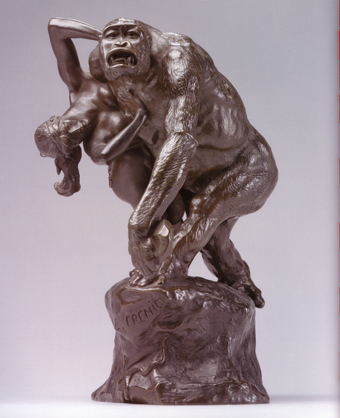
Emmanuel Frémiet - Gorille enlevant une negresse (1887)

"After his involvement with the Museum d'histoire naturelle, Frémiet was surely familiar with the research of Jacques Boucher de Perthes (1788-1868). In the successive volumes of his Antiquites Celtiques et Antediluviennes (1847, 1857 and 1863), Boucher de Perthes argued that the peculiarly shaped stones he had found among the bones of extinct mammals in the Abbeville region of France were actually primitive cutting and hunting implements fashioned by antediluvian peoples. At the time of their first publication, his theories were ridiculed by many, since they did not concur with the Christian Church's religious notions of the beginnings of mankind dating no earlier than 4000 BC. By 1887, however, Boucher de Perthes' discoveries were thoroughly vindicated. It is interesting to consider whether the ape's possession of a chiselled cutting tool in Frémiet’s Gorilla Carrying off a Woman depicts a pure gorilla or an ape that has evolved in intelligence one step towards the human condition. Certainly, the critics of the day were divided as to whether his new work promoted or argued against Darwinian theory.

In 1887, the state authorities were faced with acknowledging the celebrity of Frémiet’s life-size plaster and immediately acquired it; yet they were also confronted by its highly controversial subject matter. Frémiet himself had written to the chief arts administrator of the day, pleading that 'with your dual interest in the fine arts and in science, it is to be hoped that you will decide to acquire my sculpture, which really belongs in the Museum d'histoire naturelle'. This was not to be and despite Frémiet’s many entreaties, the work was stowed away until 1895 when it was consigned to the Musee des Beaux-Arts de Nantes, where it remains today. The sculptor was able to bring the work back to Paris briefly some years later, when he received a commission from an American collector for a life-size bronze to be cast from it. This enabled the sculpture to be once again exhibited to a huge audience, at the Exposition Universelle of 1900.

Its exile in Nantes failed to make Frémiet’s composition disappear as he had permission from the French State to edition bronze versions of the work in a reduced size, and these proved to be highly popular collectables. The ambiguous but compelling Gorilla Carrying off a Woman was also reproduced widely, by both engraving and photography. By all these means, Frémiet’s sculpture entered the public consciousness as one of the defining images of the time."

From Clutch of the Beast by Ted Gott

Thursday, November 16, 2006

The Monster's Bride: Part Two


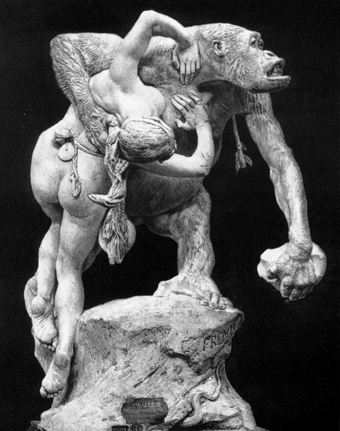
Emmanuel Frémiet - Gorille enlevant une negresse (1887)

"The 'Gorilla wars' of the 1860s and the entire weight of evolutionary debate attendant upon the theories of Darwin, Huxley and others lay behind Emmanuel Frémiet’s decision to revisit the gorilla in 1887. As Bartlett recounted in 1891:


Always seeing a plaster cast of a gorilla at the Garden [the Jardin des Plantes of the Museum] and regretting the destruction of the one he had made in 1859, decided Frémiet to make another group of the same subject, but differently and more compactly treated. Its appearance in the Salon of 1887 created an immense sensation and, as usual, a wide division of opinion. The few best artists and art lovers pronounced it, independent of subject, a great masterpiece, while many wholly condemned it, because of its subject.

Frémiet’s life and career had also changed significantly in the three decades that lay between his first and second versions of the Gorilla. From the 1860s Frémiet had become fascinated with creating meticulously accurate reconstructions of the appearance and armour of military figures from Roman times to the Middle Ages. His St George and the Dragon 1891, for example, casts the Christian saint in the guise of a medieval warrior, whose armour is based on actual examples of the period that the artist studied in France's Imperial Army Museum. A deep interest in the sciences of prehistoric archaeology and palaeontology also ran alongside Frémiet’s fascination for medieval reconstructions, leading him to create a number of sculptures depicting the struggles of Stone Age peoples. In July 1875, a month after the death of the esteemed animalier sculptor Antoine-Louis Barye, Frémiet was named as Barye's replacement to the post of Master of Zoological Drawing at the Museum d'histoire naturelle.

When Frémiet created the 1887 version of the life-size Gorille enlevant une femme (Gorilla carrying off a woman), it carried the same power to shock audiences as its predecessor of 1859. The immediacy and solidity of its depiction of a wounded primate locked in mortal combat with a living, struggling woman was far removed from the passivity of even the best taxidermists' efforts then on display in the world's museums. While gorillas had by now become familiarised within both scientific and public discourse, living specimens of the great ape were still highly prized and exotic items for those zoos lucky enough to possess one. The life-size Gorilla carrying off a woman was another controversial triumph for Frémiet, who had last received a medal at the Salon in 1851. He now carried off the Salon's coveted prize, the Medal of Honour.


Whereas the 1859 sculpture had depicted a female gorilla dragging away an arguably 'naturally selected' dead trophy, Frémiet upped the ante in 1887. The woman was now Caucasian and very much alive, even presaging an art nouveau nymph in her curvaceous struggle with a visibly male primate. Frémiet no longer made his viewers play mute witness to the triumphant swagger of a murderous beast, but took them right into the heart of a much more ambiguous battle, set in the Stone Age.

The 1887 sculpture further muddied the waters by alluding to controversial new archaeological discoveries. Rather than being an innocent victim, the woman wears part of a gorilla's jawbone as a hair adornment, indicating her status as a Stone Age predator. She is part of a prehistoric hunting party that has been attacking the gorilla as edible prey. Moreover, it is her companions at whom the beast grimaces and snarls - those who have hurled the lance that pierces the left shoulder of the gorilla. The chiselled rock which the ape grabs in self-defence might well have belonged to his attackers, for it resembles a cutting tool from the Palaeolithic era."

From Clutch of the Beast by Ted Gott

Wednesday, November 15, 2006

The Monster's Bride: Part One


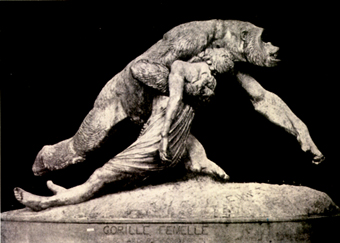
Emmanuel Frémiet - Gorille enlevant une negresse (1859)

"In 1859, the French sculptor Emmanuel Frémiet (1824-1910) alarmed the jury of the Paris Salon by submitting a greater than life-size plaster composition, Gorille enlevant une negresse (Gorilla Carrying off a Negress). The jury found it to be too confronting for both its graphic violence and for its proximity to current debates about evolution. In that same year, Charles Darwin had published On the Origin of Species by Means of Natural Selection, a work that acted as a flashpoint for evolutionary theory. For decades prior to the appearance of Darwin's landmark text, scientists and theologians struggled to reconcile a barrage of new discoveries in the fields of archaeology, geology and comparative anatomy with traditionally held beliefs concerning the world's and humanity's creation.

By 1859 Frémiet had already established a national and international reputation as a master sculptor. He had caught the imagination of visitors to the annual Paris Salon in 1843 with his life-size plaster sculptures of both wild and domestic animals that were astonishing for their faithfulness to nature and lifelike qualities. Frémiet’s three-dimensional evocations of domestic pets proved especially popular in his early career, bringing him increasing critical acclaim and the financial reward of official patronage. He seemed, however, to have seriously blotted his copybook with the Gorilla Carrying off a Negress, at least in the eyes of the more conservative controllers of the art world. Frémiet himself recalled:


At a time when a lot of noise was being made about mankind and apes being brothers, it was an audacious idea; and my work proved even more aggravating since, the gorilla being the ugliest of all the primates, the comparison was hardly flattering for humans ... The jury's condemnation was unanimous. My work was declared to be seriously offensive to public morality, and it was banished pitilessly from the Salon.

Alfred, Comte de Nieuwerkerke, the chief arts administrator, quickly intervened and a place was found for the artist's sculpture, despite its official rejection from the items accepted into the Salon proper. The Gorilla was installed towards the entrance of the Salon's sculpture section, set back in a niche behind heavy green velvet curtains. While the conservative jury surely hoped to marginalise the work, this special treatment - or maltreatment - served only to create a cause celebre around Frémiet's sculpture. Parting these curtains to obtain a glimpse of the censored work became de rigueur for adult visitors to that year's Salon. According to the artist, women were especially titillated by the piece, whose composition was certainly confronting. The sculpture not only depicted a murder, but also seemed to allude to ravishment, visualising the worst fears of many about the planet's largest and most human-seeming primate. Reading the sculpture in this way, the critic Charles Baudelaire took exception to its subject matter:


Why are we not given a crocodile, a tiger, or any other wild animal that might eat a woman? Because this is not about eating, but rape! It is the ape alone, this gigantic ape at once so much more and less than a man, which has at times shown a human appetite for women ... To be honest, such subjects are beneath the dignity of so talented an artist, and the jury has done well to reject this sordid topic.

It is perhaps not surprising that Gorilla Carrying off a Negress, which was destroyed in 1861 and is now known only from a handful of photographs, was disturbing to viewers in 1859. The gorilla itself was still a newly discovered and much misunderstood species, and this added scientific and speculative weight to the frisson produced by Frémiet's sculpture."

From Clutch of the Beast by Ted Gott

Tuesday, November 14, 2006

The Light Of The Mind


Georges de La Tour - Woman Catching Fleas (1630s)


"Great images have both a history and a prehistory; they are always a blend of memory and legend, with the result that we never experience an image directly. Indeed, every great image has an unfathomable oneiric depth to which the personal past adds colour. Consequently it is not until late in life that we really revere an image, when we discover that its roots plunge well beyond the history that is fixed in our memories. In the realm of absolute imagination, we remain young late in life. But we must lose our earthly Paradise in order actually to live in it, to experience it in the reality of its images, in the absolute sublimation that transcends all passion."

From The Poetics of Space by Gaston Bachelard


"When the silent vision falls into speech, and when the speech in turn, opening up a field of the nameable and the sayable, inscribes itself in that field, in its place, according to its truth - in short, when it metamorphoses the structures of the visible world and makes itself a gaze of the mind, intuitus mentis - this is always in virtue of the same fundamental phenomenon of reversibility which sustains both the mute perception and the speech."

From The Visible and The Invisible by Maurice Merleau-Ponty


"'I was going to say...'- You remember various details. But not even all of them shew your intention. It is as if a snapshot of a scene had been taken, but only a few scattered details of it were to be seen...And now it is as if we knew quite certainly what the whole picture respresented. As if I could read the darkness."

From Philosophical Investigations by Ludwig Wittgenstein

Monday, November 13, 2006

These Lips Were Made For Talking


Salvador Dali
- Mae West (1934)


"When I'm good I'm very good, but when I'm bad I'm better."

"A hard man is good to find."

"It's not the men in my life that counts, but the life in my men."

"I go for two kinds of men: domestic and imported."

"I generally avoid temptation - unless I can't resist it."

"It's better to be looked over than overlooked."

"To err is human - but it feels divine."

"I used to be Snow White...but I drifted."

"I like my clothes to be tight enough to show I'm a woman but loose enough to show I'm a lady."

"When choosing between two evils, I like to try the one I've never tried before."

Mae West

Sunday, November 12, 2006

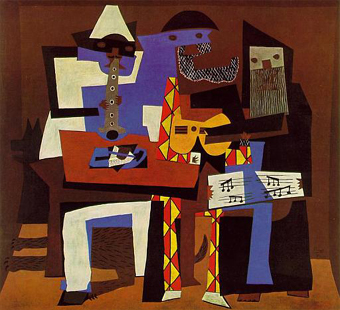
The Music Of Chance


Pablo Picasso
- Three Musicians (1921)


"We all know that art is not truth. Art is a lie that makes us realise the truth."

"The hidden harmony is better than the obvious."

"Some painters transform the sun into a yellow spot, others transform a yellow spot into the sun."

"I paint objects as I think them, not as I see them."

"I do not seek. I find."

"I am always doing that which I cannot do, in order that I may learn how to do it."

"Everything you can imagine is real."

"Every act of creation is first an act of destruction."

"It takes a long time to become young."

"Every child is an artist. The problem is how to remain an artist once we grow up."

Pablo Picasso

Saturday, November 11, 2006

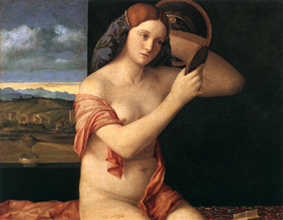
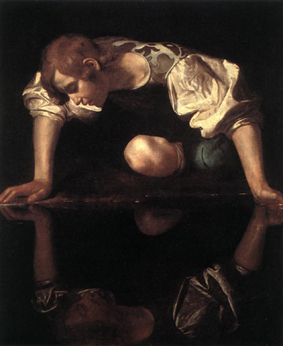
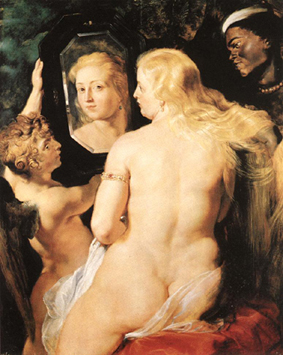
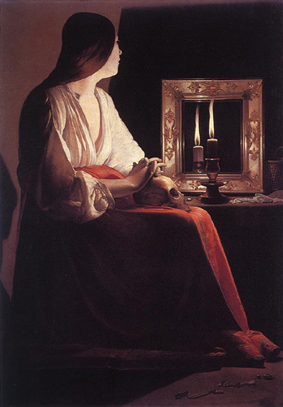
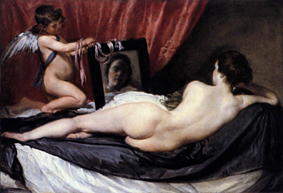
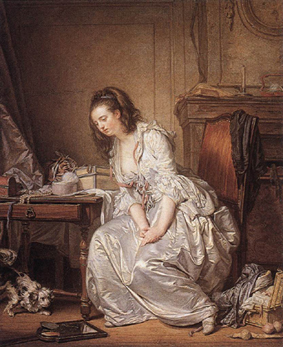
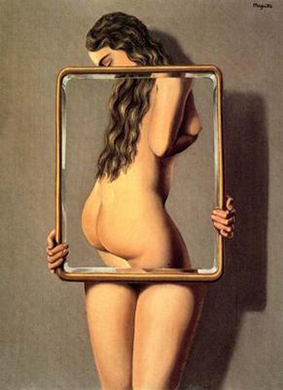
Eleven Mirrors (November Special)


Hans Memling - Earthly Vanity (c. 1485)


Giovanni Bellini - Naked Young Woman in Front of the Mirror (1515)


Parmigianino - Self-portrait in a Convex Mirror (c. 1524)


Michelangelo Merisi da Caravaggio - Narcissus (1598-99)


Peter Paul Rubens - Venus at a Mirror (c. 1615)


Georges de la Tour - The Penitent Magdalen (1638)


Diego Velasquez - Venus at her Mirror (1649-51)


Jean- Baptiste Greuze - The Broken Mirror (1763)


Rene Magritte - Dangerous Liaison (1926)


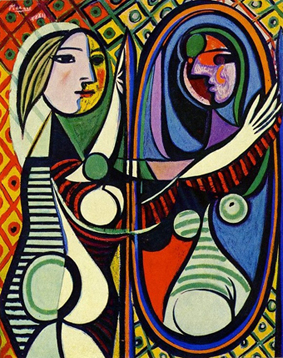
Pablo Picasso - Girl Before a Mirror (1932)


Barbara Kruger - Who's the Fairest of them All? (date unknown)


"The mirror reflects all objects without being sullied."

Confucious

Friday, November 10, 2006

The Serenity Machine


Georges Seurat
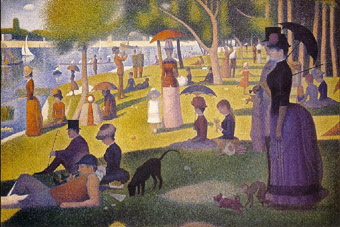
- Sunday Afternoon on the Island of La Grande Jatte (1884-86)


"Let's go get drunk on light again - it has the power to console."

Georges Seurat


"Boredom is the feeling that everything is a waste of time; serenity, that nothing is."

Thomas Szasz

"There are in our existence spots of time,
Which with distinct pre-eminence retain
A vivifying virtue, whence, depressed
By false opinion and contentious thought,
Or aught of heavier or more deadly weight,
In trivial occupations, and the round
Of ordinary intercourse, our minds
Are nourished and invisibly repaired;
A virtue, by which pleasure is enhanced,
That penetrates, enables us to mount,
When high, more high, and lifts us up
when fallen."

From The Prelude by William Wordsworth

Thursday, November 09, 2006

Oh, Nothing


Lucio Fontana
- Spatial Concept, Attesa (1966)


"God made everything out of nothing but the nothingness shows through."

Paul Valery


"Man is equally incapable of seeing the nothingness from which he emerges and the infinity in which he is engulfed."

Blaise Pascal


"Every word is like an unnecessary stain on silence and nothingness."

Samuel Beckett

Wednesday, November 08, 2006

What You See Is What You'll Be


Piet Mondrian
- Broadway Boogie Woogie (1942-1943)


"In art the search for a content which is collectively understandable is false; the content will always be individual."

Piet Mondrian


"Abstract Art: A product of the untalented, sold by the unprincipled to the utterly bewildered."
Albert Camus


"The foundation of one's thought is the thought of another; thought is like a brick cemented in a wall. It is the simulacrum of thought if, in his looking back at himself, the being who thinks he sees a free brick and not the price of semblance this freedom cost him: he doesn't see the waste ground and the heaps of detritus to which a sensitive vanity consigns him with his brick.

The work of the mason, who assembles, is the work that matters. Thus the adjoining bricks, in a book, should not be less visible than the new brick, which is the book. What is offered the reader, in fact, cannot be an element, but must be an ensemble in which it is inserted: it is the whole human assemblage and edifice, which must be, not just a pike of scraps, but rather a self-consciousness.

In this sense, the unlimited assemblage is the impossible. It takes courage and stubbornness not to go slack. Everything invites one to drop the substance for shadow, to forsake the open and impersonal movement of thought for the isolated opinion. Of course the isolated opinion is also the shortest means of revealing what the assemblage really is - the impossible. But it has this deep meaning only if it is not conscious of the fact.

This powerlessness defines the apex of possibility, or at least, awareness of the impossibility opens consciousness to all that it is possible for it to think. In this gathering place, where violence is rife, at the boundary of that which escapes cohesion, he who realises cohesion realises that there is no longer any room for him."

From Theory of Religion by Georges Bataille

Tuesday, November 07, 2006

After Philosophy


Joan Miró
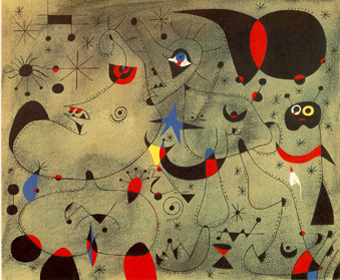
- Nocturne (1940)


"The spectacle of the sky overwhelms me. I'm overwhelmed when I see, in an immense sky, the crescent of the moon, or the sun. There, in my pictures, tiny forms in huge empty spaces. Empty spaces, empty horizons, empty plains - everything which is bare has always greatly impressed me."
Joan Miró


"The problem with philosophy is the passage from the knowledge of limited objects to the knowledge of the entirety of what is."

From Aphorisms for the "System" by Georges Bataille


"A multiplicity is, in the most basic sense, a complex structure that does not reference a prior unity. Multiplicities are not parts of a greater whole that have been fragmented, and they cannot be considered manifold expressions of a single concept or transcendental unity."

From The Deleuze Dictionary - (ed.) Adrian Parr

Monday, November 06, 2006

Lady Paints The Blues


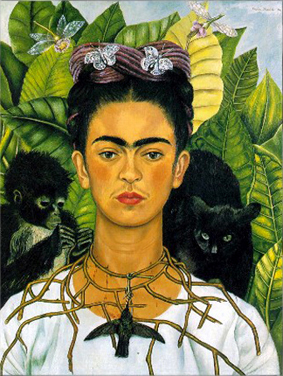
Frida Kahlo - Self-Portrait with Thorn Necklace and Hummingbird (1940)


"I paint self-portraits because I am so often alone, because I am the person I know best."

Frida Kahlo

"Frida Kahlo used the often traumatic and harrowing iconography of her Mexican heritage to paint herself and the pain which had become an integral part of her life after, at age eighteen, a streetcar accident left her crippled. From then on she underwent a series of operations and, because of her severely injured pelvis, a number of miscarriages and abortions. Her physical disability never inhibited Kahlo's flair for theatrics, and this, combined with the tempestuous relationship with her philandering husband, the mural painter Diego Rivera, established her as a tragically romantic and exotic figure. As a result, Kahlo's works have been exhaustively psychoanalysed and thereby whitewashed of their bloody, brutal, and overtly political content. Kahlo's personal pain should not eclipse her commitment to Mexico and the Mexican people. As she sought her own roots, she also voiced concern for her country as it struggled for an independent cultural identity. Her life and even her death were political.

. . .

Kahlo's representation of the skeletal figure and death can be understood only in relation to their iconography in Aztec work. The Coatlicue sculpture provides a clue to understanding their use in Kahlo's painting. Pasztory writes that Coatlicue "embodies the duality of Mexican consciousness...At the very centre of the figure is a contrast of quintessential opposites: breasts seen behind a skull, the two images of life and death." Although Kahlo seldom included an actual representation of Coatlicue in her work, the enigmatic goddess recurs in symbolic form in a number of Kahlo's self-portraits. For example, in Self-Portrait with Thorn Necklace and Hummingbird, 1940, Kahlo's thorn necklace draws blood from her neck. Aztec priests performed self-mutilation with agave thorns and stingray spines, and Coatlicue's neck also bleeds. The dead hummingbird is sacred to the chief god of Tenochtitlan, Huitzilopichtli, the god of the sun and war. It also represents the soul or spirit of the warrior who died in battle or on the sacrificial stone."

From Culture, Politics and Identity in the Paintings of Frida Kahlo - Janice Helland


"Of course, the line between art and life is a particularly hard one to draw in Kahlo's case. The majority of her work is self-portraiture; her aesthetic concerns grew from her fascination with the falsity of appearance. Dressing up, role playing and masquerade form the conceptual basis of Kahlo's work."

From 'Her Dress Hangs There': De-frocking the Kahlo Cult by Oriana Baddeley

Sunday, November 05, 2006

The Ballad Of Jack The Dripper


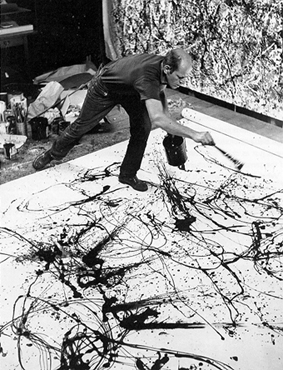
Jackson Pollock in his studio (1950) - p. Hans Namuth

"When I am in my painting, I'm not aware of what I'm doing. It's only after a sort of 'get acquainted' period that I see what I have been about...It is only when I lose contact with the painting that the result is a mess. Otherwise there is pure harmony, an easy give and take, and the painting comes out well."

Jackson Pollock


"Modern painting is the first complex style in history which proceeds from elements that are not pre-ordered as closed articulated shapes. The artist today creates an order out of unordered variable elements to a degree greater than the artist of the past.

In ancient art an image of two animals facing each other orders symmetrically bodies that in nature are already closed symmetrical forms. The modern artist, on the contrary, is attracted to those possibilities of form which include a considerable randomness, variability and disorder, whether he finds them in the world or while improvising with his brush, or in looking at spots and marks, or in playing freely with shapes - inverting, adjusting, cutting, varying, reshaping, regrouping, so as to maximise the appearance of randomness. His goal is often an order which retains a decided quality of randomness as far as this is compatible with an ultimate unity of the whole. That randomness corresponds in turn to a feeling of freedom, an unconstrained activity at every point.

Ignoring natural shapes, he is alert to qualities of movement, interplay, change and becoming in nature. And he provokes within himself, in his spontaneous motions and play, an automatic production of chance."

From Recent Abstract Painting (1957) by Meyer Schapiro


"[The] drip paintings are clearly implicated in a whole informing metaphoric of masculinity: the very concepts that seem immediately to apply to them - space, scale, action, trace, energy, 'organic intensity', 'being in the painting', being 'One' - are all, among other things, operators of sexual difference."

From Jackson Pollock's Abstraction by T. J. Clark


"The catalyst that brought to a head Pollock's self-consciousness of his masquerade was the film Hans Namuth made of the artist at work in the late summer and fall of 1950...After the completion of the painting-on-glass scene, Pollock, who had been sober for more than two years, walked into the house and poured himself a large drink. At the dinner that followed, a drunken Pollock repeatedly shouted at Namuth, "I'm not a phony, you're a phony," before overturning the dinner table. He never got back on the wagon; the drip paintings, and his career, were effectively over."

From Pollock and Postwar Masculinity by Andrew Perchuk


Reading:

This is My Body - Jan Avgikos

'Her Dress Hangs Here': De-frocking the Kahlo Cult - Oriana Badderley

Theory and Art Criticism - Terry Barrett

Of Sculpture and Painting - David Bachelor

Gauguin's Tahitian Body - Peter Brooks

New Encounters with Les Demoiselles d'Avignon: Gender, Race and the Origins of Cubism - Anna C. Chave

Gauguin: On Primitivism (in Theories of Modern Art) - Herschel B. Chipp (ed.)

Going Native: Paul Gauguin and the Invention of Primitivist Modernism - Abigail Solomon-Godeau

Modernist Painting - Clement Greenberg

Culture, Politics and Identity in the Paintings of Frida Kahlo - Janice Helland

By Design: The Early Work of Hannah Hoch in Context - Maria Makela

Notes on Sculpture, Part 2 - Robert Morris

The Imaginary Orient - Linda Nochlin

Pollock and Postwar Masculinity - Andrew Perchuk

Picasso in the Light of a Marxist Sociology of Art - Max Raphael

Picasso and Braque: 1909-1911 - Robert Rosenblum

Orientalism - Edward Said

Recent Abstract Painting (1957) - Meyer Schapiro

Beautiful Beasts: The Call of the Wild (in Managing Monsters: Six Myths of Our Time) - Marina Warner

Reluctant Brides: Beauty and the Beast I and Go! Be a Beast: Beauty and the Beast II (in From the Beast to the Blonde) - Marina Warner

In Purgatory: The Work of Felix Gonzales-Torres - Simon Watney


Viewing:

King Kong (1933) - d. Merian C. Cooper and Ernest B. Schoedsack

RKO Production 601: The Making of King Kong: Eighth Wonder of the World (seven-part documentary series) - d. Phil Savernick (2005)


Listening:

Bleed Like Me - Garbage

beautifulgarbage - Garbage

Garbage Version: 2.0 - Garbage

Garbage - Garbage

Saturday, November 04, 2006

The Lascivious Eye


Pablo Picasso - Les Demoiselles d'Avignon (1907)


"Conventionally, both the act of painting and that of viewing have been described as phallic acts, acts of penetration performed on the passive receptacle, the blank field of the canvas. "I paint with my prick," Renoir supposedly boasted. "A painter has also to paint 'with [his] balls,'" bragged Picasso to his mistress, the painter Françoise Gilot. "I guess that even if a painter fucks a picture to a real climax once a year, it is quite a record," Mark Rothko later estimated. And the critic Jean Clair once pithily proclaimed, "The gaze is the erection of the eye."

From New Encounters with Les Demoiselles d'Avignon: Gender, Race and the Origins of Cubism by Anna C. Chave

Friday, November 03, 2006

Thus Spake Friedrich Nietzsche


A Clockwork Orange - d. Stanley Kubrick (1971)


"God is Dead; but given the way of men, there may still be caves for thousands of years in which his shadow will be shown. And we - we still have to vanquish his shadow, too."

From Die fröhliche Wissenschaft by Friedrich Nietzsche